
Livraison le jour même ou le lendemain

Qualité garantie

Débloquez vos offres de bienvenue: Livraison GRATUITE | Jusqu'à -80 % | 30 jours d'essai gratuits à JoyPlus
Téléchargez l'application
Are you looking for Faber-Castell watercolour pencils to draw, paint or give as a creative gift? The choice isn't just about the number of colours. Between the Albrecht Dürer, Goldfaber Aqua and Colour Grip ranges, plus the classic Polychromos coloured pencils, the binder, the lead, the storage and the intended use can significantly change the experience.
A poorly chosen set risks ending up at the back of a drawer: a palette too limited for your illustrations, a box that's impractical to carry, or pencils ill-suited to your technique. Here are the criteria to consider before buying, followed by a selection tailored to different profiles.
A water-soluble pencil contains a binder that reactivates when it comes into contact with a damp brush. It allows you to draw dry, then transform the strokes into washes or flat areas of colour. Polychromos watercolour pencils, however, don't exist: Polychromos use an oil-based lead, designed for dry work, layering and blending.
So check for the words "watercolour", "aquarelle" or "water-soluble" on the product page. The brand name alone isn't enough to identify the technique.
Twelve colours can be perfectly adequate for a travel sketchbook or a first attempt. However, this palette may limit your blending options for portraits, landscapes and detailed illustrations. At the other end of the scale, a set of 120 pencils represents a larger investment and requires more storage space.
The number of shades should primarily match your practice:
A wooden box makes organisation easy and sits naturally in a studio, but it will be heavier than a metal box for travel. A set that includes a brush can be practical for beginners, whereas an artist who already has their own equipment may prefer to spend their budget on the pencils alone.
Also look at the exact contents of the set: some boxes presented as watercolour sets contain brush pens, not pencils. The product reference and technical description should take priority over the visuals.
Watercolour pencils should allow two uses: precise dry application and water activation. To create a wash, use suitable paper, apply the pigment, then run a damp brush over the area. The amount of water determines the transparency and spread of the colour.
For professional use, look for a lead described as fully water-soluble. This feature makes blending, gradients and brush reworking easier. Still, test it on a scrap of paper: the result also depends on the weight and texture of the surface.
The Albrecht Dürer sets in this selection feature, according to the product pages, a 3.8 mm lead with SV-bonded reinforcement. This construction aims to reduce breakage during sharpening and use, particularly for details or heavy washes.
A thicker lead isn't automatically suitable for every use. For fine details, a quality sharpener is essential. Also avoid pressing on a damp lead and store the pencils completely dry after use.
The product pages for several references mention acid-free, lightfast pigments. This information applies to the products in question and does not constitute a guarantee for the entire range. If your works are intended to be preserved, check the exact reference and the lightfastness ratings.
Keep the set closed, in a dry place, at a stable temperature and away from direct sunlight. The watercolour paper, brush and quality of water used also influence the durability of the result.
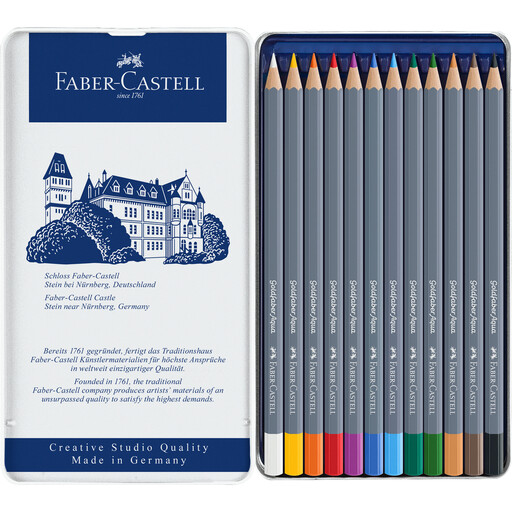
Why this choice suits this profile: Its 12-colour format is ideal for a first foray into drawing and watercolour, whether for students or creative sketchbook enthusiasts.
The compact set avoids overbuying and clearly states its use for both dry and wet techniques, without imposing a large box that's hard to store.
12 water-soluble colours, metal tin and easy-to-carry format.
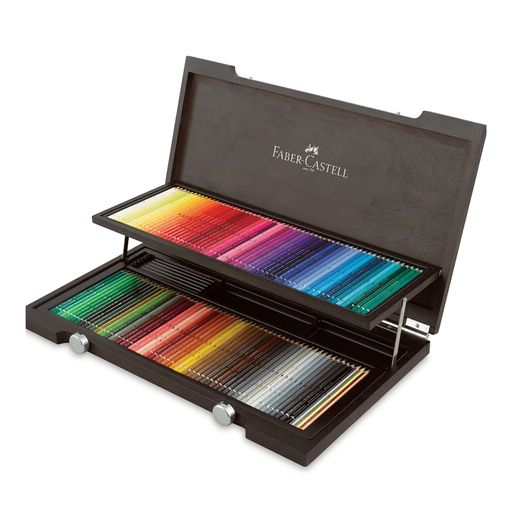
Why this choice suits this profile: Its extensive palette and wooden storage are aimed at illustrators and artists who work regularly in a studio.
The number of shades reduces the need for blending to achieve each colour, while the information about the 3.8 mm lead details the pencil's construction.
120 colours, 3.8 mm water-soluble lead and compartmentalised wooden box.
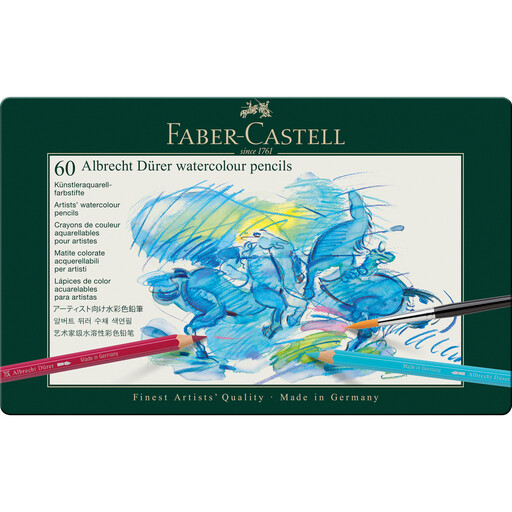
Why this choice suits this profile: Its 60 shades and metal box are ideal for frequent projects, art classes and travel between home and studio.
The metal tin protects and organises the pencils without the weight or bulk of a large wooden box, while covering several techniques.
60 colours, 3.8 mm lead advertised as break-resistant, and use both dry and with water.
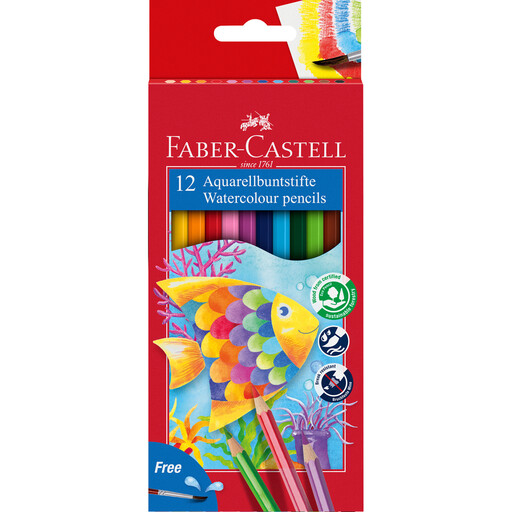
Why this choice suits this profile: The included brush lets you dive straight into wet techniques, whether in class, a shared studio or at home.
The contents are clearly identified: 24 pencils and one brush. No additional purchase is needed to try moving from line to wash.
24 water-soluble pencils, blending brush and storage box.
We've put together a comprehensive, real-time selection of products that meet these exacting criteria as well as European safety standards.
Children under 3 years old must not use these products due to small parts and sharp points. For older children, use under supervision is recommended.
Draw or colour on watercolour paper, then run a slightly damp brush over the pigment. Start with a little water and add more gradually to maintain control over the spread.
The lifespan depends on frequency of use, the pressure applied and how the pencils are sharpened. Storing them dry and closed helps preserve the wood and pigments. For works intended to be kept, check the lightfastness information for your chosen reference.
Twelve colours are suitable for beginners and travel. Twenty-four colours offer a versatile base, especially with a brush. From 36 to 60 colours, you have more shades for illustration, landscapes and regular projects. Before confirming your purchase, compare the actual palette and the type of box.