
Livraison le jour même ou le lendemain

Qualité garantie

Débloquez vos offres de bienvenue: Livraison GRATUITE | Jusqu'à -80 % | 30 jours d'essai gratuits à JoyPlus
Téléchargez l'application
For any artist, whether a beginner or seasoned professional, the choice of materials is never a trivial one. The right tool doesn't just translate an idea?— it elevates it, opening the door to new creative horizons. In this respect, watercolour pencils are exceptional allies, bridging the gap between the precision of a line and the poetry of watercolour.
Among the industry's leading names, the Faber-Castell Albrecht Dürer 36-pencil watercolour set is an undisputed benchmark. But is it the right fit for you and your artistic practice?
I'm Joy, your product expert at Joybuy. My role isn't to sell you a product, but to give you the keys to make an informed choice, free from marketing hype. In this guide, we'll break down this renowned set and explore alternatives to fuel all your creative projects.
Before settling on a particular set, let's review the essential criteria that separate an excellent watercolour pencil from a low-end model. Here are the key points to look out for.
The richness of an art pencil lies primarily in the quality and concentration of its pigments. High-end pigments guarantee vibrant colours and perfect blendability. The other critical factor is lightfastness, often indicated by a star rating system on the pencil's barrel. A high rating ensures your artwork won't lose its brilliance over time—a crucial detail for professional artists who create work for sale or exhibition.
What defines a professional watercolour pencil is its ability to dissolve completely in water. Perfect solubility is the key to achieving smooth, even washes without any underlying pencil marks, for a result nearly identical to traditional watercolour. The lead should activate effortlessly with a wet brush, whether you're working on broad flat washes or delicate gradients.
The pencil's durability, from barrel to lead, is paramount. A thick lead (typically around 3.8?mm) not only allows for a generous application of colour but also offers much better resistance to breakage, whether during sharpening or under heavy pressure. The Secural Bonding (SV) process, a signature of brands like Faber-Castell, involves gluing the lead along the entire length of the wood, making it exceptionally strong.
Now that we've covered the basics, let's move on to the products that might catch your eye, starting with the renowned set at the heart of this guide.
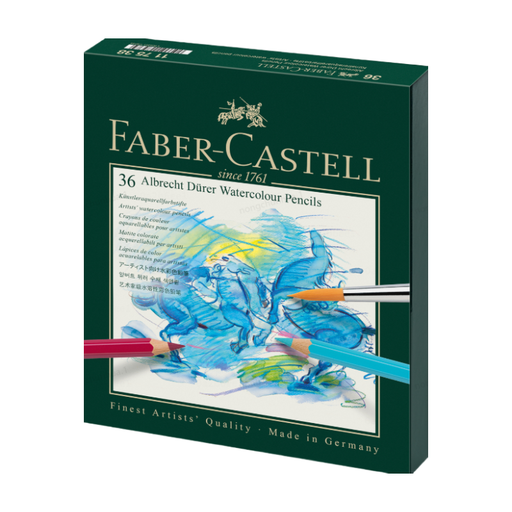
This set of watercolour pencils is a true institution for many artists. The Albrecht Dürer 36-pencil box offers a very well-balanced colour palette, perfect for getting started or for supplementing an existing collection.
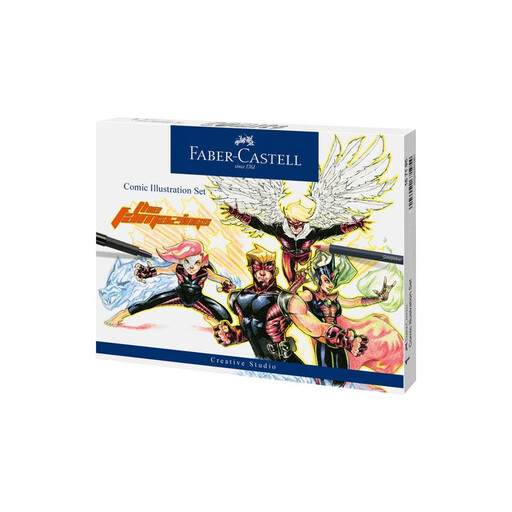
If you're more into illustration, comics, or manga, this set is a highly relevant alternative.
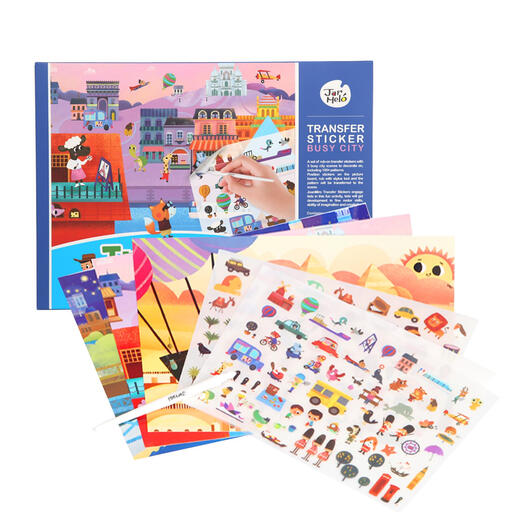
For artist-parents, or anyone looking for a simple and fun creative activity to share with young ones.
Choosing art supplies is ultimately a matter of personal taste and project needs. If the products featured here aren't exactly what you're looking for, or if you're simply curious to discover other gems to enrich your practice, feel free to explore our full collection.
? Discover a wider selection in our Studio & Office category.
To delve deeper and supplement this review of Faber-Castell pencils, here are the answers to your most common questions.
There are several techniques you can use. You can draw on dry paper and then go over the drawing with a wet brush to dissolve the pigments. Another method is to lift the colour directly from the pencil lead with a wet brush and use it like traditional watercolour paint. Finally, you can draw on pre-dampened paper to achieve softer edges and more diffused colours.
The fundamental difference lies in their binder. Albrecht Dürer pencils are water-soluble thanks to a water-soluble binder. Polychromos, on the other hand, are oil-based permanent pencils. They do not dissolve in water but are highly prized for their ability to be layered (the glazing technique) and for their incredibly smooth, velvety finish.
To harness the full potential of the watercolour effect, paper choice is crucial. Opt for a dedicated watercolour paper with a weight of at least 200?gsm, which won't buckle when wet. A fine-grain or hot-press paper will preserve the precision of your lines, while a rough-grain paper will add more texture and character to your washes.