
Livraison le jour même ou le lendemain

Qualité garantie

Débloquez vos offres de bienvenue: Livraison GRATUITE | Jusqu'à -80 % | 30 jours d'essai gratuits à JoyPlus
Téléchargez l'application
Flooding your home with natural light while preserving your privacy? It's often a real challenge. Fortunately, the eyelet sheer curtain rises to the occasion with a solution that is as elegant as it is practical. Easy to install, it dresses your windows with a light touch, softens the light without darkening the room, and shields your space from prying eyes.
To help you see things more clearly, this guide breaks down the essential criteria and presents our selection of the best models to help you find the sheer curtain that will elevate your decor.
To ensure you make the right choice, several factors need to be carefully considered. Style, brightness, practicality: we explain it all.
The choice of fabric is crucial. It dictates the appearance of your sheer curtain, as well as how it sculpts natural light.
Taking the correct measurements is a non-negotiable step. For beautiful, uniform pleats, even when the sheer is closed, plan for a total fabric width that is 1.5 to 2 times the width of your curtain rod.
As for the height, it all depends on the desired effect. A clean drape is achieved by stopping the sheer 1 or 2?cm from the floor. For a cosier "puddling" effect, let it trail by a few centimetres. While the standard 140x240 cm sheer size is very common, precise measurement is essential, especially for a sheer for a bay window or patio door.
Far from being a mere detail, the colour of your sheer curtain sets the tone for the room.
To move from theory to practice, here are three models that caught our attention for their quality and style.

What sets it apart: This model successfully combines 30% natural linen and 70% polyester. The result? The textured look and elegance of linen, with the ease of care and durability of a synthetic as a bonus. Its airy weave filters just the right amount of light and allows air to circulate, creating an ambiance that is both chic and relaxed.
Key features:
Who is it for? For anyone who loves the authentic look of linen but not its high-maintenance demands. A must-have in a living room, bedroom, or kitchen with a classic and calming aesthetic.
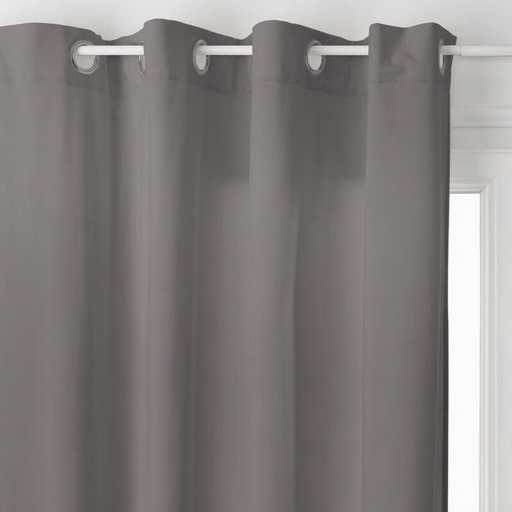
What sets it apart: Here, we're shifting gears. This is not a sheer, but a true blackout curtain, perfect for rooms that require near-total darkness, like a bedroom. Its secret? A dense polyester fabric (200 gsm) that radically blocks external light. Its steel eyelet system makes it just as easy to hang as a classic sheer.
Key features:
Who is it for? Essential for bedrooms, home cinemas, or for anyone who is woken by the slightest ray of light. It's also an excellent trick for creating a chic room divider in a studio apartment.

What sets it apart: This model is the epitome of the eyelet sheer curtain: it perfectly masters the balance between brightness and privacy. Its fabric allows a soft, diffused light to filter through, while blurring the view from the outside to reveal only silhouettes. Its composite filament composition gives it a silky drape and an elegance far superior to a standard polyester.
Key features:
Who is it for? The ultimate all-rounder, equally at home in a living room, office, or bedroom. It's the ideal choice for anyone looking for a white sheer curtain that is classic, effective, and refined.
Do these models not quite fit your project? Don't worry, there's no shortage of solutions for dressing your windows: roller blinds, Japanese panels... each option has its strengths.
To discover a wider range of products that combine design and modularity, take a look at our complete collection of Day and night blinds with curtains.
It's all a matter of thickness and transparency. A sheer is made from a lightweight, transparent or semi-transparent fabric (voile, polyester, linen), whose role is to soften light while protecting from prying eyes. A curtain, on the other hand, is thicker, heavier, and often blackout or thermal. Its mission: to block light, or insulate from cold or noise.
Good news: most polyester or blended sheers are machine washable. Opt for a delicate cycle at a low temperature (30°C) and place your sheers in a laundry bag to protect the eyelets and the fabric. Skip the tumble dryer: air-drying them directly on the rod will often save you the chore of ironing. In any case, the golden rule is to check the care label.
For the width, it's simple: measure your rod (without the end caps) and multiply by 1.5 or 2 to get a beautiful pleat. For the height, measure from the top of the rod to the floor. Then, subtract 1 to 2?cm for a clean drape that skims the floor, or, conversely, add a few centimetres for a more relaxed "puddling" effect.