
Livraison le jour même ou le lendemain

Qualité garantie

Débloquez vos offres de bienvenue: Livraison GRATUITE | Jusqu'à -80 % | 30 jours d'essai gratuits à JoyPlus
Téléchargez l'application
An extra-tall XXL cat tree can transform your living room into a real playground, resting area and scratching zone. But an imposing structure is not necessarily suitable for every home. Some models take up a lot of space without offering enough platforms, while others lack stability when several cats leap onto them at once.
Before placing your order, it is therefore worth looking beyond the photos and marketing claims. Here are the key criteria to consider when choosing a large cat tower suited to your home and your companions’ habits.
A tall cat tree is not necessarily a good multi-level cat tree. Some models reach an impressive height while offering narrow or difficult-to-reach platforms. For an active cat, check that there are several levels, a ramp or a route that allows them to climb up and down without having to perform one precarious leap after another.
In a multi-cat household, there should also be enough spaces to prevent pushing and shoving. Two perches, several hideaways and a hammock allow each cat to retreat when they want to.
An overly lightweight base, thin posts or poorly tightened fixings can make the whole structure wobble as soon as your cat starts climbing. A strong, stable cat tree should stand on a reinforced base and, for models over 150 cm, have an anti-tip system that can be secured to the wall.
Stability also depends on the floor, the quality of the assembly and where the furniture is placed. Even a model with a high stated maximum load should be installed on a level surface and checked regularly.
A single sisal post is likely to be put under heavy strain very quickly. With several cats, it will wear out faster and may not be positioned in the right place. A cat tree with scratching posts should ideally offer several posts and, if possible, a ramp covered in sisal.
Scratching is part of a cat’s natural behaviour. Placing the structure near well-used walkways or furniture your pet already targets may encourage them to use it. However, this does not guarantee that they will immediately abandon all other scratching surfaces.
Measure the available floor space, as well as the ceiling height. A 168 cm cat tree will fit into many homes, while a 206 cm cat tree requires a sufficiently high room and clear space around the structure.
Make a note of all the dimensions, not just the height. For example, a 55 × 45 cm base does not take up the same amount of space as a significantly wider model. Also allow enough room for jumping and accessing the platforms.
The stated maximum load is a useful indicator, but it does not replace the safety instructions. For a multi-cat tree, pay particular attention to:
A load rating of 65 or 75 kg does not mean that several cats can sit on a single platform at the same time. You must also take into account how the cats are distributed and any sudden movements.
Particleboard panels are commonly used for cat tree structures. Plush coverings improve comfort, while sisal generally covers the posts intended for scratching. Check that all surfaces are securely attached and that textile components can be vacuumed or spot-cleaned.
Inspect the stitching, posts, ramps and hanging toys regularly. Remove pom-poms and elastic cords if your cat tries to chew or swallow them. A damaged hideaway or platform should be repaired or replaced before allowing your pet to continue using it.
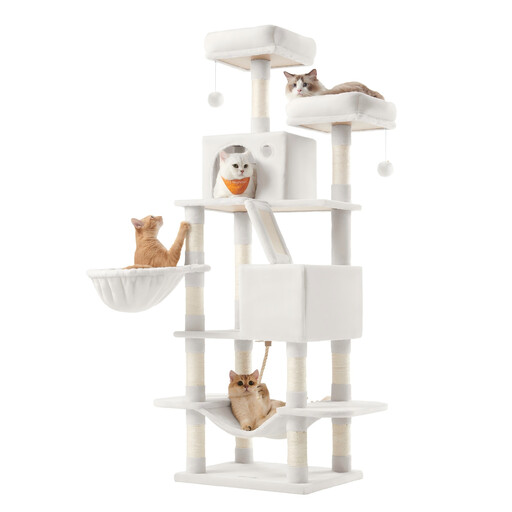
Why this choice suits this profile : Standing 168 cm tall and featuring five levels, this model offers a complete vertical route without moving straight to a structure over two metres tall. It is suitable for households looking to gradually create a dedicated space for their cat.
The structure has 13 scratching posts and a ramp, preventing all the wear from being concentrated on a single support. An anti-tip kit is included for securing it to the wall.
Two perches, two hideaways, a basket and a hammock. Stated dimensions : 55 × 45 × 168 cm, with a stated total static load of 65 kg.
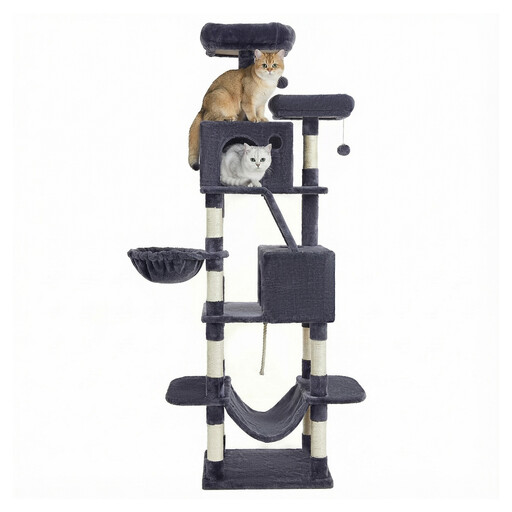
Why this choice suits this profile : Standing over two metres tall, this model is designed for people with a suitable ceiling height who want a vertical set-up made up of several separate areas.
Its reinforced base and anti-tip system help reduce the risks associated with very tall towers. For this type of use, securing it to the wall is strongly recommended.
13 sisal posts, a ramp, two hideaways, two platforms, a basket and a hammock. Stated total static load : 75 kg.
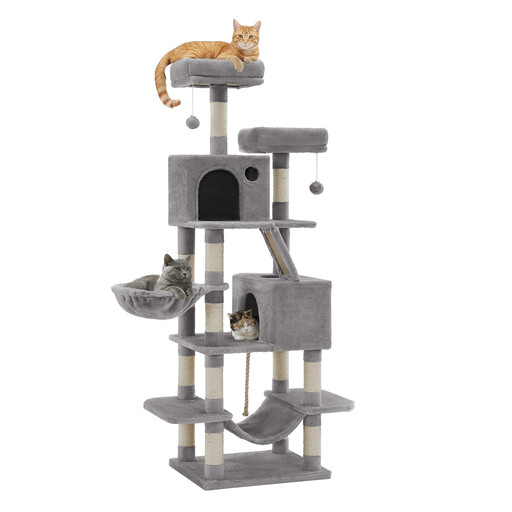
Why this choice suits this profile : With its numerous spaces and stated static load, this version is designed for households that want to spread out playtime and rest periods among several indoor cats.
The 14 scratching areas, distributed between the posts and the ramp, help spread usage more evenly. The hideaways, basket and hammock also provide several places to retreat.
Stated materials : particleboard panels, plush and sisal. Assembly includes labelled parts, instructions and an anti-tip device.
We have put together a complete selection, updated in real time, of products that meet these demanding selection criteria and European safety standards.
Install the cat condo on a flat, non-slip floor away from any heat source. For taller models, secure the structure to the wall using the kit provided, choosing fixings suitable for the type of wall. After assembly, check the screws and connectors, then repeat this check regularly.
To help your cat settle in, let them explore the different levels at their own pace. A toy or small treat may encourage them to discover the platforms and scratching posts. Vacuum the plush covering, remove fur and replace any cracked, loose or heavily worn parts.
A 168 cm model already offers several levels and a high observation point. A 206 cm model requires more ceiling height, as well as particularly careful wall anchoring. In both cases, measure the available space before buying.
Yes, provided you check the number of platforms, hideaways and scratching areas. The stated total static load is not enough on its own: stability, the surface area of the levels and how the cats are distributed are equally important.
It all depends on frequency of use, the cats’ weight, the quality of the assembly and how well it is maintained. Inspect the sisal, textile coverings, screws and base regularly. Stop using the cat tree as soon as a part becomes unstable or shows signs of damage.