Homes where an external duct is possible
If you cook often and can confirm a connection to the outside, look at extractor hoods with external venting first. Check the duct route, the work required and the dimensions of your chosen format.


Start by confirming whether connecting to an external outlet is feasible. UFC-Que Choisir states that extractor hoods vented outside are generally more effective than recirculating models; if there is no usable duct, recirculation is still an option, provided you use a compatible carbon filter and keep up with maintenance. The format then depends on the width of your hob, the space available and the exact installation dimensions.
If you cook often and can confirm a connection to the outside, look at extractor hoods with external venting first. Check the duct route, the work required and the dimensions of your chosen format.
If an external connection is not possible, look for a model explicitly compatible with recirculation. Check which carbon filter is suitable, its maintenance instructions and whether the filters will remain accessible after installation.
To limit odours and fumes without compromising your layout, compare island, built-in and hob-integrated formats. Capture width, available support and installation dimensions are all crucial.
Start with the installation method that is genuinely possible, then check the format and maintenance your kitchen can accommodate day to day.
| Priority | What to check | Your needs |
|---|---|---|
| Installation method | Confirm whether the model supports external venting, recirculation or both. For external venting, check the outside connection and duct route; for recirculation, check the compatible filter or kit. | I want to avoid buying an extractor hood that cannot be installed in my home. |
| Odours, grease and steam | Compare the two available modes for the exact model. UFC-Que Choisir states that external venting is generally more effective than recirculation; clean the grease filters and plan to maintain the carbon filter when using recirculation. | I cook frequently and want to choose a mode suited to fumes, odours and grease, rather than basing my choice solely on the kitchen’s style. |
| Dimensions and integration | The extractor hood should be at least as wide as the hob, according to Bosch. Also check the cut-out dimensions, depth, motor clearance and the wall, ceiling or cabinet support. | I want capture performance suited to my hob and an appliance that will actually fit in my cabinet or island layout. |
| Filter maintenance | Check access to the grease filter, the type of carbon filter and the instructions in the manual. Electrolux generally recommends cleaning the grease filter after around 40 hours of use. | I want to be able to maintain the extractor hood easily so it remains suitable for a frequently used kitchen. |
An extractor hood with external venting only works in this mode if it is actually connected to the outside. The work required may also depend on the building’s configuration.
Before comparing extraction rates or design, confirm the duct route, the possible external outlet and the conditions that apply to your home.
Recirculation filters the air and sends it back into the kitchen, while external venting expels it outdoors. In its testing protocol for hobs with integrated extraction, UFC-Que Choisir assesses steam extraction only in external-venting mode.
If steam and humidity are major concerns, take this compromise into account. If recirculation is necessary, check the carbon filter reference and its maintenance requirements.
Recirculation requires carbon filters to be maintained or replaced periodically.
The advertised width alone does not guarantee effective capture or compatibility with a cabinet. Built-in models, in particular, require you to check the cut-out, depth and motor clearance.
Measure the width of your hob, then consult the model manual for the built-in dimensions, clearances and required accessories.
A build-up of grease can reduce extraction performance and increase noise. Carbon filters used for recirculation have maintenance instructions specific to each model.
Before buying, check that compatible filters are available, along with their type, cleaning or replacement instructions and accessibility once the extractor hood has been installed.
Carbon filters are consumables or require maintenance, depending on their type.
The French range includes wall-mounted, island and built-in extractor hoods, with the two installation modes needing to be checked for each individual reference.
Elica offers wall-mounted, built-in, suspended and island extractor hoods, as well as integrated solutions, to consider when the format and duct routing are part of the project.
This brand is a useful reference for shoppers considering recirculation who want to examine the grease and carbon filters, as well as their maintenance instructions.
The French range includes wall-mounted, island, fully integrated and worktop extractor hoods for projects requiring a particular type of integration.
These Joybuy options include wall-mounted and built-in extractor hoods advertised for external venting or recirculation. Always check that the duct is feasible, the installation dimensions and the filters required for your setup.
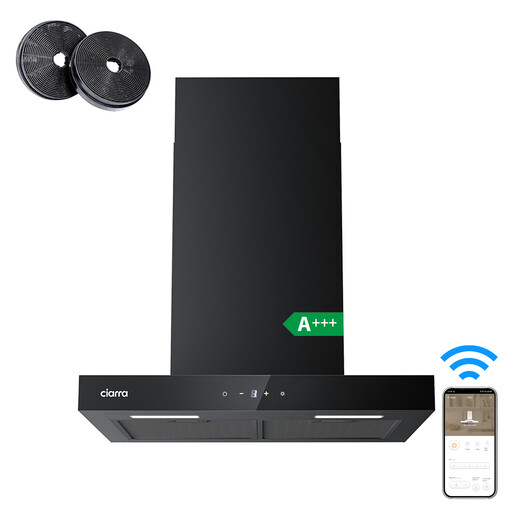 Image unavailable
For a 60 cm wall-mounted hob when both installation modes are being considered.
600 mm wide, with a stated maximum extraction rate of 650 m³/h, three speeds with booster, washable aluminium filters and CBCF003 carbon filters included. Check the hob width, installation height and duct route.
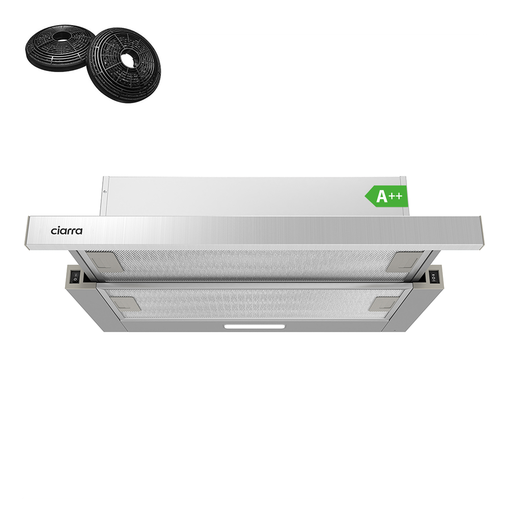 Image unavailable
Worth considering for a kitchen with a compatible wall cabinet and a more discreet visual footprint.
599 × 298–453 × 200 mm format, two speeds, stated maximum extraction rate of 370 m³/h, washable aluminium filters and CBCF002X2 carbon filters included. Check the cut-out, depth, motor clearance and duct routing.
 Image unavailable
A wall-mounted option for a frequently used kitchen, with external venting or recirculation advertised.
595 mm wide, with a stated maximum extraction rate of 580 m³/h, three speeds, touch controls and CBCF055 carbon filters included. The stated adjustable height is 633 to 900 mm; check the clearances and filter maintenance requirements.
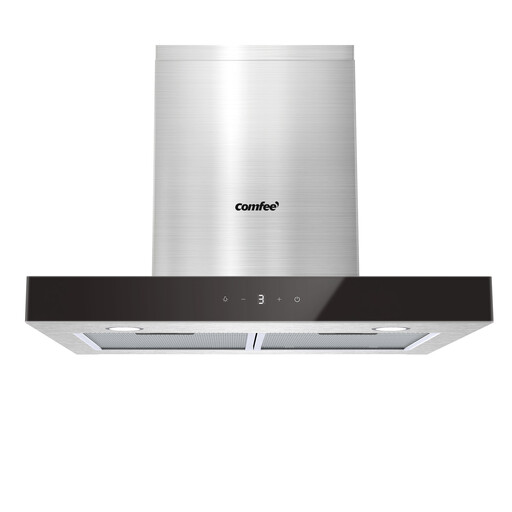 Image unavailable
For a 60 cm wall-mounted installation when external venting or recirculation are both being considered.
600 mm wide, 500 mm deep, with a stated maximum extraction rate of 650 m³/h, four speeds and a washable five-layer aluminium filter. Confirm which filter or kit is required for recirculation, along with the chimney height and mounting method.
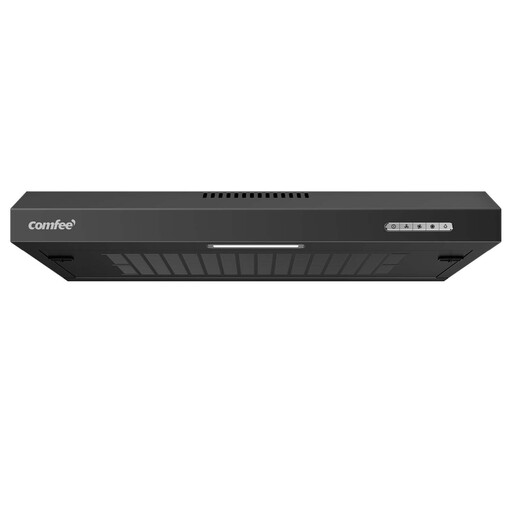 Image unavailable
Worth considering for a compact kitchen with a wall cabinet, provided the installation dimensions are suitable.
Dimensions of 600 × 80 × 440 mm, with a stated maximum extraction rate of 200 m³/h, three speeds, LED lighting and a removable aluminium filter. The recirculation filter must be purchased separately; check its reference and availability.
Yes, if an external connection is genuinely feasible. UFC-Que Choisir states that systems connected to the outside are generally more effective than recirculating systems; however, check the duct, the work required and the conditions that apply to your home.
Yes. When an external connection is not possible, recirculation is the solution to consider: the air passes through a grease filter and a carbon filter before returning to the kitchen. Make sure the exact model supports this mode and the required filter or kit.
Always follow your model’s manual first. Electrolux generally recommends cleaning the grease filter after around 40 hours of use and states that a carbon filter may need cleaning or replacing after around 160 hours, depending on its type.
Bosch states that the extractor hood should be at least as wide as the hob. For a built-in hood, also check the cut-out dimensions, depth and space available in the cabinet: these measurements cannot be determined from the advertised width alone.
If the work affects communal areas or the external appearance of the building, Article 25 of the law of 10 July 1965 requires authorisation from the general meeting by a majority of the votes of all co-owners. The classification depends on the project, the co-ownership rules and local regulations; have the work checked before starting it.