Planning an open-plan kitchen
You want to keep the view clear above an island or cooking area, and can plan the hob, cabinetry and airflow route together.


An extractor hob can be a good option if you want to cook without an overhead extractor, provided it fits in your cabinetry and there’s a workable route for the air. Choose extraction only if an external outlet is possible and permitted. Otherwise, compare recirculation and its filters with a hob and separate hood.
You want to keep the view clear above an island or cooking area, and can plan the hob, cabinetry and airflow route together.
You want to cook without an overhead extractor and need to compare recirculation, the return of air to the room and filter maintenance with other possible layouts.
You already have a cut-out and drawers in place. The visible width of the hob alone won’t tell you whether the extraction system will fit beneath the worktop.
Worth considering: if you can create an outlet to the outside and have its feasibility and permissions confirmed.
Plan for: the airflow route and the space the system takes up beneath the worktop as part of your project.
Worth considering: when an external outlet isn’t feasible, provided you can install the air return and filters specified for your chosen model.
Plan for: filtered air is returned to the room, and filters need to be checked and maintained according to the model.
Worth considering: if an extractor hob won’t fit your cabinetry, or if you’d prefer to choose your hob and extractor separately.
Plan for: you’ll need to find space for both appliances. A telescopic downdraft extractor behind the hob could be an option if you want to avoid an overhead hood and have enough room.
| What matters to you | What to check before buying | Who it matters most to |
|---|---|---|
| Keeping the view clear above the hob | Compare an extractor hob with a telescopic hood; check the dimensions and the space needed beneath the worktop. | If I want to keep the view clear above an island, I’ll compare these layouts without overlooking the space beneath the worktop. Around 31% of consumers prioritise this clear sightline. |
| Fitting the system into the cabinetry | Check the installation plan for the exact model; measure the cut-out, available depth and space taken up by drawers. | If I’m replacing a hob in an existing cabinet, I want to check the installation measurements rather than rely on the visible width. Around 25% of consumers prioritise whether the cabinetry is compatible. |
| Choosing a workable airflow route | Ask a professional to identify the proposed outlet and check any restrictions that apply to your home before choosing ducted extraction. | If I’m not sure whether an external outlet is possible, I want to decide between ducted extraction and recirculation before choosing an appliance. Around 25% of consumers put this question at the heart of their decision. |
| Planning for maintenance | Check the filter reference, its cleaning or replacement requirements, and any components needed for air to return to the room. | If I’d rather avoid ductwork, I’ll also factor in filter maintenance for recirculation. Around 19% of consumers prioritise maintenance and ease of use. |
The extraction system takes up space beneath the hob, which may be thicker than a traditional hob. An existing cut-out and drawers can therefore make replacement more complicated.
Before choosing a model, compare the cut-out plan and the space needed beneath the worktop for the exact version with the measurements taken in your kitchen.
Modifying the worktop or cabinetry could affect your installation plans.
Article 14 of the order of 24 March 1982 prohibits connecting an individual mechanical system equipped with a fan to a shared air outlet system.
Ask a professional to identify the duct. Consider recirculation or an independent external outlet only after checking feasibility and any permissions required.
If the proposed connection isn’t possible, you may need to rethink the airflow route and planned installation.
Recirculation returns filtered air to the room and requires filter maintenance, while ducted extraction relies on a route to the outside.
For the exact model, check which parts are included and the maintenance instructions for your chosen mode.
With recirculation, odour filters and some installation components may need regular attention or may have to be purchased separately.
The PVQ811H26E could be a useful point of comparison for a project around 80 cm wide, and for checking the extraction modes listed for this range.
Electrolux France presents the 600 Bridge Y63CC410CK extractor hob as suitable for 60 cm cabinetry, which may appeal if your project has limited cabinet width.
BORA lists the Pure Rough PURU2R version as a recirculating model. It may be worth considering if filter specifications and the space beneath the worktop are important to your project.
Elica France presents the NikolaTesla Fit XL range as an induction hob with integrated extraction. It’s worth considering if you’re looking for a large cooking surface.
These models combine an induction hob with integrated extraction, so you can cook without an overhead hood. Before choosing, check the cut-out, space beneath the worktop, connections and any accessories needed for installation.
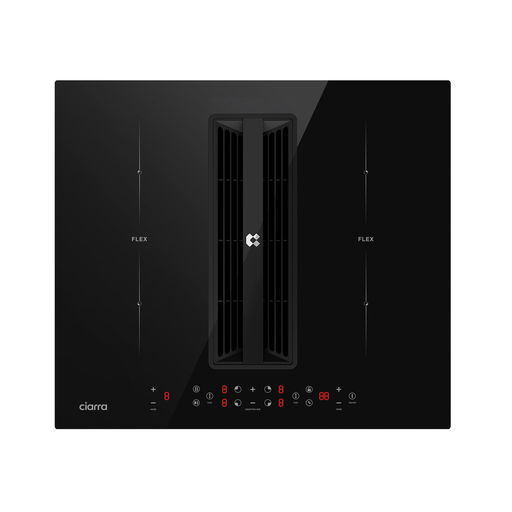 Image unavailable
Worth considering if you want to combine cooking and extraction in one appliance without an overhead hood.
The product listing specifies a 560 × 490 mm cut-out, a 32 A power supply and professional installation. The CBEHKIT accessory is sold separately.
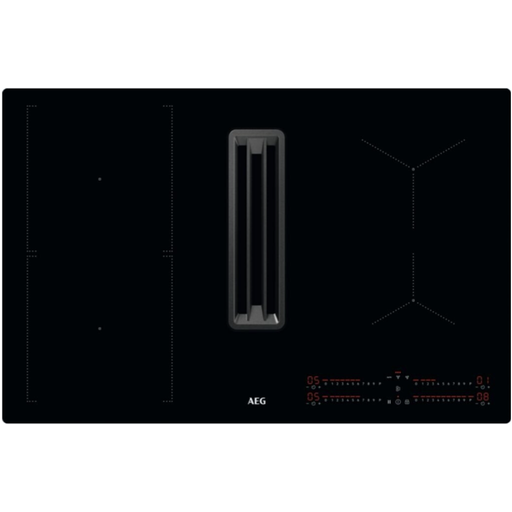 Image unavailable
Worth considering if you’re planning an induction hob with integrated extraction and want to check whether an 80 cm model will fit your kitchen.
The product listing specifies a 7.6 kW two-phase electrical connection and professional installation. Check that your cabinetry is compatible and confirm the connection requirements before installation.
No. Article 14 of the order of 24 March 1982 prohibits connecting an individual mechanical system equipped with a fan to a shared air outlet system, whether it uses mechanical ventilation or natural draught. An independent external outlet is a different type of installation, and its feasibility still needs to be checked.
Check which permissions and procedures apply to your specific project before starting work. Article 25 of the law of 10 July 1965 requires general meeting approval for certain work affecting shared areas or the building’s external appearance. If you’re a tenant, alterations to the property or its fittings require the landlord’s written consent. Service Public also states that a change to the building’s external appearance may require prior planning permission.
No. The order of 24 March 1982 provides for general, permanent ventilation in the home under the conditions it sets out. An appliance designed to deal with cooking fumes isn’t a reason to remove or divert the existing ventilation.
Give the installer the cut-out dimensions, worktop thickness, internal cabinet space, drawer positions and proposed airflow route. Compare these measurements with the installation plan for the exact model and version. The appliance’s external dimensions aren’t the same as the cut-out dimensions.
Check which odour filters are specified for your model and follow the instructions for cleaning or replacing them. UFC-Que Choisir says additional odour filters need to be replaced regularly. BORA lists a maximum filter life of 150 hours for the PURU2R model only.