
Livraison le jour même ou le lendemain

Qualité garantie

Débloquez vos offres de bienvenue: Livraison GRATUITE | Jusqu'à -80 % | 30 jours d'essai gratuits à JoyPlus
Téléchargez l'application
An extra-tall XXL cat tree can transform a flat into a true vertical playground. However, a substantial structure is not necessarily suitable for large cats or multi-cat households. A base that is too narrow, shallow platforms or sisal posts that are too thin can quickly make your purchase disappointing, or even limit how much it is used after just a few weeks.
Here are the key criteria to consider before choosing a 170 cm, 200 cm or taller cat tree, along with a selection of models suited to different types of household.
Height catches the eye, but the floor area, the weight of the structure and the presence of an anti-tip device play a much more important role in everyday use. A stable cat tree should stand on a flat, sufficiently wide base. Depending on the model and the manufacturer's instructions, wall mounting may even be essential.
A cat tree over 190 cm tall placed on a smooth or uneven floor may move when your cat jumps from one level to another. So check its full dimensions, not just the height highlighted on the product page.
A cat tree with numerous levels provides plenty of opportunities for climbing, but may not offer enough room for sleeping or relaxing. In a household with several cats, look for a balance between observation platforms, hideaways, beds and hammocks. Separate sleeping areas can also help prevent arguments over a single spot.
The space between platforms should remain accessible to your pet. An older, heavier or less agile cat will appreciate a gradual ascent more than a series of large jumps.
The number of posts is not everything. Also examine their diameter, distribution and the quality of their covering. Sisal posts measuring around 10 to 11 cm in diameter provide a more comfortable and durable scratching area than small tubes concentrated solely at the base.
The most heavily used areas should be accessible from several levels. This allows you to provide a proper cat scratching post and more easily redirect your cat's attention away from sofas or curtains, although it cannot guarantee that furniture will remain completely scratch-free.
Start by measuring the intended location: width, depth, ceiling height and distance from nearby furniture. A large cat tree makes effective use of vertical space, but it should leave a clear walkway around its base.
For a large cat, check the actual dimensions of the platforms. A surface measuring 50 × 30 cm or 60 × 40 cm tells you far more than simply seeing the word ‘XXL’. If several cats will be using the structure, also compare the number of independent sleeping areas and the stated maximum load.
Wood-based panels, a reinforced base and properly tightened connections all contribute to the overall rigidity of the structure. Anti-tip fixing becomes particularly important above 190 cm. It must be installed on a load-bearing part of the wall, following the instructions carefully.
Once assembly is complete, place the structure on a flat surface and check every screw. Regular checks are still necessary, especially when several cats use the tree at the same time.
Choose models equipped with several sisal posts distributed across the different levels. The sisal should be tightly wound and inspected regularly. Removable, washable covers make cleaning much easier in households where hair and dust quickly build up.
A vacuum cleaner, lint roller and dry cloth are generally all you need to clean the fabric surfaces and frame. Replace or repair accessories as soon as they become loose or show signs of damage.
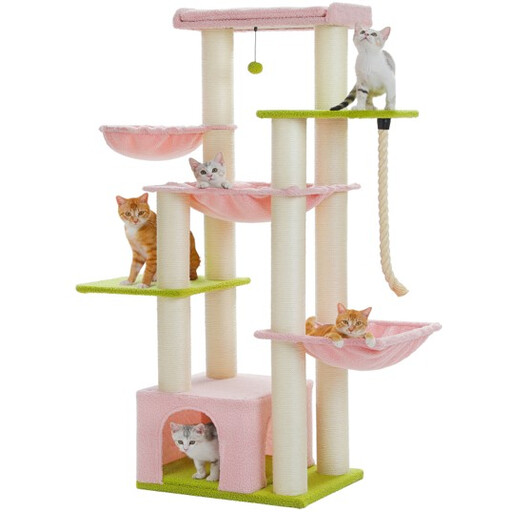
Why this choice suits this profile: With its 7 levels, this model is a good first purchase for one or more adult cats. It offers a variety of spaces without taking up as much room as a 200 cm tower.
The product description lists 13 sisal posts measuring 11 cm in diameter, three hammocks and one hideaway. The removable covers make cleaning easier.
170 cm tall, 7 levels, 13 11 cm posts and a stated capacity of up to 10 kg per cat.
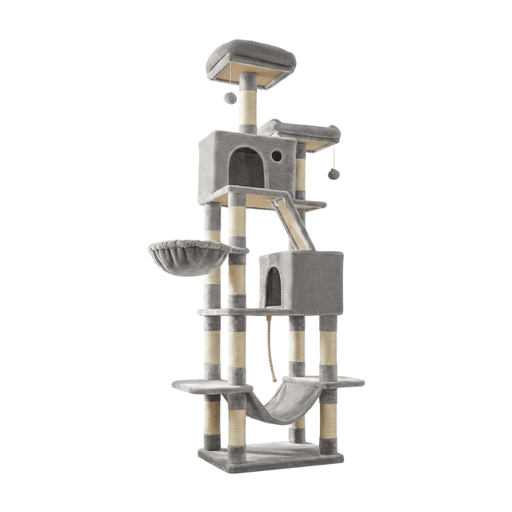
Why this choice suits this profile: This vertical tower is designed for households looking for a 200 cm cat tree with plenty of resting and scratching areas.
An anti-tip fixing is provided and must be installed. The reinforced base complements the 13 sisal posts.
206 cm, two hideaways, two platforms, one hammock, one bed and a recommended capacity of six cats weighing 7 kg each.
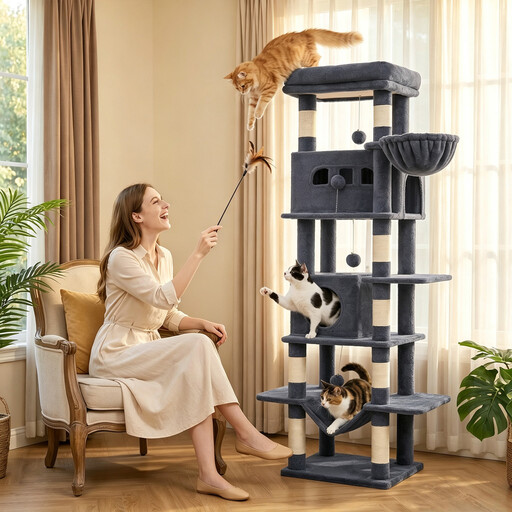
Why this choice suits this profile: Its height and six levels suit active cats and households that want several separate spaces despite having limited floor area.
The product description mentions a widened, reinforced base and an anti-tip device. The two hideaways, hammock and bed distribute the resting areas.
212.5 cm, a 60 × 40 cm platform, 8 sisal posts and several separate spaces for climbing and resting.
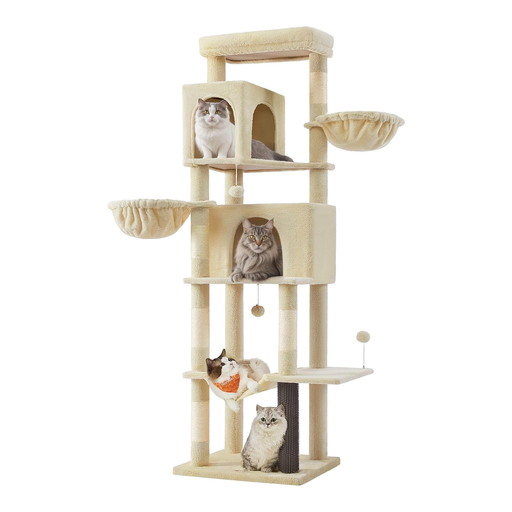
Why this choice suits this profile: This model combines sleeping areas, a lookout point, scratching zones and grooming in a single structure, making it a practical choice for a flat.
Wall mounting is required, reducing the risk of tipping associated with large structures. The five sisal columns are distributed across the different levels.
Two hideaways, two inclined platforms, one hammock, one large platform and an integrated brush.
We have put together a comprehensive, real-time-updated selection of products that meet these demanding criteria and European safety standards.
The lifespan depends on the cats' weight, how often they scratch and the level of care. A heavily used cat scratching post may wear out before the rest of the structure, so inspect it regularly instead of relying on the cat tree's overall appearance.
A 170 cm model is suitable when ceiling height or available space is limited. A 200 cm cat tree or taller offers greater verticality, but requires suitable fixing and clear space around its base. Always measure the room before ordering.
Choose models offering several platforms, hideaways and separate sleeping areas, as well as enough sisal posts. A cat tree advertised as suitable for several cats should also be assessed according to its maximum load and the width of its resting areas.
Place it on a flat floor, tighten all the connections and use the anti-tip device provided. For a very tall model, fixing it to the wall is an essential precaution. Stop using it if any part is cracked, loose or badly worn.