
Livraison le jour même ou le lendemain

Qualité garantie

Débloquez vos offres de bienvenue: Livraison GRATUITE | Jusqu'à -80 % | 30 jours d'essai gratuits à JoyPlus
Téléchargez l'application
An extra-tall XXL cat tree can transform a lounge or flat into a real vertical playground for your cats. But an imposing structure is not necessarily practical, stable or suitable for several animals. Platforms that are too narrow, poorly distributed posts or a forgotten fixing can quickly make your purchase disappointing.
Before comparing models, here are the main pitfalls to avoid and the criteria to consider when choosing a multi-level cat tower suited to your home and your pets.
An advert may highlight a height of 170, 190 or 200 cm without specifying the width of the platforms, the gap between levels or the space available inside the dens. A giant cat tree with sleeping areas that are too cramped will not be well suited to large cats or a household with several pets.
In particular, check:
The taller a cat tree is, the more carefully you need to consider its centre of gravity. A narrow base or lightweight structure may start to wobble when cats run and jump from one level to another. An anti-tip device is a real advantage, but it does not remove the need for careful installation.
For models over 190 cm, make sure they stand on a perfectly level surface and follow the wall-fixing instructions to the letter. Some cat trees must be anchored to a load-bearing part of the wall.
Dens, hammocks, baskets and hanging toys are useful, but they cannot make up for flimsy posts or a covering that is difficult to maintain. A cat tree with a sisal scratching post should provide enough scratching surfaces, spread across several levels. This allows each cat to find its own spot, which may help divert their attention from sofas and curtains, although it cannot guarantee complete protection from scratching.
For a 170 cm cat tree, measure the available vertical space and leave some clearance from the ceiling. Models measuring 200 cm or more provide a higher vantage point, but generally require more secure fixing.
In a flat, a vertical design can reduce the floor area required. However, a sufficiently wide base remains essential to absorb cats’ movements. Compare the height with the model’s overall dimensions rather than relying solely on the figure highlighted in the title.
A platform measuring around 50 × 30 cm already provides enough room for a cat to stretch out. A 60 × 40 cm surface offers greater comfort for heavier cats or larger breeds. For a cat tree intended for several animals, several separate resting areas are preferable to one central platform.
Removable, washable cushions make it easier to deal with fur and minor messes. A washable or detachable platform is also practical, provided you follow the manufacturer’s cleaning instructions.
The sisal should be firmly wound around the posts and should not come loose after just a few uses. Count how many posts are actually covered, check their diameter and look at how they are distributed. A model with 8 sisal posts offers more scratching points than a tower with just one central post.
The stated maximum load should be treated with caution: add up your cats’ weights and take their movements into account. A capacity designed for six cats weighing 6.8 or 7 kg each does not remove the need to follow the anti-tip fixing instructions or regularly check that the screws remain tight.
The following models meet different needs. The dimensions and features are taken from the product listings; always check the information available at the time of ordering.
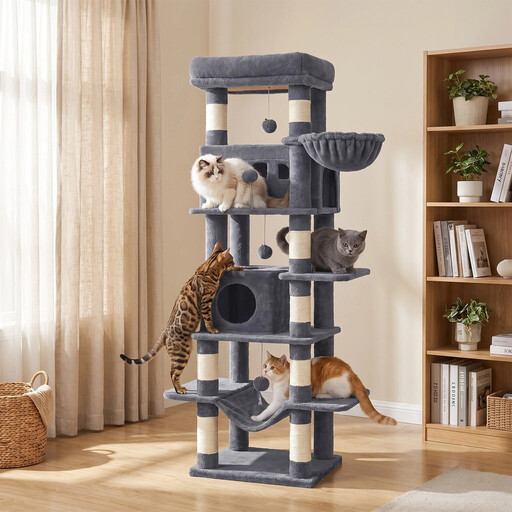
Why this model suits this profile: Standing 170 cm tall, with six levels, two dens, a hammock and a basket, this tower offers a complete set-up without moving straight to a model over 2 m tall.
The listing mentions a reinforced double base, an anti-tip device and 17 posts, 8 of which are covered in sisal.
A 50 × 30 cm platform, two removable cushions and a detachable top platform for easier cleaning.
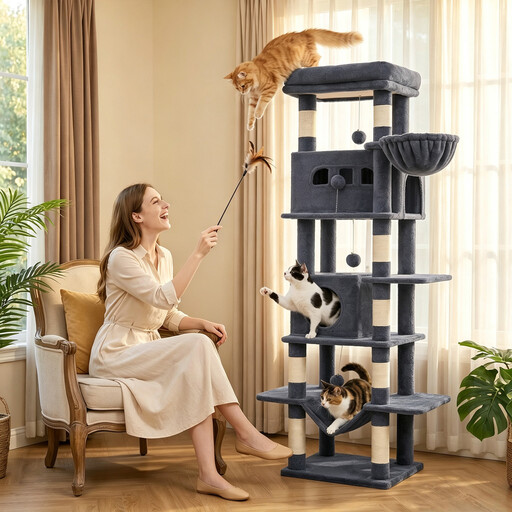
Why this model suits this profile: This tall structure is designed for households that want to make full use of their available height and provide their cats with several separate spaces.
The widened, reinforced base is supplied with anti-tip devices. These must be installed before use.
A 60 × 40 cm platform, two dens, a hammock, a basket and 8 sisal-covered posts.
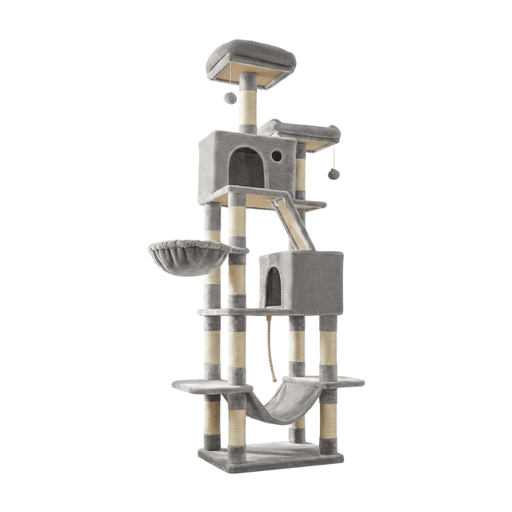
Why this model suits this profile: With 13 scratching posts, two dens, a walkway, a basket and a hammock, this configuration is aimed at households with several active cats.
The listing states that the anti-tip fixing is mandatory. It also specifies a reinforced base and an indicative maximum capacity of six cats weighing 7 kg each.
Five levels spaced 30 to 40 cm apart, an angled scratching board and replacement toys included.
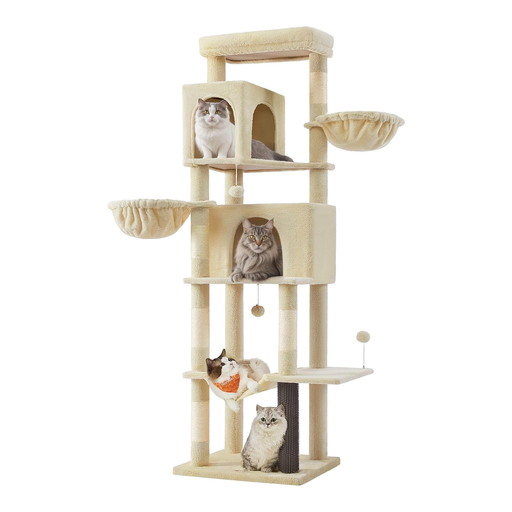
Why this model suits this profile: Its two cubby holes, two resting platforms and large observation platform provide several spaces for cats that like to alternate between play, exploration and naps.
The manufacturer states that the anti-tip protection must be fixed to the wall before use. This should be planned from the outset during installation.
Five sisal columns, two cubby holes, two loungers, a hammock and an integrated brush.
We have brought together a complete, real-time updated selection of products that meet these strict selection criteria and European safety requirements.
Once assembly is complete, check every fixing before allowing your cats to use the tower. Place it on a level floor, avoid narrow walkways and do not let children climb on the structure. For a particularly tall model, the wall anchor must be compatible with the type of partition wall and installed in accordance with the manufacturer’s instructions.
Regularly vacuum or use a lint roller on fabric surfaces. Inspect the sisal ropes, hanging toys, screws and the various fixing components. Replace any damaged part or toy your cat has started chewing without delay. These checks help extend the cat tree’s lifespan and reduce the risks associated with wear and tear.
A 170 cm model will generally suit a lounge with a standard ceiling height and already provides several levels. A tower measuring 200 cm or more offers a higher vantage point, but requires more vertical space and carefully installed anti-tip fixing.
Yes, provided the structure has several platforms, dens, hammocks and scratching areas. Above all, check the stated total load capacity, the width of the sleeping areas and whether the cats can move around without constantly being forced to share the same space.
Its lifespan depends on the cats’ weight and activity levels, the quality of the joints and the care it receives. Regularly checking the sisal posts, coverings and fixings makes it possible to quickly identify components that need replacing. Frequency of use and the number of cats should also be taken into account before buying.