
Livraison le jour même ou le lendemain

Qualité garantie

Débloquez vos offres de bienvenue: Livraison GRATUITE | Jusqu'à -80 % | 30 jours d'essai gratuits à JoyPlus
Téléchargez l'application
Hanging a frame, mirror, or shelf without pulling out the drill? The promise is tempting. Extra-strong double-sided tape has emerged as the miracle solution for any drill-free wall mounting. But there's a catch: the market is flooded with products making often-exaggerated marketing claims, and a poor choice can quickly turn into a disaster, leaving you with a shattered object on the floor and a wall to repaint.
To avoid falling for the hype, here are the most common pitfalls that lead to disappointment:
To avoid these setbacks, it is crucial to rely on objective technical criteria.
Choosing the right tape isn't just about grabbing the thickest one on the shelf. Here are the key points to check to hang a heavy object without drilling with peace of mind.
The load capacity advertised by manufacturers (e.g., in kg/m) is a starting point, but it must be read with a critical eye. For optimal safety, never push the theoretical maximum limit.
The location of your fixture is critical. An ultra-strong mounting tape for indoors will not have the same formulation as an outdoor double-sided tape.
The success of the operation depends as much on the adhesive as it does on the surface. Meticulous surface preparation is therefore a non-negotiable step.
To guide you through this jungle of options, we have selected three products that stand out from the crowd, each tailored to a specific user profile and need.
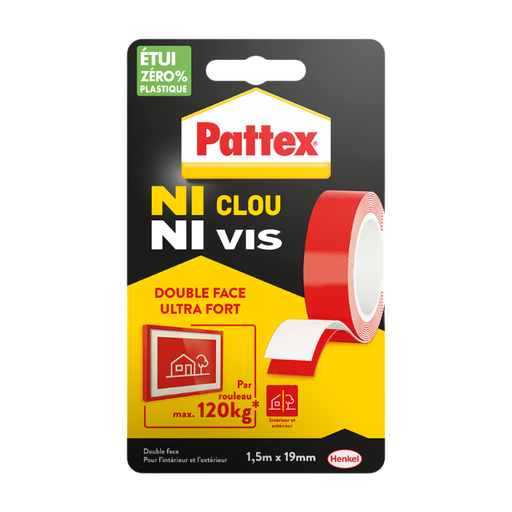
Why we chose it: The heavy-duty solution for critical, high-load fixtures. Ideal for a mailbox, a large mirror, or bathroom accessories, with no compromise on durability.
Its formula is specifically designed for both indoor and outdoor use, with excellent resistance to moisture and temperature changes. The very high load capacity (up to 120 kg per roll) provides a comfortable safety margin, even for the most ambitious projects.
Versatility: Effective on a wide range of materials (glass, metal, stone, some plastics). Instant hold: The bond is immediate, with no drying time required.
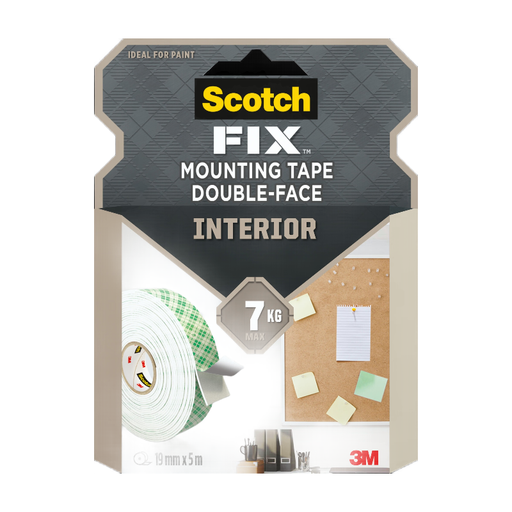
Why we chose it: The perfect ally for everyday decorating projects: hanging light frames, posters, or small objects on painted walls, without needing the heavy-duty power of a construction-grade adhesive.
This product doesn't oversell extreme outdoor resistance. It focuses on its mission: providing a reliable indoor hold on painted walls. This way, you avoid paying for unnecessary features.
The right tool for the job: Designed specifically for painted walls, it ensures a reliable and permanent hold for objects up to 7 kg. Simplicity: Easy to cut and apply for all small projects.
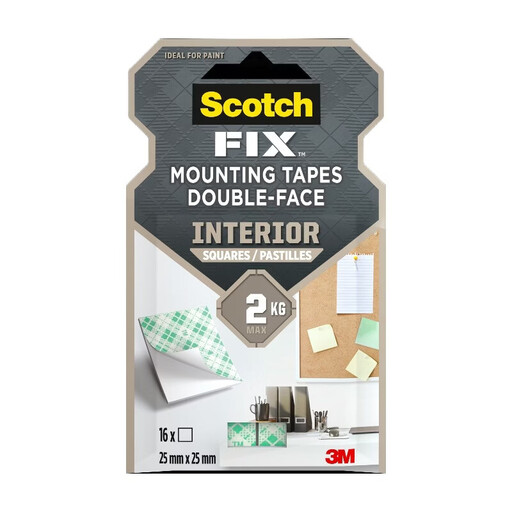
Why we chose it: The express solution for mounting small objects (up to 2 kg) without the fuss of a roll and scissors. Perfect for mini-organising or decorating projects that demand speed and precision.
The pre-cut format eliminates guesswork. Each square is calibrated for a light and precise load, which prevents you from under-sizing the fixture for a small object.
Ultimate convenience: No scissors, no waste. Just peel, stick, and it's mounted. Lightning-fast application: Allows for a clean and immediate installation for the smallest items.
We have compiled a complete selection of products that meet our performance criteria and current quality standards.
The lifespan depends heavily on the environment. Indoors, under stable conditions, a quality fixture can last for several years. Outdoors, even a tape treated for UV and moisture resistance will show its limits over time. We recommend checking the fixture's condition annually, especially for heavy or highly exposed objects.
Removing a permanent adhesive without causing damage is a delicate task, especially on a painted wall. The best technique is to gently heat the tape with a hair dryer to soften the glue. You can then slide a piece of fishing line or dental floss behind the object to "saw" through the adhesive. Despite these precautions, a small paint touch-up is often unavoidable.
Always refer to the manufacturer's instructions, which indicate the load capacity per centimetre or metre. The golden rule for a heavy object: apply vertical strips along the entire height, spaced 10 to 15 cm apart. And when in doubt, the prudent DIYer's motto still applies: better safe than sorry.