Households freezing meals in portions
If you regularly prepare meals in advance, drawers or compartments can help you keep portions separate and find the ones you use most often.


If you often take out individual portions or prepared meals, an upright freezer offers convenient organisation and access. For larger stocks of food, consider a chest freezer if you have enough room to position it and open the lid. A small appliance may be enough for occasional extra storage, while a larger fridge freezer is worth comparing if you also need more fridge space. In every case, check the usable freezer capacity and the permitted ambient temperature range for the room where you plan to install it.
If you regularly prepare meals in advance, drawers or compartments can help you keep portions separate and find the ones you use most often.
For bulk or seasonal shopping, start by checking the freezer capacity and the floor space available. In a chest freezer, baskets make smaller items easier to reach.
In a small kitchen, the appliance’s dimensions and how it opens may determine which model is right for you. For a cellar, garage or outbuilding, also compare the room temperature with the model’s permitted range.
First decide whether you’d prefer the easy access of an upright freezer or the extra space offered by a chest freezer. Then check whether a compact model has the capacity you need. If your current fridge is also too small, compare replacing it with a larger fridge freezer against adding a separate freezer, looking only at the freezer capacity in litres.
| Factor | What to check | Who it suits |
|---|---|---|
| Access to portions | Available drawers or shelves; door clearance. | If I often take out a prepared meal, I want to find it without moving the whole stock. Around 31% of consumers would put this organised access first. |
| Capacity for provisions | Usable freezer capacity in litres; baskets and lid clearance. | For storing bulk purchases or large batches of food, I prioritise capacity, even if that means sorting items at the back into categories. Around 31% of consumers would put this need for extra capacity first. |
| Space at home | External dimensions and clearance when open; distances specified in the manual. | In a narrow kitchen, I need to be able to position and open the appliance without blocking the way, even if it means choosing a more modest capacity. This would be the main consideration for around 23% of consumers. |
| Installation room and continuous use | The model’s ambient temperature range; stated energy consumption in kWh/year. | If the appliance is going in a cellar or garage, I first check that it’s suitable for the room temperature. I also take its continuous energy consumption into account. Around 15% of consumers would prioritise these installation and usage conditions. |
A large chest freezer may fit in the room but leave too little space to open the lid, or it may not fit through a doorway or up the stairs.
Measure the delivery route, the space where the appliance will go and the clearance it needs when open. Follow the clearance guidance in the model’s manual.
ADEME recommends comparing the room’s ambient temperature with the range recommended for the freezer. A room that’s too cold or too warm can affect how it works.
Check the minimum and maximum temperatures at the intended location, then make sure they fall within the range stated for the model you’ve chosen.
The stated capacity of a fridge freezer includes the fridge compartment, so it doesn’t all represent frozen storage space.
Compare the capacity of the freezer compartment alone, then check the dimensions, noise level and kWh/year stated for each appliance.
Drawers, No Frost defrosting and stated suitability for a cold room vary from one model to another.
Check these features on the exact model’s product page, along with its freezer capacity, dimensions and ambient temperature range.
Beko offers upright and chest freezers, including some Freezer Guard models designed for colder locations.
The range includes upright freezers, with the layout and defrosting method varying by model.
The chest freezer range is worth considering for storing larger quantities of food, with baskets available on some models.
Haier also offers upright freezers, with dimensions and features varying by model.
This selection includes four convertible chest freezers for storing provisions and a small upright freezer with compartments for keeping portions separate. Choose the capacity and layout that suit the way you’ll use it, then check the installation requirements for your chosen model.
 Image unavailable
For storing provisions in a chest freezer, with a removable basket to keep some of the contents separate.
Advertised features include fridge or freezer modes, five-level digital controls, LED lighting and an E energy rating.
Before choosing a cellar or garage, check the permitted ambient temperature range for this model and the clearance it needs.
 Image unavailable
For a small amount of extra food storage rather than a large family stock; the removable basket keeps some items separate.
Advertised features include fridge or freezer modes, a seven-level thermostat and an E energy rating.
Check that 95 L is enough for your needs and that the ambient temperature range is suitable for the room where you plan to put it.
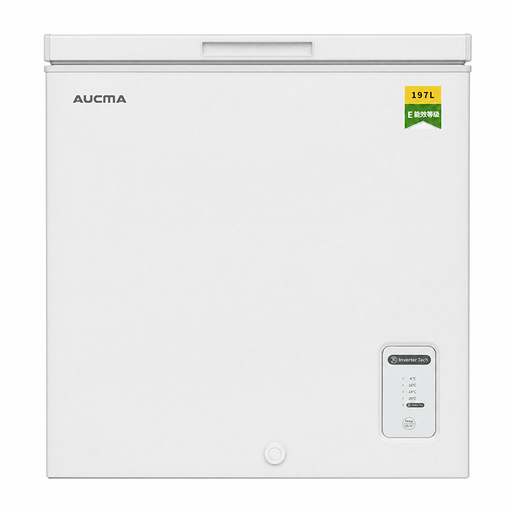 Image unavailable
For extra food storage if a top-opening lid suits your space and the way you like to organise your food.
Advertised features include a removable basket, fridge and freezer modes, five-level digital controls and an E energy rating.
Allow enough room to open the lid and check the model’s ambient temperature range before installation.
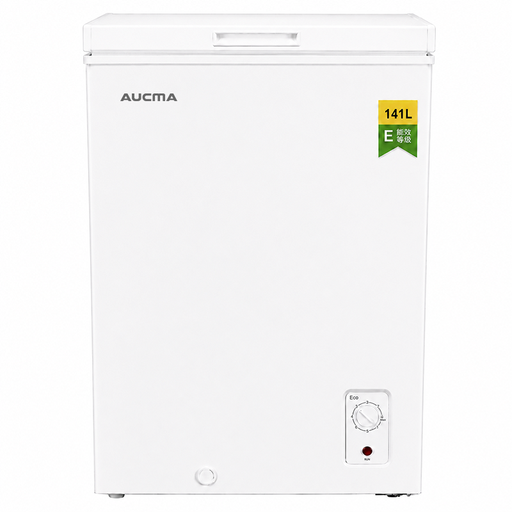 Image unavailable
Add extra freezer space for provisions without choosing the larger AUCMA 291 L chest freezer; a removable basket helps keep smaller items separate.
Advertised features include fridge and freezer modes, a seven-level thermostat and an E energy rating.
Check there’s enough room for the lid to open and that the room is within the permitted ambient temperature range.
 Image unavailable
For keeping individual portions organised in a compact upright freezer, rather than building up a large stock.
Advertised features include a reversible door, adjustable temperature and an E energy rating.
Check that the capacity suits your needs, and review the model’s annual energy consumption and ambient temperature range before buying.
Compare the room’s minimum and maximum temperatures with the ambient temperature range permitted for the specific model. ADEME recommends checking this before you buy. Beko and Haier state that some models can operate at temperatures as low as −15 °C, but this doesn’t apply to all their appliances.
Compare annual energy consumption in kWh, freezer capacity in litres, energy efficiency class and noise level for appliances that meet the same storage needs. The European Commission says these details appear on the labels of relevant appliances in the European Union; you can scan the QR code to view the model’s information in EPREL.
Consider a chest freezer if your priority is storing a large stock and you have enough floor space and room above the lid. If you often take out small portions, an upright freezer’s drawers can make them easier to organise and reach. Que Choisir also recommends comparing capacity and installation location.
Compare their stated kWh/year, taking into account the freezer capacity you need, rather than choosing based on the energy efficiency letter alone. ADEME points out that a freezer runs continuously, so also check that the appliance can operate in the room where you plan to put it.