What should you compare before choosing?
If your fridge’s freezer compartment is no longer big enough, start by working out how much usable capacity you need and where the appliance will go. Then compare ease of access, energy consumption and maintenance. UFC-Que Choisir reminds us that ease of use matters too, while ADEME notes that a freezer runs continuously.
| Feature |
What to check |
Who it matters most to |
| Usable capacity |
Compare the freezer’s usable capacity with the size of the food you want to store and the space available. For a fridge-freezer, check the freezer capacity separately. |
If I store batches or large packs, I want to make sure everything fits without making food hard to reach. Around 26 % of consumers prioritise extra storage capacity. |
| Access and storage |
Check the size and number of drawers or baskets, how easy they are to handle, and how much room you need to open the door or lid. |
If I often take out small portions, I want to find and remove them without moving everything else. Around 21 % of consumers prioritise easy access to food they use often. |
| Installation |
Measure the space and opening area. Check the room temperature against the model’s specifications and follow the instructions for ventilation. |
If the appliance needs to go in a cool room or a tight space, I want to make sure its dimensions and installation requirements are suitable. Around 21 % of consumers put room suitability first. |
| Energy consumption |
Compare the kWh/year figures on the current energy labels of appliances suited to similar needs, taking usable capacity into account. |
If I add an appliance that runs continuously, I want to compare its stated energy consumption and estimate the cost using my own tariff. Around 16 % of consumers are most concerned about electricity use. |
| Storage time in the event of a power cut and defrosting |
Check the stated storage time in hours and distinguish between manual defrosting, frost reduction and the No Frost function. |
If I keep a large stock of food, I want to know the stated storage time and how much maintenance to expect, without assuming that the stated duration is guaranteed for every power cut. Around 16 % of consumers prioritise storage time and maintenance. |
Joybuy options for a separate freezer
This selection includes upright freezers with drawers and chest freezers, with stated capacities from 99 to 291 L. Compare them according to how much you need to store, the layout you prefer and the space available for installation.
 Image unavailable
Heinrich’s 161 L upright freezer, class C
Its drawers and shelves help you organise portions in a separate upright freezer.
The product fiche lists No Frost, three drawers, two shelves, an LED display and an alarm.
Stated temperature range: −14 to −22 °C.
View on Joybuy
 Image unavailable
AUCMA 291 L convertible chest freezer, class E
Its stated capacity makes it suitable for storing a good supply of food, and the product fiche says it can be used as either a fridge or a freezer.
The product fiche lists a removable basket, LED lighting and a five-level digital control.
According to the product fiche, leave at least 10 cm of ventilation space around the appliance.
View on Joybuy
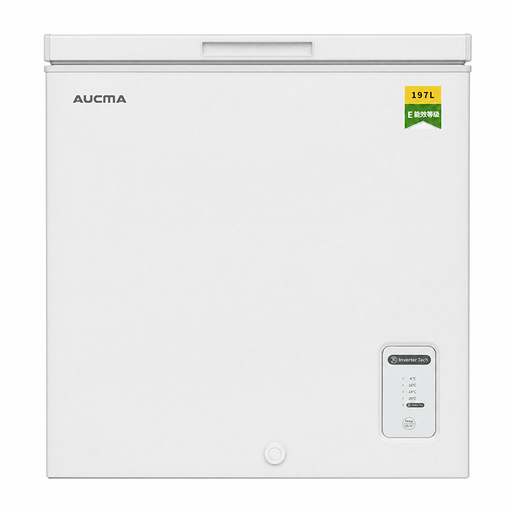 Image unavailable
AUCMA 197 L convertible chest freezer, class E
This chest freezer provides separate storage, with a removable basket to help you organise food.
The product fiche states that it can be switched between fridge and freezer modes and has a five-level digital control.
According to the product fiche, leave at least 10 cm of ventilation space around the appliance.
View on Joybuy
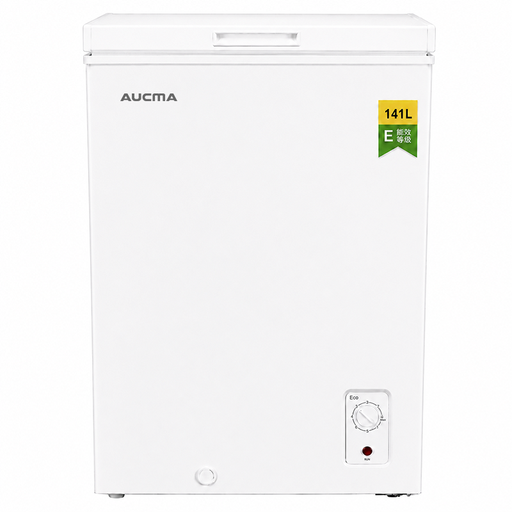 Image unavailable
AUCMA 141 L convertible chest freezer, class E
Its stated capacity makes it suitable as an additional chest freezer. The product fiche lists a removable basket and convertible operation.
The product fiche states that the thermostat has seven settings.
View on Joybuy
 Image unavailable
CHiQ JR99DWE 99 L chest freezer, class E
Its compact size may suit you if you need extra freezer space but have limited room. Its stated dimensions are 54,5 × 47,6 × 83,5 cm.
The product fiche lists a removable basket, a sliding lid and a four-star freezer rating.
The product fiche specifies at least 10 cm of ventilation space and manual defrosting when frost exceeds 5 mm.
View on Joybuy
Frequently asked questions about choosing a freezer
Can you put a freezer in a cellar or an unheated garage?
Yes, as long as the room temperature stays within the range specified for your chosen model. Beko states that the HSM35050 can operate at ambient temperatures down to −15 °C, while Whirlpool gives the same figure for the W3RHS19DW. These specifications don’t apply to every appliance. Check the instructions and installation requirements for the exact model.
How much space should you leave for ventilation?
Follow the instructions for your chosen model, as installation requirements vary from one model to another. Bosch’s general advice doesn’t replace the appliance manual. Also check that the door or lid can open fully and that drawers or baskets can be removed.
How should you store food after shopping?
Manger Bouger recommends putting food intended for the freezer away first, setting the appliance to −18 °C and avoiding overfilling the compartments so cold air can circulate. This advice doesn’t set a maximum capacity that applies to every model.
Which energy information should you compare on a freezer sold in France?
Compare the current energy efficiency class and the energy consumption shown on the model’s label. The Ministry of the Economy and the DGCCRF state that energy labelling for household refrigeration appliances is covered by Delegated Regulation (EU) 2019/2016, which has applied since 1 March 2021. Don’t rely on the old A+, A++ or A+++ ratings.
What can you do if a freezer bought from a professional seller has a lack of conformity?
You can contact the professional seller under the statutory guarantee of conformity, subject to the conditions set out in the regulations. The Ministry of the Economy explains that this guarantee applies to new, second-hand and refurbished goods sold to consumers. It is separate from an optional commercial guarantee. Keep your proof of purchase and check the conditions that apply to the fault you have found.


