If your current appliance still works and you’re regularly short of space for batch cooking and bulk buys, choose an additional freezer based on the capacity you need, how you’ll access the food and where you can put it. A chest freezer suits a large stock of food, an upright freezer makes portions easier to organise, and a compact model can fill a smaller gap. If you’re already replacing your main appliance, first compare the freezer capacity of a larger fridge freezer. In every case, check the dimensions, the permitted room temperatures and the stated energy consumption in kWh/year.
Who is this choice for?
Households that stock up
Bulk buys, batch cooking and bulky packaging mean you need to consider both usable capacity and how much space the appliance will take up. UFC-Que Choisir’s guide looks in particular at chest and upright freezers in light of these considerations.
People who often need to reach individual portions
If you store homemade meals and ingredients separately, being able to find them easily matters just as much as capacity. Look at the drawers and compartments, and consider how easy it will be to reach the food once the appliance is full.
Households with limited space
Whether it’s going under a worktop, in a garage or in a cellar, you need to be able to deliver, install and open the appliance. If the room is unheated, also check that the model’s stated ambient temperature range covers the temperatures it will actually be exposed to.
How do the different formats compare?
First, work out how much food no longer fits in your current appliance. If you already need to replace it, compare its future freezer capacity with that need before adding a separate appliance.
| Criteria |
What to check |
Who is it for? |
| Extra capacity |
Compare the stated usable capacity with the maximum amount of food you need to store, and measure the space available for a chest or upright freezer. |
If batch-cooked meals and bulk buys regularly overflow from your fridge freezer, extra capacity becomes the main priority. Around 36% of consumers prioritise this additional space. |
| Access to food |
Check how it opens, how easy the drawers are to handle and how accessible the bottom of a chest freezer is. |
If you often need to find portions and ingredients without rummaging through a chest, organisation matters especially: around 29% of consumers prioritise easy everyday access. |
| Available space |
Measure the space, the delivery route and the clearance needed to open the appliance. Check that a compact model’s capacity will meet your storage needs. |
Under a worktop or in a narrow utility room, the appliance needs to fit and remain easy to use. Around 21% of consumers put suitability for the available space first. |
| Operating conditions |
Compare the room’s actual temperatures with those permitted for the exact model, then compare the kWh/year for appliances with similar capacities. |
In an unheated room, permitted temperatures may determine your choice; elsewhere, the consumption of an appliance that stays on all the time may matter more. Around 14% of consumers prioritise these installation or usage conditions. |
Mistakes to avoid
-
Choosing a chest freezer for capacity alone
Its compartment can hold bulky packaging, but the appliance takes up floor space and you’ll need to be able to reach anything stored at the bottom.
Measure the space, access routes and clearance needed to open the lid. Think about how you’ll organise food inside.
-
Assuming any model will work in a garage
Whether an appliance can operate in a cold room depends on the specific model; you can’t tell from its chest-freezer format or brand alone.
Note the room’s minimum and maximum temperatures, then compare them with the climate class and installation limits stated for the model you’re considering.
-
Comparing only the energy label rating
ADEME points out that a freezer runs continuously. The energy rating alone doesn’t tell you how much it will use: check the kWh/year alongside its capacity and how you plan to use it.
Compare appliances with a capacity that suits your needs. The European EPREL database lets you check the declared specifications of models covered by energy labelling.
-
Forgetting about your old appliance when replacing it
In France, a used freezer should go through the waste electrical and electronic equipment (WEEE) scheme, as described by the Ministry for Ecological Transition.
If you’re replacing a freezer, check with the seller how they’ll take back your old appliance of the same type, and whether it can be collected when your new one is delivered.
Brands to know when comparing models
Liebherr
The range includes chest freezers and freestanding models, with features varying by model.
- Liebherr states that its CFe 1870 Pure chest freezer has a capacity of 281 L and FrostProtect, which works down to −15 °C.
- Don’t assume another model has FrostProtect, NoFrost or SmartFrost. Check its product details and installation temperatures.
Beko
The brand offers a range of chest freezers, with capacity and installation conditions varying by model.
- For the HSM14540 chest freezer, Beko states a capacity of 205 L and a minimum operating ambient temperature of −15 °C.
- This permitted temperature and the HSM14540’s specific features don’t automatically apply to other Beko freezers.
Haier
The French catalogue includes upright and chest freezers, with different layouts depending on the model.
- Haier describes its H4F272WCH1 upright freezer as suitable for ambient temperatures as low as −15 °C.
- Check the dimensions, layout and permitted temperature range for the specific version you’re buying, rather than assuming they’re the same across the range.
Additional freezers on Joybuy
These models include chest freezers in different capacities and two upright options for extra storage. Compare their capacity and access to food before checking the installation conditions for the model you choose.
 Image unavailable
AUCMA 291 L convertible chest freezer
Consider this chest freezer for a large amount of extra storage, if you have room on the floor and are happy with top access. The product name specifies an E energy rating, LED lighting, five-level digital controls and a removable basket. It switches between fridge and freezer modes, so you can’t use both at once. Check the permitted ambient temperatures for your chosen location.
View on Joybuy
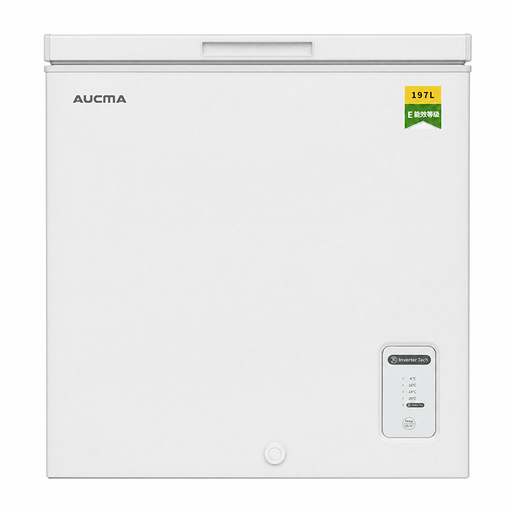 Image unavailable
AUCMA 197 L convertible chest freezer
This chest freezer can provide extra storage if a top-opening design suits the way you organise your food. The product name specifies an E energy rating, five-level digital controls and a removable basket. You choose either fridge or freezer mode for the whole appliance. Before installing it in a cold room, also check the permitted ambient temperature range.
View on Joybuy
 Image unavailable
Heinrich´s 161 L stainless steel upright freezer
An upright design may suit you if you’d rather keep portions separate than store them together in a chest. The product name mentions drawers, an LED display, No Frost and a C energy rating. Check the dimensions, kWh/year and permitted ambient temperatures to assess how it will fit and how much energy it uses.
View on Joybuy
 Image unavailable
AUCMA 95 L compact convertible chest freezer
This chest freezer can help with a more modest capacity shortfall, provided you have room to open the lid. The product name specifies an E energy rating, a seven-level thermostat and a removable basket. You’ll need to choose between fridge and freezer modes. Check the permitted ambient temperature range, especially if you plan to keep it in a garage or cellar.
View on Joybuy
 Image unavailable
COMFEE' RCU60WH2(E) 60 L white upright freezer
This upright model is designed for a small amount of extra storage, provided its dimensions suit your chosen location. The product name specifies a reversible door, adjustable temperature and an E energy rating. Before buying, check the exact internal layout, as well as the kWh/year and permitted ambient temperatures.
View on Joybuy
Frequently asked questions
Should you add a freezer or choose a larger fridge freezer?
First, work out what no longer fits in your current appliance after your food shop and batch cooking. A separate freezer is a good solution if you’re regularly short of space. If you already need to replace your main appliance, compare the freezer capacity of a larger fridge freezer with the amount of food you actually need to store.
Can a freezer work in an unheated garage?
Yes, if the ambient temperature range stated for the exact model covers the temperatures in your garage. Note the garage’s minimum and maximum temperatures, then check the appliance specifications. Beko, Haier and Liebherr state that certain specific models can operate down to −15 °C, but this doesn’t apply to their entire ranges.
How do you compare the energy use of two freezers?
Compare the kWh/year shown on the energy label or in EPREL for models with capacities suited to the same need, then factor in where you plan to put them and how you’ll use them. ADEME points out that a freezer runs continuously, so its energy rating alone doesn’t tell you its annual energy use.
What should you do with your old freezer when replacing it in France?
Take it to a waste electrical and electronic equipment (WEEE) collection scheme. The French Ministry for Ecological Transition FAQ says that when you buy an appliance of the same type in a shop, the old one can be taken back on a “one for one” basis. Check the practical collection and handling arrangements with the seller.


