For storing large quantities of meals and bulk buys, choose a chest freezer if you have enough floor space. An upright freezer is a better choice if you often take out individual portions and want to organise them in drawers. A compact model suits more modest needs, while a large fridge-freezer is worth considering if you’re also short of space for fresh food. Whatever you choose, check the net capacity, dimensions and ambient temperature range specified for the model.
Which format is right for you?
Households that cook and freeze in bulk
If you prepare meals ahead or regularly buy in bulk, start by working out how much extra storage you need. A chest freezer has room for bulky containers, while an upright makes it easier to organise portions in drawers.
People who often take out individual meals
If you regularly choose one portion from several containers, access matters just as much as capacity. Look at the drawers or baskets and check you can reach your food without having to move everything else.
Households planning to install a freezer outside the kitchen
If you’re considering a cellar, pantry or unheated garage, compare the room’s minimum and maximum temperatures with the permitted range for the exact model. A chest freezer isn’t automatically suitable for a cold room.
How do the different formats compare?
First decide whether you need a large, separate stock of frozen food or just a few extra portions. UFC-Que Choisir highlights the capacity of chest freezers and the compartment-based access offered by upright models. Whichever format you choose, compare the kWh/year and stated power-cut storage time for the models you’re considering.
Chest freezer
Consider it: for batches of meals or bulky containers, if you have the floor space and top access works for you.
Bear in mind: food stored at the bottom can be harder to find without baskets or an organised layout.
Upright freezer
Consider it: if you want to sort portions by category and regularly take them out of drawers.
Bear in mind: compartments may be less flexible than an open space for very large containers.
Compact freezer
Consider it: for a modest amount of extra storage when space is limited.
Bear in mind: it may not have enough capacity for bulk buys or lots of prepared meals.
Large fridge-freezer
Consider it: if you’re also short of space for fresh food and would prefer one appliance for both.
Bear in mind: its total capacity doesn’t tell you how much space will actually be available in the freezer compartment.
| Criteria |
What to check |
Who this matters to |
| Storage capacity |
Compare the net freezer capacity with the space you need for tubs, bags or large containers. |
If prepared meals and bulk buys already fill the freezer in my fridge-freezer, I want separate storage with room for those batches. Around 31% of consumers would put capacity first. |
| Access to portions |
Check how easy the drawers or baskets are to use and whether you can reach food stored at the back. |
If I often take out one portion, I want to find it without disturbing the other meals. Access and organisation would be the priority for around 31% of consumers. |
| Room temperature |
Check the room’s lowest and highest temperatures and compare them with the range specified for the exact model. |
If I’m using an unheated cellar or garage, I need to choose an appliance suited to the temperatures the room actually reaches. Around 23% of consumers would put this first. |
| Available space |
Measure the space with the door or lid open. Compare the freezer capacity of a compact model with that of a potential replacement fridge-freezer. |
If my kitchen is small, I’m looking for a little extra freezer space, or one appliance if I’m also short of room for fresh food. Around 15% of consumers would prioritise this trade-off between capacity and space. |
Mistakes to avoid
-
Assuming a chest freezer will suit any cellar
The temperature in an unheated room can fall outside the ambient range specified for the appliance. Climate class and any specific suitability for cold conditions apply to the exact model, not to all chest freezers.
Check the room’s minimum and maximum temperatures, then compare them with the product details or manual before deciding where to put the freezer.
-
Choosing the largest capacity without considering anything else
A large freezer can be awkward to use if the portions you need each week end up buried beneath other food. UFC-Que Choisir also recommends checking how easy it is to access the different compartments.
If you take food out often, look at an upright’s drawers or the basket layout in a chest freezer, and think about where you’ll store the meals you use most.
-
Comparing only the energy label rating
The rating doesn’t replace the declared annual energy consumption: two appliances with different capacities or formats may not meet the same storage needs. ADEME points out that a freezer runs continuously.
Compare kWh/year for models with a similar capacity and format, taking into account how much freezer space you actually need.
-
Replacing your fridge-freezer without checking its freezer compartment
A large fridge-freezer may solve a shortage of space for fresh food without providing all the extra room you need for prepared meals.
Compare the net freezer capacity of your current appliance with the new fridge-freezer you’re considering, then compare both with a separate freezer.
Brands to consider
These ranges illustrate different formats and features. Check the specifications for the exact model you’re interested in rather than assuming they apply to every appliance from a brand.
Beko
The range includes chest freezers, some of which are designed for unheated rooms.
- According to Beko, selected models with Freezer Guard can operate at ambient temperatures as low as −15 °C.
- This feature isn’t available across all Beko models. Check the exact model and its operating range before installing it in a cellar or garage.
Bosch
The range includes upright freezers as well as built-in and under-counter models.
- Depending on the model, Bosch offers drawers and features such as NoFrost or super freezing.
- Net capacity, dimensions, energy consumption and features vary, so check the details for the model you choose.
Liebherr
The range spans under-counter freezers and larger upright models, with NoFrost available on selected models.
- Liebherr includes a 92-litre under-counter model, offering an option for extra storage that’s distinct from a large upright freezer.
- Check the capacity, defrosting function and installation requirements for each model.
Whirlpool
The French range includes several chest freezers designed for horizontal storage.
- These models offer a separate storage option if a chest freezer suits the space you have available.
- The format alone doesn’t tell you about energy consumption, noise, storage time during a power cut or suitability for a cold room. Compare each model individually.
Freezers for extra storage
These Joybuy models include chest freezers in different capacities and an upright freezer. They suit a range of needs for separate storage, from a small top-up to larger batches of meals. Choose according to usable capacity, access to the contents and the space available.
 Image unavailable
AUCMA, 291 L convertible chest freezer
Worth considering if you need plenty of extra storage and have room for a chest freezer with top access.
Fridge and freezer modes, energy rating E, LED light, five-level digital control, removable basket and defrost drain.
If you’re planning to use it in a cellar or garage, check the model’s ambient temperature range. Also compare its stated storage time during a power cut if this matters to you.
View on Joybuy
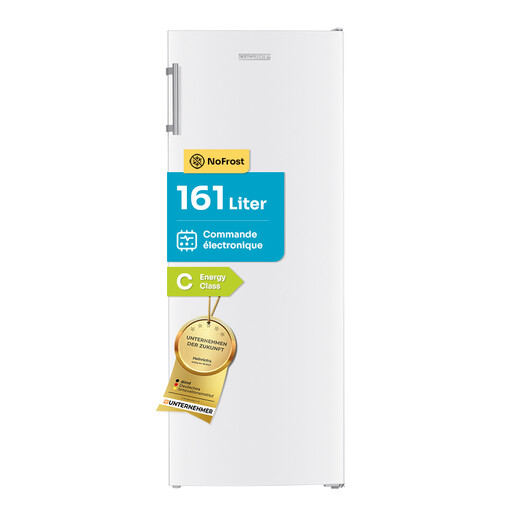 Image unavailable
Heinrich´s, 161 L No-Frost upright freezer
Worth considering if you’d rather organise portions in drawers than store them in the open space of a chest freezer.
Drawers, LED display, alarm, reversible door hinge and energy rating C. The stated adjustable temperature range is −14 °C to −22 °C; this refers to the appliance’s temperature, not the permitted ambient temperature range of the room.
Measure the space and check the kWh/year, ambient temperature range and stated storage time during a power cut for this model.
View on Joybuy
 Image unavailable
TCL CF182EWE0FR, 140 L chest freezer
Worth considering if you need some extra storage but don’t need the capacity of the 291 L AUCMA model.
Storage basket, counterbalanced lid, temperature control and energy rating E.
Allow enough room to open the lid, and check the model’s kWh/year, ambient temperature range and stated storage time during a power cut.
View on Joybuy
 Image unavailable
CHiQ JR99DWE, 99 L chest freezer
Worth considering for modest extra storage if you don’t have room for a larger freezer.
Adjustable thermostat, removable metal basket, sliding lid and energy rating E.
Check how much clearance the lid needs, along with the kWh/year, ambient temperature range and stated storage time during a power cut for this model.
View on Joybuy
 Image unavailable
AUCMA, 95 L convertible chest freezer
Worth considering for a small amount of extra storage if you’d like the option to switch between fridge and freezer modes.
Energy rating E, seven-level thermostat, removable basket and defrost drain.
Check that 95 L is enough for your meals, then check the model’s ambient temperature range and stated storage time during a power cut.
View on Joybuy
Frequently asked questions
Can you put a chest freezer in a cellar or garage?
Yes, as long as the actual room temperature stays within the ambient range specified for the model you choose. For example, Bosch states a range of 10 to 32 °C for climate class SN and 10 to 43 °C for SN-T. The latter alone therefore doesn’t cover a cellar that drops below 10 °C. According to Beko, selected Freezer Guard models are designed to operate at temperatures as low as −15 °C. Check that this feature is listed for the model you’re considering.
How do you compare the energy consumption of two extra freezers?
Compare their declared annual energy consumption in kWh/year for models with a similar capacity and format, then look at their energy ratings. ADEME points out that a freezer runs continuously. Choosing a capacity that suits your storage needs is more useful than making a decision based on the label rating alone.
When should you choose a large fridge-freezer instead of a separate freezer?
A large fridge-freezer is a more direct solution if you’re short of space for both fresh and frozen food and would prefer to keep just one appliance. If prepared meals are the main reason you need extra storage, compare the net capacity of its freezer compartment with that of a separate freezer before replacing your fridge-freezer.
Is storage time during a power cut enough to choose between two models?
No. Consider the stated storage time during a power cut alongside capacity, access to the contents and energy consumption. UFC-Que Choisir’s testing protocol measures how long food stays frozen during a power cut by tracking the temperature rise to −9 °C. When comparing stated figures, check that they’re based on comparable conditions.


