
Livraison le jour même ou le lendemain

Qualité garantie

Débloquez vos offres de bienvenue: Livraison GRATUITE | Jusqu'à -80 % | 30 jours d'essai gratuits à JoyPlus
Téléchargez l'application
Whether you're plugging in a PC at the office, mowing the lawn in the back garden, or setting up a TV corner, the extension cord is an accessory we all think we know inside and out. Yet, when faced with overloaded shelves, it's easy to make a mistake. And the wrong purchase isn't just a waste of money: it poses a real risk to your safety and your devices.
Let's break down the common pitfalls to avoid and the essential criteria to ensure you never make the wrong choice again.
The 3 Common Mistakes to Avoid When Buying an Extension Cord:
You don't need to be an engineer to make the right choice, but understanding a few technical specifications is essential. They aren't there to overwhelm you with jargon, but to guarantee your safety and the longevity of your purchase.
An extension cord's ability to safely deliver power depends on an inseparable pair: the maximum power it accepts (in Watts, W) and the cross-sectional area of its conductor wires (in square millimetres, mm?).
Crucial point of attention: On a cable reel, the maximum power rating shown is only valid if the power cable is fully unwound. When coiled, its capacity can drop by as much as two-thirds! The product label always mentions this, so read it carefully.
The Ingress Protection (IP) rating is the code that tells you if your extension cord can handle water. It's a non-negotiable criterion for outdoor use.
Choose the right length to avoid clutter and risks. Beyond the metres, a few thoughtful features can be a game-changer:
To put theory into practice, here is our selection of models that meet specific needs while scrupulously adhering to safety and practicality standards.
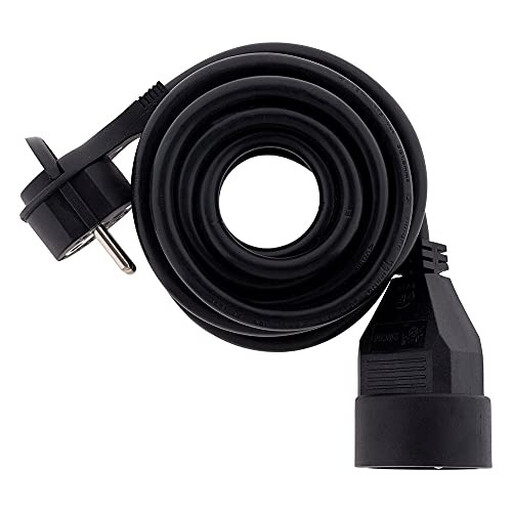
Perfect for optimising indoor space, its extra-flat plug is the ideal solution for placing furniture (bookshelves, sofas, desks) flush against a wall without leaving an unsightly gap or damaging the cable.
No more furniture pushed away from the wall by a standard plug! This clever design preserves the harmony of your interior layout.
Extra-flat plug: The solution for tight spaces. 3G1.5 mm? cable: A versatile gauge suitable for all home appliances up to 3680 W.
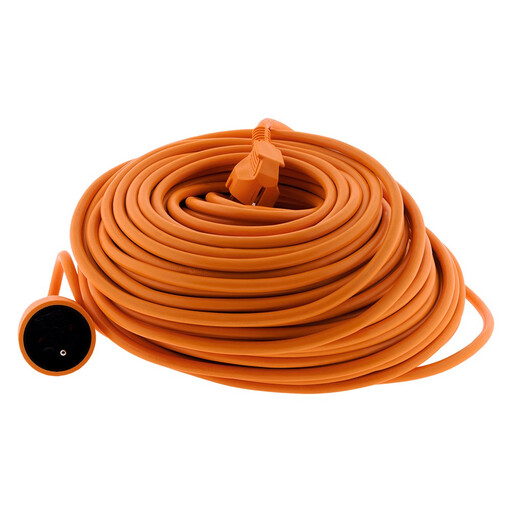
At 45 metres long, it's perfect for covering a large garden and effortlessly powering a lawnmower, hedge trimmer, or electric barbecue. Its bright colour isn't just for show—it's a genuine safety feature.
This model is specifically designed for the garden, avoiding the fatal error of using a living room extension cord. Note that it is not IP44 rated, so it should only be used in dry weather. Its bright orange colour makes it impossible to miss, preventing trips and accidental cuts from a lawnmower.
45 m reach: Ideal for most gardens. High visibility: Its orange colour reduces the risk of tripping or cutting the cord. NF certified: A guarantee of compliance with French standards.
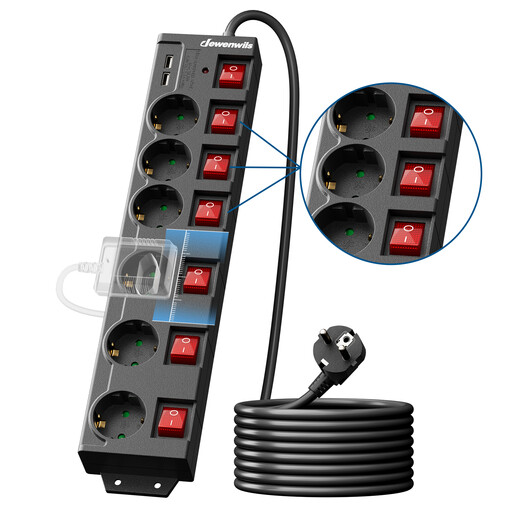
The perfect partner for a complete workstation (PC, monitor, printer, chargers...). Each socket has its own switch to manage its power consumption, so you no longer have to unplug everything.
It directly tackles the "phantom" power consumption of devices on standby. No more inflated electricity bills from equipment that draws power even when turned off.
Individual switches: Total control for real energy savings. 90° outlets: Perfect for plugging in bulky power adapters without blocking neighbouring sockets. Overload protection: An essential safety feature for your valuable devices.
Explore our full selection of products, all rigorously chosen for their compliance with French safety standards and their practicality.
Yes, it's absolutely essential, especially with powerful appliances. A coiled cable acts like an inductor: heat cannot dissipate, it builds up (this is the Joule effect), and can melt the insulation. The risk of a short circuit and fire is then at its highest. The permitted power load when the cable is coiled is drastically lower than when it is unwound.
It's all about water resistance. An IP20 model is for indoor use in a dry location. Period. An IP44 model, on the other hand, is protected against water splashes (like light rain), making it suitable for occasional outdoor use (garden, patio) or in damp environments (garage). Using an IP20 cord outside is knowingly putting yourself at risk.
Never. This is one of the golden rules of electrical safety. Daisy-chaining power strips creates an overload on the original wall outlet. The total power demanded by all the devices eventually exceeds the circuit's capacity, leading to a major risk of overheating and fire. This practice is strictly forbidden by safety standards.