
Livraison le jour même ou le lendemain

Qualité garantie

Débloquez vos offres de bienvenue: Livraison GRATUITE | Jusqu'à -80 % | 30 jours d'essai gratuits à JoyPlus
Téléchargez l'application
Between a cluttered worktop, lids stacked haphazardly in a cupboard, and a microwave that’s awkward to reach, the kitchen can quickly become impractical. An extendable microwave shelf adds an extra level of storage, whether on the counter or inside a cabinet, without requiring major work.
However, not all adjustable structures are created equal, and some won’t suit your kitchen. Before placing an order, it’s worth checking several points: dimensions, stability, and the quality of the sliding mechanism.
An extendable shelf may look perfectly suited on the product page. Yet its minimum and maximum dimensions alone aren’t enough to confirm compatibility. You also need to measure the depth of the cabinet, the available height, and the space needed to open the microwave door.
For a microwave stand to place on a worktop, make sure to note:
A structure designed for pots or crockery isn’t necessarily able to support a heavy electrical appliance. The maximum load and the support surface must be checked separately.
A sliding shelf without drilling can be a good solution for tenants or to preserve a cabinet. That doesn’t, however, excuse you from careful assembly. The rails must be properly fixed, the structure installed on a flat surface, and the weight distributed evenly.
Beware of baskets that slide easily when empty but become unstable once loaded. A sufficiently high rim, non-slip pads, and suitable glides are often more useful than a simple promise of space-saving.
In a kitchen, steam, splashes, and cleaning products put storage to the test. A metal kitchen organiser with a painted or enamel finish will generally be easy to maintain, provided you wipe wet surfaces promptly.
Avoid metal scourers and abrasive cleaners, which risk damaging the coating. In most cases, a soft, slightly damp cloth and a mild detergent are sufficient.
An adjustable kitchen shelf should offer a range of adjustment compatible with your cabinet. Measure the space at the top, middle, and bottom: the walls of a cupboard aren’t always perfectly parallel.
For storage intended for a microwave, also check the total height once the shelf is installed. If you plan to add a second level for boxes or plates, leave enough clearance to take them out without knocking them against the shelf above.
The maximum load stated by the manufacturer should be treated as a limit not to be exceeded. Place heavy items in the centre or in the designated areas, then distribute lighter items to the sides.
For an extendable pull-out basket, the stated load generally applies to the whole basket, not each part separately. The rails may slide less smoothly if pots, lids, or jars are stacked unevenly.
Check the contents of the box: screws, rails, pads, brackets, and instructions should all be present. Tool-free assembly is a nice bonus, but it doesn’t replace checking the overall stability once installed.
For storing pots and lids, grooves and dividers prevent them from tipping over. Inside a cabinet, also make sure the sliding mechanism doesn’t hit the door or the hinge.
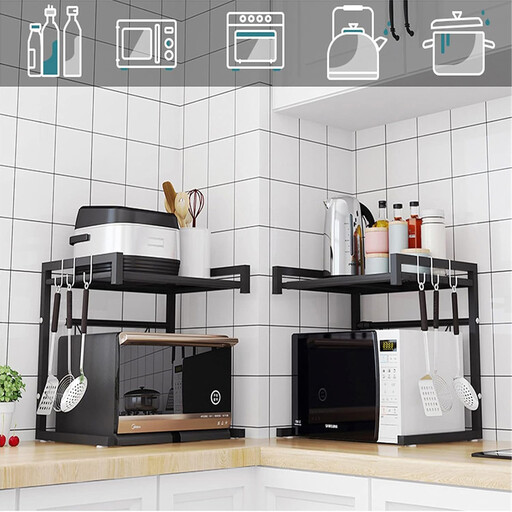
Why this choice suits this profile: its extendable format can work for those who want to add storage space around a microwave or in a small kitchen, provided you check the dimensions and maximum load before buying.
Checking the extension range and the space needed for ventilation helps avoid an installation that’s too tight or poorly suited.
An extendable format that can serve as a shelf on a worktop, depending on your kitchen layout.
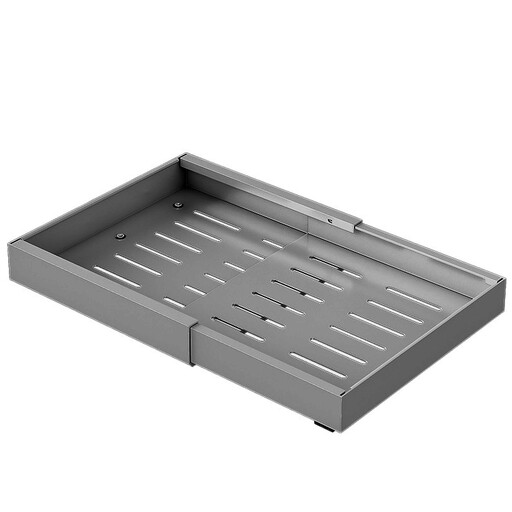
Why this choice suits this profile: its pull-out basket makes it easy to access provisions, crockery, and utensils stored inside a cabinet.
The adjustment from 42 to 68 cm and the drill-free installation address fixed-width constraints and avoid modifying cabinets.
An enamelled carbon steel structure, sliding rails, and a stated maximum load of 33 lb, approximately 15 kg. Weight must be distributed evenly.
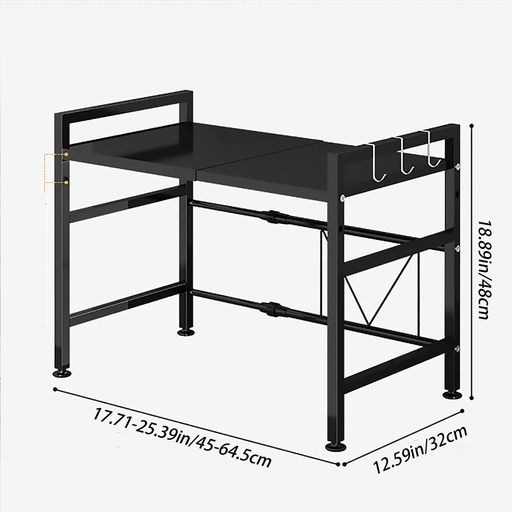
Why this choice suits this profile: its various configurations suit households that want to organise several categories of items, from pots to lids, as well as chopping boards and utensils.
The eight adjustable levels and three mounting modes allow you to adapt the structure to a worktop or under a cabinet, rather than imposing a single configuration.
Iron with a rust-resistant black finish, two organisers included, and U-shaped grooves fitted with silicone pads to hold certain lids.
We’ve listed products that meet these demanding selection criteria and European safety standards, in a comprehensive list updated in real time.
Before installing the shelf, empty the cabinet and clean the surface. Assemble the structure on a table, then check its dimensions before putting it in place. With a sliding system, first test the movement when empty, then gradually add items.
A few simple precautions:
No. Compare the width, depth, height, and weight of the microwave with the shelf’s specifications, not forgetting the ventilation recommendations. A structure designed for crockery should not hold an appliance if its maximum load is insufficient.
Remove all items, then clean the basket with a soft cloth and a non-abrasive product. Dry metal parts thoroughly, especially after exposure to steam or water. Metal sponges and corrosive products should be avoided.
Yes, it can be perfectly suitable for daily use if the cabinet is compatible, the rails are correctly fitted, and the load is well distributed. Regularly check the overall stability and tighten or reposition elements if the basket shows unusual play.