
Livraison le jour même ou le lendemain

Qualité garantie

Débloquez vos offres de bienvenue: Livraison GRATUITE | Jusqu'à -80 % | 30 jours d'essai gratuits à JoyPlus
Téléchargez l'application
An extendable clothes rail on wheels can save valuable space in a bedroom, utility room or shop. But not all models are created equal. Between flattering photos, stated capacities with no explanation and frames that become loose after just a few uses, there are several points worth checking before placing your order.
A maximum static load does not necessarily mean that the clothes rail will be easy to move once loaded. Coats, jackets and damp clothes weigh considerably more than a row of shirts. You therefore need to distinguish between the capacity stated by the manufacturer, the stability of the base and how easily the rail can be moved across an uneven floor.
A mobile clothes rail may seem perfectly suited to a bedroom, then become cumbersome once its telescopic rail is extended. Note its minimum and maximum width, its depth and the space needed to turn it on its wheels. In a small room or rented home, a few dozen centimetres can make a dramatic difference to everyday ease of use.
Swivelling castors make moving the rail easier, provided they can be locked. Without brakes, the rail may move when you take down a coat or if it is placed on a slightly sloping floor. Also check that the base remains stable and that the connections are properly tightened after assembly.
When choosing an adjustable clothes rail, compare its adjustable height and width with the dimensions of your longest garments. Coats, dresses and trousers folded over hangers require sufficient height to prevent them from touching the floor.
A telescopic rail or one fitted with a double rail makes it easy to adapt the available space. This configuration can be used to separate clean clothes, the next day’s outfits or items intended for professional activities. Also remember to measure the width of doors, lifts and the various passageways before ordering.
A steel or metal frame can be perfectly suitable for regular use, provided that the tubes, joints and base are correctly sized. Do not rely solely on a label such as « heavy duty »: check the maximum load, expressed in kilograms, and stick to it.
By way of comparison, the Ochama model states a maximum static load of 150 kg, compared with 100 kg for the JOYFURNOS model. The JE CHERCHE UNE IDEE clothes rail fitted with four shelves, meanwhile, states a maximum load of 10 kg. These figures are not directly comparable: they need to be considered in relation to how you intend to use the rail, how the weight is distributed and the level of stability you require.
A clothes rail with shelves can hold accessories, shoes, boxes or folded laundry. Lower rails are also useful for storing storage crates. For occasional use, a foldable or dismantable model helps reduce the amount of space it takes up when no longer needed.
Assembly also deserves a little attention. A clothes rail that is easy to assemble should come with clearly identified parts and easy-to-understand instructions. Once the frame has been assembled, check every fastening before loading it. When folding away certain telescopic rails, push from the end intended for this purpose and keep your fingers away from moving parts.
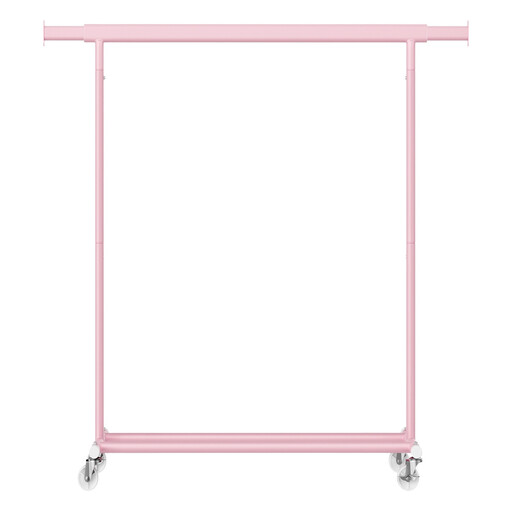
Why this choice suits this profile : its adjustable width of 92 to 132 cm is ideal for a bedroom or utility room where the available space needs to remain flexible. Its stated static load reaches 100 kg.
Its extendable rail and lockable castors prevent you from ending up with a fixed model that is difficult to reposition.
Steel frame, tool-free assembly, lower rails for boxes and a pink finish.
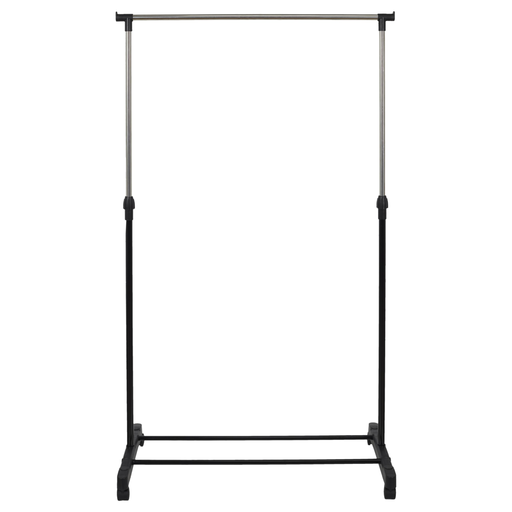
Why this choice suits this profile : its four shelves and adjustable height of 90 to 160 cm are ideal for anyone who wants to organise clothes, shoes and accessories on a single frame.
Its 10 kg capacity is clearly stated, helping you avoid overloading a shelving model designed for lighter storage.
Four shelves, adjustable height, castors and a stated floor footprint of 80 × 43 cm.
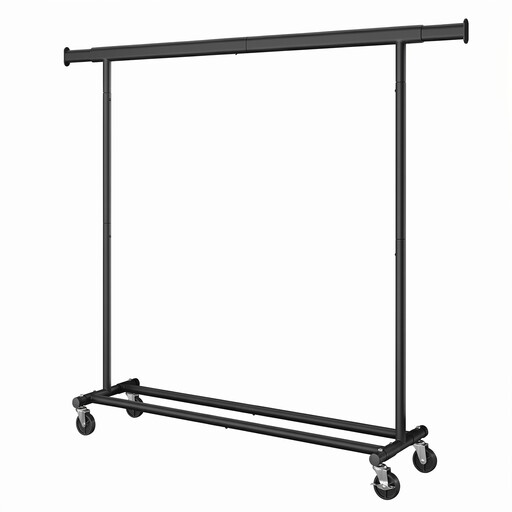
Why this choice suits this profile : its adjustable width of 160 to 200 cm and stated static load of 150 kg make it suitable for a large wardrobe, utility room or temporary professional use.
The dimensions and maximum load are clearly specified, while the lockable swivelling castors let you move the rail and then keep it securely in place.
Steel frame, extendable width, depth of 45 cm, height of 161,5 cm and lower rails for boxes.
We have put together a complete, real-time updated list of products that meet these strict selection criteria, as well as European safety requirements.
To keep a freestanding clothes rail stable, distribute clothes along the full length of the rail rather than concentrating the weight in one place. Set up the rail on a level floor, lock the castors before hanging items on it and tighten the fixings again after the first few uses.
A soft, slightly damp cloth is generally all you need to clean the metal parts. Dry the frame afterwards, particularly if it is used in a utility room. Avoid direct heat sources and prolonged exposure to moisture to reduce the risk of damage. If you need to move the loaded rail, remove some of the weight and check that nothing is obstructing the castors.
Start by identifying the base, uprights, rails and castors. Assemble the lower frame first, then attach the uprights and top rail, following the instructions. Tighten the connections without forcing them, check that the frame is square and test the castor locks before hanging your clothes on it.
It depends on the model. Technical specifications may state a static load of 100 or 150 kg, or a considerably lower figure, such as 10 kg for a rail fitted with several shelves. Always observe the stated value, distribute the weight evenly and do not confuse a static capacity with a load that the rail can be moved regularly.
Yes, provided that its folded and extended dimensions are compatible with the room. A narrow, adjustable or dismantable model can provide temporary storage without requiring a fixed wardrobe to be installed. However, measure the passageways and leave enough space around the castors to move the rail easily.