
Livraison le jour même ou le lendemain

Qualité garantie

Débloquez vos offres de bienvenue: Livraison GRATUITE | Jusqu'à -80 % | 30 jours d'essai gratuits à JoyPlus
Téléchargez l'application
Between the looming back-to-school season and the files piling up at the office, your workspace is on the brink of collapse. The expandable file folder emerges as the perfect solution. But making the wrong choice can quickly turn into a nightmare?: a snapping elastic band, cracking plastic, laughable storage capacity... frustration is never far behind.
Before you fall for the first model you see, learn how to avoid the common traps. Too many budget-friendly folders sacrifice durability for design, leaving you with an accessory that's headed for the trash after just a few weeks of heavy use. To make a smart purchase, here are the key points to check.
To effectively organise your university lectures or file your professional documents seamlessly, focus on these technical points that make all the difference.
Forget cardboard and low-grade plastics. A polypropylene file folder is a guarantee of durability. Polypropylene (PP) is a plastic that is both rigid and flexible, resisting twists, impacts, and water. A thick, opaque PP cover protects your documents from prying eyes and everyday mishaps, ensuring a much longer lifespan.
A folder's true flexibility lies in its expandable spine. Look for models with a sliding back or an accordion-style gusset that truly adapts to the volume of papers you insert. For optimal organisation, an 8-pocket file folder is often the perfect balance for students or for managing multiple projects simultaneously. This allows you to dedicate a section to each subject or project, making information quick to access.
The closure system is crucial. A large flap covering most of the front, combined with a snap button or sturdy elastic bands, ensures nothing falls out, even when you're on the move. The little extras, like a customisable index sheet for labelling each section or an accordion file folder with an integrated zip pocket for storing small items, are significant advantages.
Here are a few models that check all the boxes, suited for different needs and profiles.
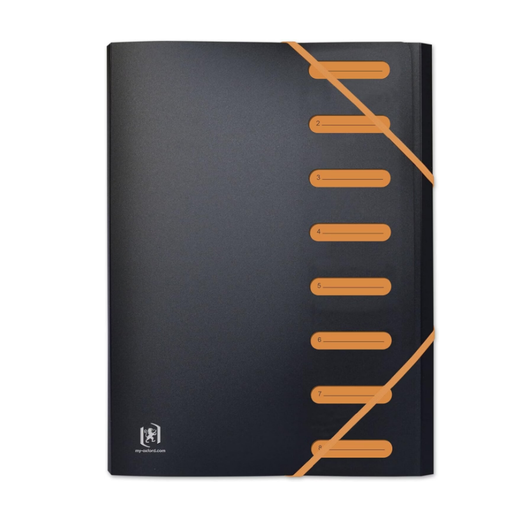
Why we love it : Designed for the intense pace of student life, this A4 file folder is an all-in-one tool. Its 8 pockets allow you to separate lectures, tutorials, and administrative documents, while its robust design withstands daily use in a backpack.
Its rigid, opaque polypropylene cover prevents tearing and protects the contents. The sliding back adjusts to the volume, avoiding the closure problems found in fixed-capacity models.
The integrated zip pocket is a real bonus for storing pens, glue, or scissors, keeping all your essentials in one place.
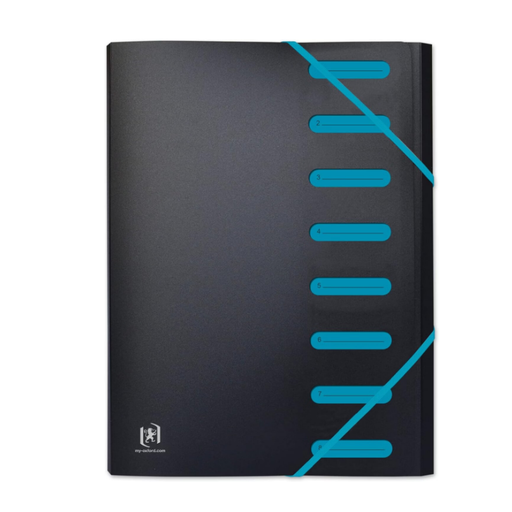
Why we love it : For those who juggle the office, remote work, and client meetings, this file folder offers a sleek and effective solution. The black exterior and blue interior look professional, while the sturdy structure protects important contracts and reports during transport.
It bypasses the trap of impractical design with its large flap that secures documents and its index sheet for quickly locating files.
Its versatility. It's just as useful for filing active projects as it is for organising personal administrative papers, all in a compact and durable format.
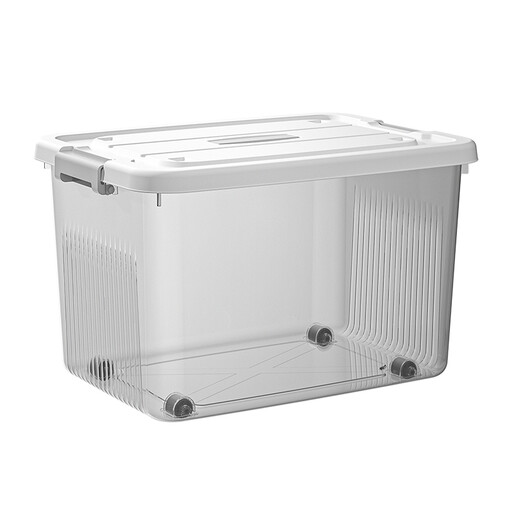
Why we love it : Here, the goal isn't transport, but long-term storage for a large volume of documents (archives, invoices, old coursework). A sturdy storage box is an excellent alternative. This set offers a high-capacity solution to protect your papers from dust and moisture.
It solves the problem of insufficient capacity by offering far more storage volume than a file folder. The 2.5 mm thick PP plastic ensures excellent durability for archiving.
The stackable design helps optimise vertical space in a cupboard or garage. The boxes' transparency makes it easy to identify the contents without having to open everything.
Discover our full selection of products that meet our criteria for quality and durability.
It all depends on your needs. For a student file folder (A4 size), 8 to 12 pockets are ideal for separating different subjects. For professional use, 6 to 8 pockets are usually enough to organise ongoing projects. Fewer pockets may be suitable if you simply want to separate "to-do" documents from "archived" ones.
Absolutely. Polypropylene (PP) is the benchmark material for this type of product. Unlike cardboard, which tears and absorbs moisture, or PVC, which can become brittle, PP offers excellent resistance to bending, impacts, and water. It's a smart investment for an item that's handled daily.
Of course. While they are designed for A4 paper, the gussets can accommodate thin notebooks, notepads, plastic sleeves, and even slim tablets if the folder is rigid enough. The zip pocket found on some models is also perfect for stashing small items like USB drives, business cards, or a calculator.