After-dinner coffee drinkers
You want to keep the ritual of a hot cup while limiting your caffeine intake. Decaffeinated coffee can still contain caffeine, which is worth bearing in mind if you’re sensitive to it.


For an evening cup made without a machine, first look for coffee clearly labelled as instant and decaffeinated. A jar lets you measure out each cup at home, while sticks are more convenient for a portion on the go. Bear in mind, though, that ‘decaffeinated’ does not guarantee that the coffee is completely caffeine-free.
You want to keep the ritual of a hot cup while limiting your caffeine intake. Decaffeinated coffee can still contain caffeine, which is worth bearing in mind if you’re sensitive to it.
You make your coffee without a machine and prefer to adjust the amount in each cup. A jar could suit this routine; check its weight and storage instructions.
You’re looking for a portion that’s easy to take to the office or elsewhere. Sticks save you measuring out the coffee, but the number and total weight vary by box.
For an evening coffee, first check how the product is labelled. Then choose the stated flavour profile and packaging to suit the way you make your coffee.
| What to consider | What to check | Who it matters to |
|---|---|---|
| Caffeine | Look for both ‘instant’ and ‘decaffeinated’ on the label. Don’t mistake decaffeinated for completely caffeine-free. | If I drink coffee after dinner, I want to limit my caffeine without giving up my evening cup. Around 33% of consumers would make reducing their caffeine intake a priority. |
| Flavour profile | Check the blend and intensity if they’re listed. These descriptions don’t guarantee that you’ll enjoy the taste. | I want to find a flavour profile that suits my preferences, even when choosing decaffeinated coffee. Taste would be the main deciding factor for around 27% of consumers. |
| Portions to take away | Check the number of sticks, the total weight and the ingredients list to distinguish pure instant coffee from a coffee-based mix. | At the office or on the go, I’d rather take a pre-measured portion with me. Around 20% of consumers would prioritise this convenience. |
| At-home use | Compare the jar’s weight, the stated number of cups and the storage instructions. | If I make coffee at home often, I want a container that suits how much I drink. This would be a priority for around 20% of consumers. |
The Anses says caffeine can delay falling asleep and affect the duration or quality of sleep. When it comes to taste, a brand’s stated intensity is specific to its range; it can’t replace your own preferences.
Decaffeinated coffee can still contain caffeine. This distinction is particularly important if you’re sensitive to its effects in the evening.
Check the product label and take into account all the caffeinated drinks you consume.
Ground coffee and soft coffee pods aren’t prepared in the same way as instant coffee mixed with water. The decaffeinated Carte Noire products featured by the brand are available in these two formats.
If you want to make coffee without a coffee machine, check that it’s labelled ‘instant coffee’ before you buy.
A 100 g jar and a box of 25 sticks weighing 50 g in total don’t contain the same amount of coffee. The stated number of cups also depends on the product.
Compare the total weight and preparation instructions with how often you drink coffee, rather than relying on the pack size alone.
How a product is sold can vary by product and store. For example, E.Leclerc notes that its Plantation sticks can’t be ordered from this page.
Check the options offered by your store before adding this to your shopping list.
These products let you compare specific formats. A brand’s inclusion here doesn’t mean all of its decaffeinated coffees are instant.
Spécial Filtre Décaféiné is instant coffee in a 100 g jar, designed to be made without a machine.
The retailer offers freeze-dried decaffeinated instant coffee in a 100 g jar and a box of 25 sticks weighing 50 g in total.
A product of freeze-dried decaffeinated instant coffee in 25 sticks, weighing 50 g in total.
The range includes a 100 g jar of freeze-dried decaffeinated instant coffee.
The decaffeinated products considered here are ground coffee and soft coffee pods, not instant coffee.
This 100 g product may appeal if you’re looking for decaffeinated coffee for an evening cup. However, the ‘filter coffee’ name is worth checking: if you want to make it without a coffee machine, make sure it’s actually instant coffee.
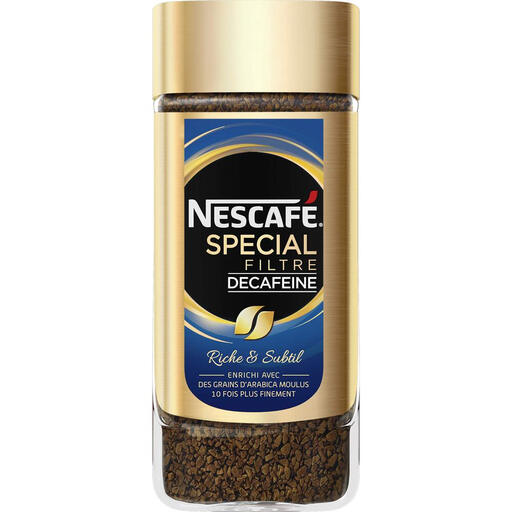 Image unavailable
If you want to make it without a machine, check that the product listing confirms it’s instant coffee. The stated pack size is 100 g; ‘decaffeinated’ doesn’t mean it’s completely caffeine-free.
No. ‘Decaffeinated’ doesn’t guarantee that the coffee is completely caffeine-free. If you need to avoid caffeine altogether for medical reasons, ask a healthcare professional for advice rather than relying on this label alone.
A jar is a good choice if you make coffee regularly and want to measure it out yourself; sticks make individual portions and taking coffee with you easier. Check the total weight, number of portions and storage instructions for the product you choose.
Follow the product instructions, as the recommended amount can vary. For its Spécial Filtre Décaféiné, NESCAFÉ recommends one teaspoon of coffee for every 100 ml of hot water.