
Livraison le jour même ou le lendemain

Qualité garantie

Débloquez vos offres de bienvenue: Livraison GRATUITE | Jusqu'à -80 % | 30 jours d'essai gratuits à JoyPlus
Téléchargez l'application
So, you've made the switch to an electric vehicle. The next, equally crucial step is finding the perfect home EV charging solution. Between a wall-mounted charger (wallbox), a portable EV charger, different power levels, and smart features, it's easy to feel overwhelmed.
This guide is here to help. As the Head of the Equipment section at Joybuy, I'm breaking down the best options on the market, designed for today's drivers. The goal: to help you make a choice that truly fits your daily life.
Before diving into our selection, let's review the key criteria that will guide your decision.
The charger's power output directly determines the charging speed. It must be compatible with your home's electrical system, as well as your vehicle's onboard charging capacity.
11kW charging station or even a 22kW wallbox, drastically reducing charging times for compatible vehicles. If your car and home support it, a three-phase charger is a worthwhile investment.Here, the choice depends entirely on your lifestyle and living situation.
portable EV charger?: This is the ultimate in flexibility. It plugs into a standard domestic socket (Schuko) or a reinforced/industrial socket (P17/CEE type). It's perfect for renters, for a second home, or simply as a reliable backup solution to keep in your trunk.A smart charging station that can be controlled via a mobile app offers real day-to-day advantages. A smart Wi-Fi charger allows you to:
Here are three products that cater to various needs and budgets, all compatible with the European standard Type 2 charging cable.
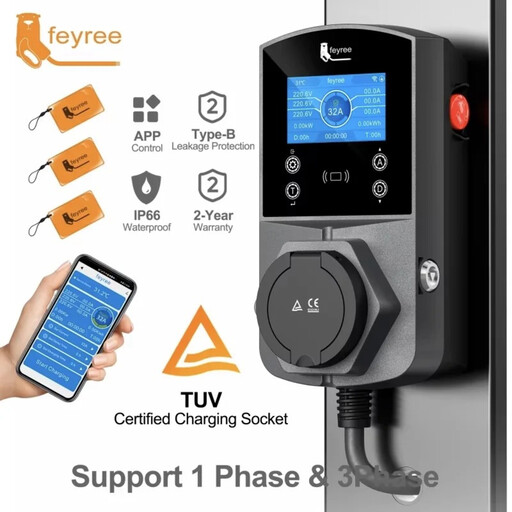
Why it stands out?: This wall-mounted charger combines impressive power with comprehensive smart management, all housed in a secure and robust unit. Its socketed version (as opposed to tethered) gives you the freedom to use any compatible cable.
Advantages:
Who is it for? For homeowners with a three-phase setup who want a fixed, powerful, and durable home charging solution with all the benefits of a smart charging station.
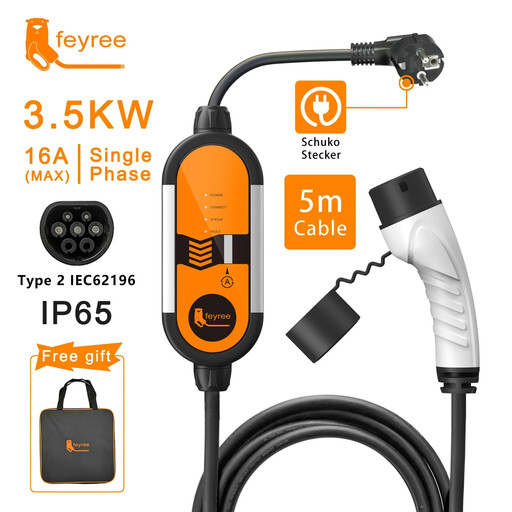
Why it stands out?: This is the quintessential portable EV charger. Simple, efficient, and installation-free, it plugs into any standard domestic socket (Schuko).
Advantages:
Who is it for? For drivers who prefer a slow overnight charge, renters who cannot install a fixed wallbox, or as a reliable backup charger for weekends and holidays.
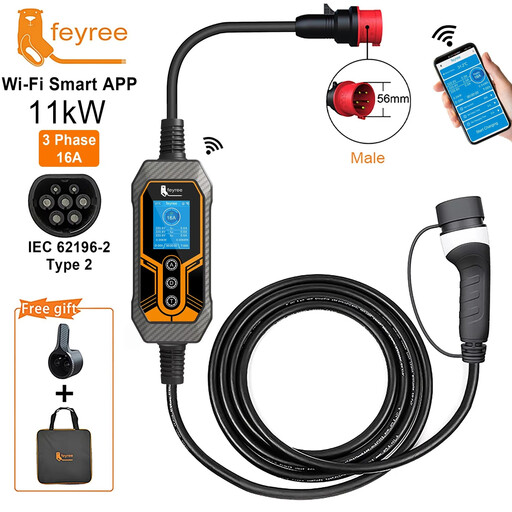
Why it stands out?: This model successfully combines the flexibility of a portable charger, the power of an 11kW charging station, and the intelligence of a smart Wi-Fi charger.
Advantages:
Who is it for? For those who have access to a three-phase CEE socket (in a workshop, modern garage, etc.) and want the speed of a wallbox without the fixed installation.
This selection covers the most common use cases, but your situation might be different. To explore other power levels, designs, or features, feel free to browse our full catalogue.
? Discover Our Full Range of Charging Solutions
1. What charger power level should I choose for my home? It depends on three things: your electrical setup (single- or three-phase), the maximum power your car can accept (its onboard charger), and your daily driving needs (mileage).
11kW charging station or a 22?kW three-phase charger is the premium option.2. Do I need to hire an electrician?
3. What is a Type 2 charging cable? The Type 2 charging cable (also known as a Mennekes connector) is the European standard for alternating current (AC) charging. Nearly all electric and plug-in hybrid vehicles sold in Europe are equipped with this connector. It's the one you will use at home, at the office, and at most public charging stations.