
Livraison le jour même ou le lendemain

Qualité garantie

Débloquez vos offres de bienvenue: Livraison GRATUITE | Jusqu'à -80 % | 30 jours d'essai gratuits à JoyPlus
Téléchargez l'application
Switching to an electric car is a major step, but home charging can quickly become a real headache. Between the endless charging times on a standard socket, the unpredictable availability of public stations, and the technical jargon (kW, Type 2, load balancing…), it's easy to feel overwhelmed. Our goal?? To help you find a reliable solution that's perfectly suited to your needs, so you can charge your vehicle at home with peace of mind and efficiency.
As the Head of Product Recommendations at Joybuy, my role is to help you make sense of it all. This article breaks down the available options and presents a selection of products that meet real-world needs, without the marketing fluff.
Before diving into our selection, it's essential to understand a few key technical criteria that will shape your day-to-day experience.
The charger's power, measured in kilowatts (kW), determines how fast your car "fills up."
wallbox 7kw (or 7.4 kW)?: This is the most common solution for home electric car charging. It runs on a single-phase electrical system, which is what the vast majority of homes are equipped with. It allows you to add about 40 to 50 km of range per hour of charging, enough to get a full battery overnight.wallbox 22kw?: Three times more powerful, it requires a three-phase electrical system, which is less common in residential settings. It's only worthwhile if your home is already equipped with it and if your vehicle can accept such a high power level for AC charging.A crucial point?: the charging speed will always be limited by the weakest link in the chain, whether it's the charger, the cable, or your car's onboard charger.
This choice depends entirely on your situation?: homeowner or renter, whether you stay put or are always on the go.
portable electric car charger?: This plugs into a simple domestic socket or a heavy-duty outlet, with no complex installation. While less powerful, it's an ideal backup solution for renters, as a secondary charger, or for charging your vehicle on holiday or at a friend's house.Modern chargers are much more than just power outlets?: they are true energy assistants.
smart EV charger?: Connected to your Wi-Fi, it can be controlled from a mobile app. The result?: the ability to start or stop charging remotely, schedule it during off-peak hours to save money, and track your consumption in real time.charger with dynamic load balancing?: This is arguably the smartest feature. The charger constantly measures your home's total power consumption and adjusts the charging power accordingly. Turning on the oven and the washing machine?? It throttles back to prevent tripping the breaker. A true peace of mind feature.Here are three solutions tailored for specific needs, all compatible with the Type 2 connector, the undisputed standard in Europe.
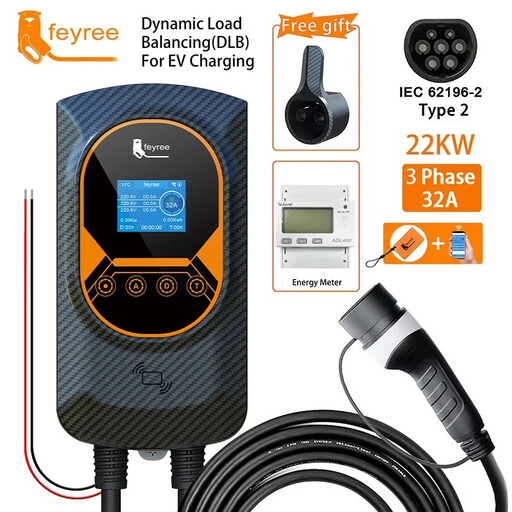
Its key advantage
This charger stands out for its Dynamic Load Balancing (DLB) feature. It's designed for those who want maximum performance without straining their electrical system. It modulates power in real time for an always-optimal charge, without ever exceeding your meter's capacity.
The highlights
Who is it for??
For homeowners with a three-phase supply whose vehicle can handle a fast AC charge. It's the no-compromise performance choice, ideal for high-mileage drivers who want absolute peace of mind.

Its key advantage
This model strikes the perfect balance between performance, intelligence, and simplicity for the majority of users. Its 7.6 kW power is ideal for single-phase installations. Its large 4.3-inch LCD screen is a real bonus?: a single glance is all it takes to know everything about the current charging session, while its Wi-Fi connectivity allows for precise control from your smartphone.
The highlights
Who is it for??
This is the sensible choice for the vast majority of EV drivers. It checks all the boxes?: a power level suited for overnight charging, smart connectivity to manage your energy consumption, and simple installation on a single-phase network.
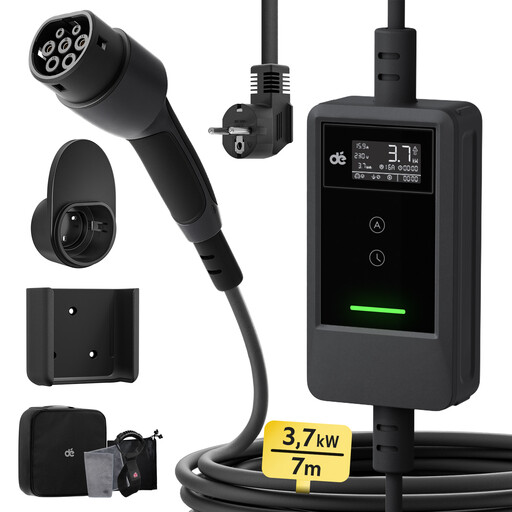
Its key advantage
Simplicity and versatility are the keywords for this portable charger. This portable electric car charger plugs into a standard household socket with zero installation. Its real bonus?? The adjustable charging current (from 6A to 16A), which allows you to use it safely even with older electrical wiring by simply selecting a lower amperage.
The highlights
Who is it for??
A must-have for renters who can't install a wallbox, as an emergency solution to keep in the trunk, or for plug-in hybrid (PHEV) owners whose small battery doesn't justify the investment in a full wallbox.
Our selection covers the most common needs, but the EV charger market is brimming with options. If you want to explore other models with different cable lengths or specific features, feel free to browse our full catalogue.
? Explore all our Type 2 Wallboxes
1. Do I need an electrician to install an EV charger?? For a wall-mounted charger (7 kW or 22 kW wallbox), hiring a qualified electrician—ideally one certified for EV charging infrastructure installation—is not just mandatory, but essential to ensure the safety and compliance of your setup. For a portable charger, no installation is required. However, if you plan to regularly use the maximum current (16A), having the socket checked by a professional is a worthwhile precaution.
2. What's the difference between a Type 2 connector and a domestic socket?? A standard domestic socket (Type E/F) is limited in power (typically 2.3 kW) and is simply not designed to withstand hours of charging at full power. The Type 2 connector is the European standard for AC charging. Specifically designed for this purpose, it allows for much higher power and includes safety and communication protocols between the charger and the car.