
Same-day & Next-day Delivery

Quality Guaranteed

Unlock Your Welcome Offers: FREE Delivery | Up to 80% OFF | Free 30-day JoyPlus trial
Download the APP
Making the switch to an electric vehicle is an excellent initiative, but choosing a home charging solution often turns into a headache. Faced with a jungle of technical specs and marketing claims, it's easy to feel overwhelmed. Our mission: to help you see clearly and identify the criteria that truly matter for a smart, secure purchase.
Before you dive in, watch out for these three common and potentially costly pitfalls:
To make an informed decision, it's crucial to focus on the parameters that truly count.
Navigating spec sheets can be intimidating. Let's focus on three fundamental points that will determine the performance and safety of your future charging station.
This is the number one criterion. Power, expressed in kilowatts (kW), defines the charging speed.
Pro Tip: Check the maximum AC charging power accepted by your car's onboard charger. This value dictates the charger power you actually need.
A modern charger is more than just an outlet. Smart features deliver convenience, safety, and savings.
In Europe, nearly all new vehicles use the same standard.
To move from theory to practice, our editorial team has selected models that check all the boxes for performance, safety, and value for money.
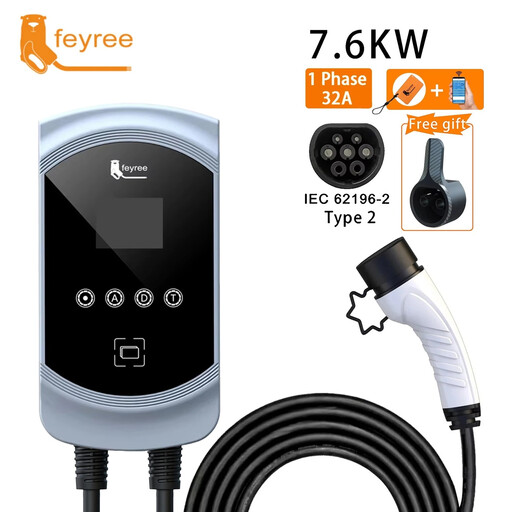
The Editor's Pick: This is the ideal solution for the majority of homes with single-phase power. Its 7.6 kW output is perfectly suited for overnight charging of the most common electric and plug-in hybrid vehicles, without requiring a major upgrade to your electricity plan.
This model prevents you from overpaying for a three-phase unit if your installation isn't compatible. It safely and simply maximises the potential of your single-phase line.
Wi-Fi connectivity via the Tuya app for scheduling off-peak charging and tracking consumption. Adjustable current to adapt to more limited circuits.
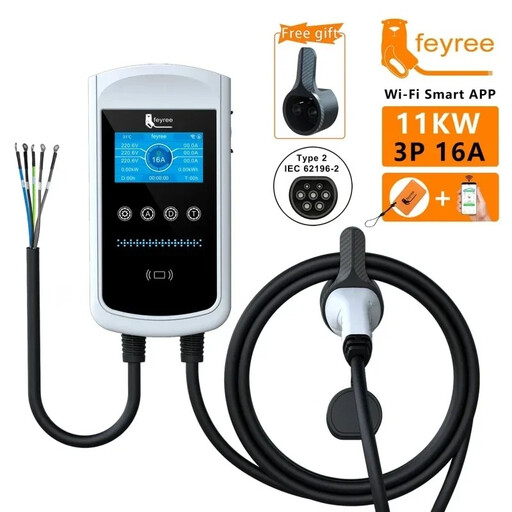
The Editor's Pick: For those with a three-phase supply, this 11 kW charger represents the sweet spot. It offers a significantly faster charging speed than a 7 kW unit, which is a great benefit for vehicles with large batteries, without demanding the power (and subscription cost) of a 22 kW model.
It delivers relevant power for modern three-phase installations and recent vehicles, avoiding both the slowness of single-phase and the excessive investment in an often underutilised 22 kW model.
Large 4.3-inch screen for clear monitoring of charging data. Smart app control for scheduling and managing charging history.
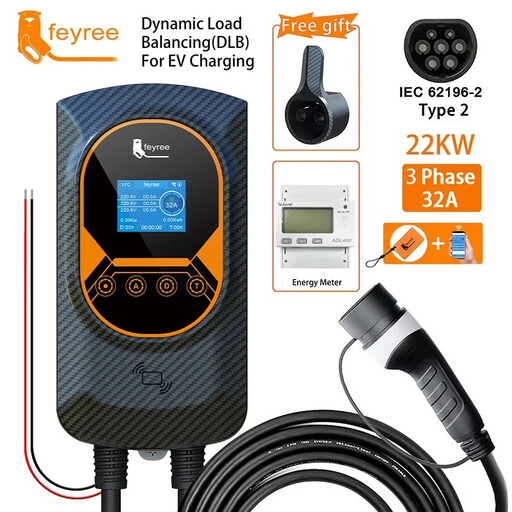
The Editor's Pick: This charger is designed for demanding users whose homes have high electricity consumption. If you have a heat pump, a heated pool, or other major appliances, the dynamic load balancing feature is essential for charging your vehicle at the fastest possible speed without ever risking an overload.
It directly solves the problem of nuisance trips. Instead of manually limiting your charger or worrying about using your appliances, the system manages power autonomously and seamlessly.
The dynamic load balancing (DLB) feature provides complete peace of mind. Maximum power of 22 kW for compatible vehicles and installations.
We've compiled a complete, up-to-date list of products that meet these strict selection criteria and current safety regulations.
Yes, the installation of a charging station, regardless of its power, must be carried out by a qualified electrician (certification for EV charger installation is recommended). This ensures the installation complies with safety standards (like the NF C 15-100 in France), that the dedicated circuit is correctly sized, and that the RCD protection is adequate. A non-compliant installation can not only be dangerous but may also void the warranty on your charger and your vehicle.
No. The charging speed will be limited by the weakest link, which in this case is your car's onboard charger (7.4?kW). The 11?kW station cannot deliver more power than the vehicle can accept. However, installing an 11?kW charger on a three-phase system can be a good future-proofing strategy if you plan to upgrade to a vehicle that accepts a higher charging power.
Home charging is significantly more economical. The cost depends on your electricity contract (base rate, peak/off-peak hours), but it generally falls between €2 and €4 per 100?km. At public stations, especially fast chargers on highways, rates are much higher and can range from €10 to €20 per 100?km, depending on the operator and the station's power. Investing in a home EV charging station therefore quickly pays for itself through the savings on each charge.