If worktop width and quick preparation are your priorities, start by looking at capsule machines, then check which format they accept and the cost of the consumables. A slim portafilter machine could suit you if you don’t mind a few extra steps; a bean-to-cup machine is better suited to frequent use with whole beans, provided you have more room for the machine and its upkeep. In every case, measure the space you’ll need to fill the water tank and remove any detachable parts.
Who are these machines for?
You’re short on worktop width
You want to keep your machine on a narrow worktop and make coffee without any complicated steps. A capsule machine is worth considering: the Essenza Mini listed by Nespresso France is 8.4 cm wide, but only works with Nespresso Original capsules.
You drink coffee every day
You’re happy to set aside more space and look after the machine so you can choose your own beans. A bean-to-cup machine could be a good fit: UFC-Que Choisir highlights its potential to reduce the cost per cup, while noting that this type of machine requires a higher initial outlay.
You prefer ground coffee
You want a slim machine without switching to a capsule system, and don’t mind measuring out the coffee and cleaning the portafilter. The Dedica Style EC685, listed by De’Longhi as 15 cm wide, is one example; remember to allow for its depth of around 33 cm too.
How do the four systems compare?
On a small worktop, the coffee system affects both your daily routine and how much room you’ll need around the machine. The dimensions below are for the specific models mentioned, not the entire range.
Capsules
Worth considering: if you prioritise quick preparation and a narrow machine; the Essenza Mini listed by Nespresso France is 8.4 cm wide.
Bear in mind: you’ll need the capsule format designed for that model. This example has a 0.6 L water tank, so you may need to refill it depending on how much coffee you drink.
Soft pods
Worth considering: if you want a simple way to make coffee with soft pods; the SENSEO Original Plus CSA210/25 listed by Philips can make one or two cups.
Bear in mind: this example measures 213 × 315 × 330 mm and uses SENSEO pods, which are different from rigid capsules and ESE pods.
Portafilter
Worth considering: if you want to use ground coffee while keeping your machine slim, like the De’Longhi Dedica Style EC685.
Bear in mind: you’ll need to handle and clean the portafilter after use. A narrow machine can still be deep, so check its depth too.
Bean-to-cup
Worth considering: if you drink coffee regularly and want to choose your own beans without grinding each dose by hand.
Bear in mind: it takes up more room and needs more upkeep; the Philips Series 2200 EP2224/10 listed here measures 246 × 371 × 433 mm.
| Criteria |
What to check |
What matters to consumers |
| Usable space |
Measure the width, depth and height, then check the instructions to see how much room you need to fill the water tank and remove the trays. |
If the machine stays in place, I want to be able to use the worktop and reach its detachable parts. Around 33% of consumers make usable space their top priority. |
| Everyday preparation |
Compare the steps involved in making each drink and check which coffee formats the machine accepts. |
Between tasks at home, I’d rather make a cup without measuring or tamping the coffee. Simplicity comes before other criteria for around 27% of consumers. |
| Running costs and coffee choice |
Check exactly which consumables are compatible, how readily available they are and the cost of each drink you plan to make. |
As I drink coffee often, I want to keep ongoing costs under control without buying into a format that limits my choice. This is the top priority for around 20% of consumers. |
| Beans and settings |
Look at the settings available and how much room you’ll need to add beans and maintain the machine. |
I want to choose my own beans and adjust how my coffee is made, even if the machine takes up more space. Around 20% of consumers put this option first. |
Mistakes to avoid
-
Only looking at the width
A slim machine can still be deep or tall: De’Longhi lists the Dedica Style EC685 as around 33 cm deep, while the Philips Series 2200 EP2224/10 is 43.3 cm tall.
Measure the space in all three dimensions and check the instructions for the exact model to see how much room you’ll need to fill the water tank and remove parts for maintenance.
-
Assuming capsules and pods are interchangeable
Formats vary by machine: Nespresso France states that the Essenza Mini only accepts Nespresso Original capsules. SENSEO pods and ESE pods belong to different systems.
Check the exact compatible format before choosing your machine and the coffee you plan to use.
-
Forgetting the ongoing cost of coffee
How much coffee you drink can change the balance between a capsule machine and a bean-to-cup machine. UFC-Que Choisir says that a bean-to-cup machine can have a lower cost per cup than a pod espresso machine, although it requires a higher initial outlay.
Compare the drinks you’ll actually make, the consumables they require and the maintenance involved over the period you expect to use the machine.
-
Confusing automatic preparation with no maintenance
A bean-to-cup machine saves you grinding and measuring each cup by hand, but you’ll still need to refill the bean hopper and empty the coffee grounds container, among other tasks.
Check the instructions for rinsing, descaling and cleaning any milk system parts, then make sure you can reach them once the machine is in place.
Brands to know
Nespresso
The Original range includes capsule machines, with the slim Essenza Mini as one example.
- Nespresso France lists the Essenza Mini as measuring 8.4 × 33 × 20.4 cm, with a 0.6 L water tank and two drink sizes.
- This machine only accepts Nespresso Original capsules, so check the system before buying your coffee.
SENSEO
The Original Plus range uses soft pods for a simple way to make coffee.
- Philips says the Original Plus CSA210/25 can make one or two cups and has a 0.7 L water tank.
- Its listed dimensions are 213 × 315 × 330 mm. SENSEO pods are different from rigid capsules and ESE pods.
De’Longhi
The Dedica Style EC685 is a manual portafilter machine for those who don’t mind preparing ground coffee.
- De’Longhi lists the Dedica Style EC685 as 15 cm wide and compatible with ground coffee and ESE pods.
- Allow for a depth of around 33 cm too, as well as enough room to handle and clean the portafilter.
Philips
The brand offers SENSEO pod machines and Series 2200 bean-to-cup machines, which are designed for different needs.
- Philips lists 12 grind settings for its Series 2200 EP2224/10 bean-to-cup machine.
- This model measures 246 × 371 × 433 mm; check that you have enough room and can reach the parts that need maintenance.
Machines for different needs
These Joybuy models let you compare capsule, portafilter and bean-to-cup machines for a limited preparation area. Check their coffee systems and the space needed to use them before choosing a model.
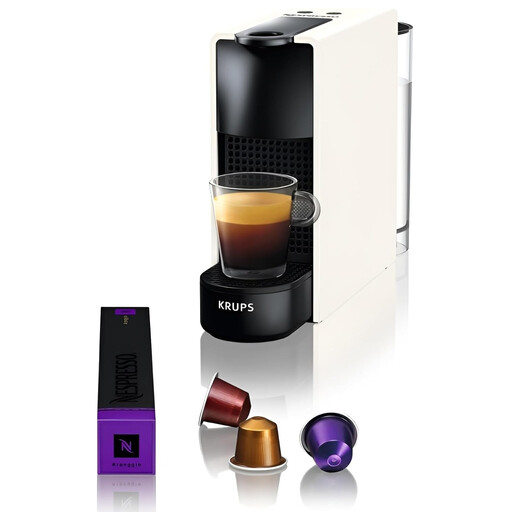 Image unavailable
White KRUPS Nespresso Essenza Mini, 0.6 L
Worth considering if you want to make coffee with capsules on a narrow worktop. This white version is listed with a 0.6 L water tank and 1,200 W of power; check which capsule format it accepts and how much room you’ll need to fill the tank.
View on Joybuy
 Image unavailable
HiBREW H10B, 20-bar semi-automatic espresso machine
Worth looking at if you prefer to make espresso with a portafilter and adjust the temperature. The model name specifies a pressure of 20 bars; allow for the preparation steps and check the instructions to see how much room you’ll need to fill and maintain the machine.
View on Joybuy
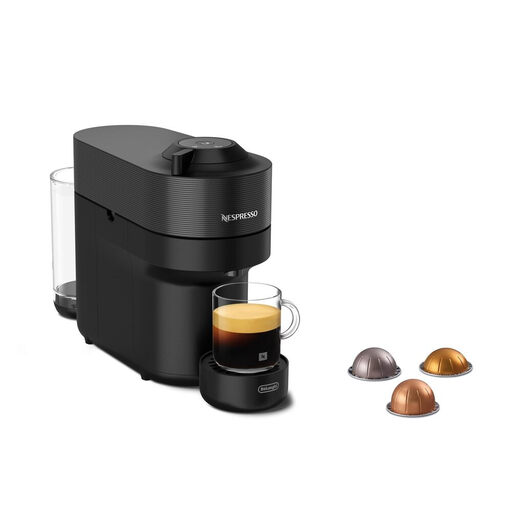 Image unavailable
Black Nespresso Vertuo Pop ENV90.B, 0.6 L
Worth considering if you want to make coffee and espresso with Vertuo capsules. The listed water tank capacity is 0.6 L; don’t confuse Vertuo capsules with those from another system, and check the available height in your chosen spot.
View on Joybuy
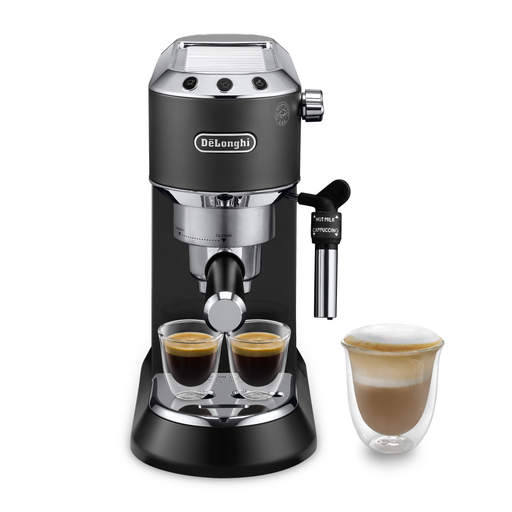 Image unavailable
Black De’Longhi Dedica Style EC685.BK
Worth looking at if you want to make coffee with a portafilter in a slim machine. Allow enough room to handle and clean the portafilter, and check the depth and access to the water tank in your chosen spot.
View on Joybuy
 Image unavailable
Philips Series 2200 EP2230/10 LatteGo
Worth considering if you want a machine with a grinder for using whole-bean coffee and have room to maintain it. Check the dimensions of this EP2230/10 version, access to the water tank and coffee grounds container, and how to clean the LatteGo system.
View on Joybuy
Frequently asked questions
Can I use any capsule or pod in a compact machine?
No: compatibility depends on the system and model. Nespresso France limits the Essenza Mini to Nespresso Original capsules, while the SENSEO Original Plus CSA210/25 uses SENSEO pods. Check the exact product reference before buying: rigid capsules, soft pods and ESE pods aren’t interchangeable.
How can I tell if the machine will fit under a wall cupboard?
Measure the space, then check the instructions for the model to see how to fill or remove the water tank and take out the trays. The height of the machine when closed isn’t enough to tell you whether you’ll be able to do these things once it’s in place.
Is a bean-to-cup machine always cheaper to run?
Not necessarily for the amount of coffee you drink. UFC-Que Choisir says a bean-to-cup machine can offer a cost per cup two to three times lower than pod espresso, but it requires a higher initial outlay. Compare how often you’ll use it, the coffee you plan to make and the maintenance involved before choosing.


