Everyday coffee with minimal effort
If you want to go from craving a coffee to enjoying your cup quickly, consider capsule and pod machines. Make sure the format they use and their choice of short or long coffees suit your habits.


If you regularly make short or long coffees at home, start by choosing between pre-portioned pods, a portafilter you control yourself, and an automatic bean-to-cup machine. Capsules and pods mean fewer steps; a portafilter involves more hands-on preparation, while a grinder makes it easier to brew from beans but needs space and regular maintenance. If several people have coffee one after another, also check the capacities and whether the machine pauses between drinks.
If you want to go from craving a coffee to enjoying your cup quickly, consider capsule and pod machines. Make sure the format they use and their choice of short or long coffees suit your habits.
If you’d like to choose your own beans without measuring and tamping each shot, an automatic bean-to-cup machine is worth considering. You’ll also need to make room for it and empty its containers and clean it regularly.
If you enjoy measuring, adjusting the extraction and frothing milk as part of making coffee, a home espresso machine with a built-in grinder could be a good fit. This hands-on approach involves more preparation and cleaning than using pre-portioned coffee.
When choosing a system, start with the steps you’re happy to take for each cup, then compare its capacity and maintenance needs with how much coffee you drink.
Consider this if: you want a short or long coffee without measuring it by hand.
Bear in mind: your choice of drinks depends on the compatible capsule system; rinsing and descaling are still necessary.
Consider this if: you want coffee that’s simple to prepare, especially when two people want a cup at the same time.
Bear in mind: the ability to make two cups and the drinks available vary by model.
Consider this if: you want to control the dose, extraction and milk yourself.
Bear in mind: each coffee takes extra steps, as does cleaning the portafilter and steam wand afterwards.
Consider this if: you often make coffee from beans but don’t want to handle a portafilter for every cup.
Bear in mind: you’ll need space for the machine, and you’ll have to refill it and clean its various parts.
| Criteria | What to check | What matters to you |
|---|---|---|
| Speed and simplicity | The coffee format the machine accepts and the steps needed to make a short or long coffee. | I want to make my daily cup without measuring or tamping the coffee. Around 31% of consumers who prioritise a single factor put this simplicity first. |
| Coffee choice and restocking | Whether the machine is compatible with your chosen capsules or pods, or lets you use the beans you prefer. | I make coffee often and want to choose what goes into the machine, without being tied to a format that doesn’t suit me. This flexibility comes first for around 31% of consumers. |
| Capacity and footprint | The water tank, containers and dimensions, allowing room to open the lids. | When I make several coffees in a row at home, I want to refill less often without taking up too much worktop space. Around 23% of consumers put this balance between capacity and space first. |
| Settings and milk-based drinks | The available settings, the milk functions on the exact model, and how to clean them. | I’m happy to spend more time adjusting my coffee or frothing milk. Around 15% of consumers put this level of control first. |
A capsule or pod machine requires a compatible format, while a grinder uses coffee beans. This choice affects every cup you make.
Check the exact format accepted by the model you’re considering, and make sure the coffees available suit the drinks you regularly prepare.
The water capacity alone won’t tell you when you’ll need to empty a container, add coffee or run a rinse cycle between cups.
If your household makes several coffees one after another, compare the different containers, the cycles listed in the manual and whether the machine can make two cups at once.
A manual steam wand and an automatic milk programme involve different steps. Their presence alone doesn’t tell you how easy a particular model is to use or maintain.
Check the manual for the exact model to find out how to clean it after making a milk-based drink and which parts can be removed.
Cleaning the wand or milk system takes extra time after use.
Two machines in the same range may have different tanks, accessories or drinks programmes.
Before ordering, check the full model number on the product listing against the dimensions, functions and consumables you need.
Two capsule machine systems to know about: Original, for formats including ristretto and espresso, and Vertuo, which Nespresso says supports a range of cup sizes up to a Mug.
A range of soft pod machines designed to make coffee simply at home.
A range of home bean-to-cup machines, with drinks and milk functions that vary by model.
Home portafilter machines for people who want to control the grind, extraction and milk themselves.
These models show two ways to make coffee regularly at home: save time with capsules or use beans in an automatic bean-to-cup machine. You can also compare soft pods and portafilter machines using the criteria above.
 Image unavailable
Worth considering if you regularly want to make coffee from beans and use the LatteGo function. Check the drinks available and the cleaning steps for this model before choosing.
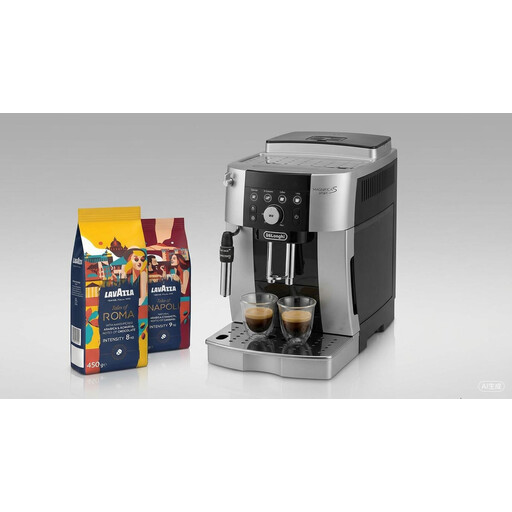 Image unavailable
Worth a look if you want an automatic machine with a grinder and a bundle that includes Lavazza coffee. Confirm exactly what’s included before ordering; making milk-based drinks also means cleaning the steam wand.
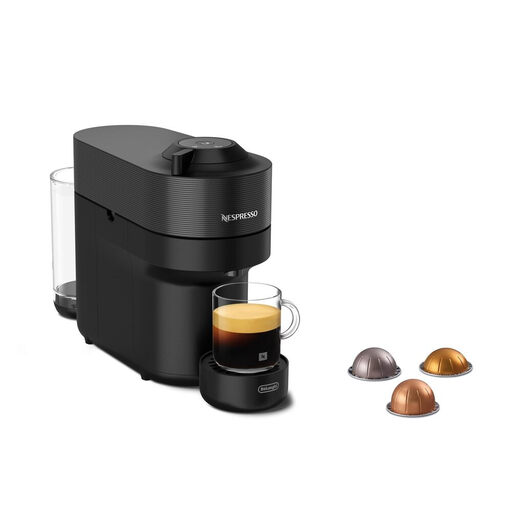 Image unavailable
Worth considering if you prefer making coffee with Vertuo capsules. Its stated 0.6 L tank capacity is worth bearing in mind if you make several coffees in a row; check that your chosen capsules are compatible.
 Image unavailable
Worth a look if you want a capsule machine for making espresso or lungo in a small space. This Essenza Mini uses the Nespresso Original system, so check the format before choosing your capsules.
 Image unavailable
Worth considering if you regularly make coffee from beans and want to spend less time preparing it by hand. De’Longhi France lists a 1.8 L tank and a grounds container holding 14 coffee pucks for this model. Still, measure the space available and allow time to clean the steam wand and descale the machine.
Start with the coffee format you’re happy to use for every cup: capsules and pods are pre-portioned, while an automatic bean-to-cup machine lets you choose your own beans. Then check compatibility, the drinks available and the maintenance required for the specific machine.
Clean the parts that collect water, coffee grounds or capsules, and descale the machine following the manufacturer’s instructions. For a grinder, check how easy it is to access the grounds container and the brewing unit, if removable. For milk-based drinks, check what you need to clean after each use of the wand or milk system.
Compare the tank, containers, rinse cycles between drinks and the number of cups you can make at once, rather than relying on the heating time alone. Que Choisir’s bean-to-cup machine testing, for example, measures how consistent the volume is across consecutive cups. Check the manual for the model you’re considering, too, to find out when it needs to pause.
For goods sold by a professional in France, the legal guarantee of conformity applies to new, second-hand and refurbished goods, as the DGCCRF explains. Check who the seller is and keep the description of the model you ordered; any commercial warranty does not replace this legal protection.