If your household enjoys a mix of short and long coffees, and the occasional milky drink, start by considering how much preparation everyone is happy to do. Capsules or pods offer pre-measured portions, a portafilter lets you use ground coffee, and a bean-to-cup machine prepares drinks from whole beans. Next, check the drinks available, the milk system, capacity and cleaning requirements of the model you’re considering. Noise and the space it takes up are particularly important if you’re thinking about a bean-to-cup machine.
Which households are these machines suited to?
A household that wants coffee without fiddling with settings
If several people use the machine, capsules and pods keep the steps involved in making each drink to a minimum. However, check that the format it accepts and the drinks it offers suit everyone’s preferences.
A household that enjoys different coffees and sometimes makes milk-based drinks
A bean-to-cup machine with the settings and recipes you’re looking for could be a good fit if you want to use whole beans without preparing every cup manually. You’ll also need to be happy with the space it takes up and the care needed for its milk system.
A household that wants to choose its ground coffee or beans
A portafilter machine lets you use ground coffee and have more hands-on control over preparation. A bean-to-cup machine offers another way to use whole beans: the right choice mainly depends on how much automation you want.
How do the four systems compare?
Capsules
Worth considering: if your household prefers a ready-to-use portion and minimal steps for each cup.
Bear in mind: your choice of coffee depends on the format compatible with the machine, and used capsules need to be sorted appropriately.
Soft coffee pods
Worth considering: for pre-measured portions of mostly longer coffees, with two cups at a time on models that allow it.
Bear in mind: drinks and features vary by machine, and it will still need regular care.
Portafilter
Worth considering: if you want to use ground coffee and take a more hands-on approach to preparation.
Bear in mind: the portafilter needs emptying after use. For milk-based drinks, check what kind of system the model uses.
Bean-to-cup
Worth considering: if several people want to customise their coffee using whole beans, with recipes to suit them on the model you choose.
Bear in mind: Que Choisir highlights the space these machines take up and the noise of grinding. Rinsing and, where relevant, cleaning the milk system add to the regular care required.
If everyone in your household has different preferences, start with the drinks they want to make, then consider the preparation and cleaning tasks everyone will be happy to take on.
| Criteria |
What to check |
Who this matters to |
| Simplicity and speed |
How many controls you need to use for each cup; how often the water tank needs refilling when several people use the machine. |
When everyone makes their coffee at a different time, I want a cup without having to adjust the settings again. Around 36% of consumers put ease of use first. |
| Choice of drinks |
The exact range of short and long coffees; the type of milk system and the recipes that are actually programmed in. |
If some people prefer espresso and others a milky drink, I want to know what I’ll need to do for each recipe. Around 29% of consumers put variety ahead of other criteria. |
| Freedom to choose your coffee |
Which capsule or pod formats the machine accepts, or whether you can use your preferred ground coffee or whole beans. |
I’d prefer to be able to change my coffee without relying on a format that doesn’t suit my preferences. This is the main priority for around 21% of consumers. |
| Care, noise and space |
Cleaning and descaling steps; the machine’s dimensions and noise test results, particularly for grinding and rinsing. |
In an open-plan kitchen or a home where people use the machine at different times, I want noise and maintenance to be manageable day to day. Around 14% of consumers put these practical considerations first. |
Things to bear in mind
-
Assuming all milk systems work the same way
A steam wand, a milk frother and an automatic programme each involve different preparation and cleaning steps.
Check the system on the model you’re considering, the rinsing steps required after use and which recipes are genuinely automatic.
-
Putting off maintenance
Drip trays, the water circuit and, depending on the model, the milk system all need different types of care. De’Longhi says that how often its bean-to-cup machines need descaling depends, among other things, on water hardness.
Read the model’s instructions before choosing, and make sure everyone in your household will be able to follow the maintenance steps.
-
Assuming all capsules are sorted in the same way
ADEME advises that aluminium or plastic capsules should be sorted with packaging waste. You’ll also need to follow your local guidelines and check what applies to the format you use.
Check your local council’s guidance and, if you plan to use a dedicated collection scheme, find out how it accepts your capsules.
Brands worth knowing
Philips / SENSEO®
Philips offers SENSEO® pod machines as well as bean-to-cup models: these are two different ways of making coffee, so compare them separately.
- According to Philips, the SENSEO® Original Plus CSA210/50 can make two cups at once. Check the features of the specific model you’re interested in.
- The pod format, drinks available and care requirements depend on the model.
De’Longhi
The brand offers bean-to-cup machines and traditional coffee machines, giving you two options if you’re weighing up automation against a portafilter.
- Its instructions cover care for bean-to-cup machines separately from care for traditional machines.
- De’Longhi says that how often a bean-to-cup machine needs descaling depends, among other things, on water hardness. Follow the instructions for the model you choose.
Nespresso
Nespresso is worth considering if you prefer making coffee with pre-measured capsules.
- Nespresso offers collection schemes for its used capsules in France.
- Check which capsules are compatible with the machine and find a local sorting or collection option that works for you.
Machines to consider on Joybuy
These models let you explore three of the options covered in this article: bean-to-cup, portafilter and capsule machines. Compare their features with the type of coffee you enjoy and the care your household is happy to take on.
 Image unavailable
Philips Series 2200 EP2230/10 LatteGo
Worth considering if your household wants to make different coffees from whole beans and use a milk system. This model combines a grinder with the LatteGo range. Check which recipes it offers and what cleaning is needed after making milk-based drinks.
If noise is a concern, look for a test that covers grinding and preparation.
View on Joybuy
 Image unavailable
HiBREW H16 with grinder and milk system
Worth considering if several people want a choice of drinks without preparing each cup with a portafilter. The product description lists a grinder, a milk system and six types of coffee. Check that this range includes the short and long coffees, as well as the milk-based drinks you want.
Also check what’s involved in cleaning the milk system.
View on Joybuy
 Image unavailable
HiBREW H13A semi-automatic, 3-in-1
Worth considering if you want to use ground coffee and keep some control over the preparation, with the option to froth milk. The product description lists 20 bar pressure and a frothing function. Check which drinks the available settings are designed for.
Remember to check how to clean the portafilter and milk system.
View on Joybuy
 Image unavailable
De’Longhi Magnifica S ECAM22.140.B
Worth considering if your household wants a machine with a grinder and is happy to check separately how it makes milk-based drinks. This model is described as an automatic machine with a grinder. Check its milk system and what’s involved in using it before you decide.
If noise matters in your kitchen, look for a test that covers grinding and preparation.
View on Joybuy
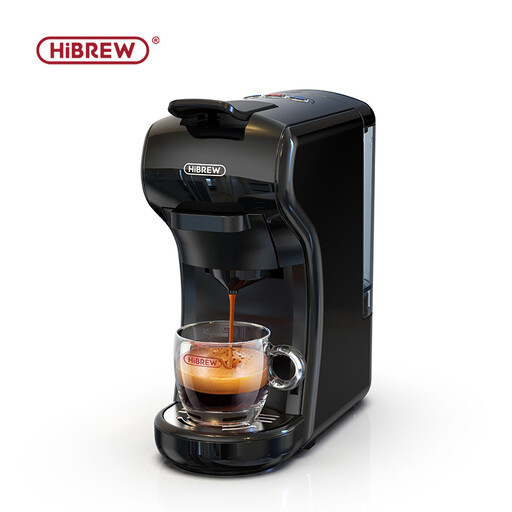 Image unavailable
HiBREW H1A multi-capsule, hot and cold
Worth considering if you want a capsule machine but would like to compare several coffee formats. The product description lists a 4-in-1 machine with 19 bar pressure. Check exactly which capsules, pods and adapters it accepts before choosing this model.
If milk-based drinks are a must, check with the seller which functions and accessories you’ll need.
View on Joybuy
Frequently asked questions
Do capsule, pod and bean-to-cup espresso machines need descaling?
Descaling is part of the regular care required for all these systems. Follow the instructions for your model. De’Longhi says that how often its bean-to-cup machines need descaling depends, among other things, on water hardness. Philips also recommends descaling its SENSEO® machines regularly.
Does every milk function need the same care?
No. A steam wand, a milk frother and an automatic programme all involve different steps. For the bean-to-cup machines it covers, Que Choisir recommends following the instructions for milk-based drinks and rinsing the steam wand after use. Check which parts need cleaning on the model you choose.
How can you compare the noise levels of two bean-to-cup machines?
Look for tests covering several stages of operation, rather than just the moment when coffee is poured. Que Choisir’s testing protocol considers noise, vibrations and stability during rinsing, grinding and preparation.
What should you do with used capsules and a machine at the end of its life?
ADEME says aluminium and plastic capsules should be sorted with packaging waste. Check the guidance for your local council area. For the machine, look into collection schemes for electrical and electronic equipment rather than putting it out with general waste.


