How do you compare the key criteria?
If you make espressos often and rarely or never have milk-based drinks, start with your priority: making cup after cup, cutting down on chores, keeping track of consumables or adjusting the preparation yourself. A bean-to-cup machine combines the grinder and brewing process, while a semi-automatic machine requires more input. Capsules and a separate grinder each bring their own routines.
| Criteria | What to check | Who it matters to |
|---|
| Speed and frequency of use |
Check how easy it is to access the water tank and trays, their capacities, and the instructions for emptying the machine you’re considering. |
When I’m making several espressos in a row, I don’t want to stop to refill the tank or empty a tray. Around 36% of consumers would prioritise this smoother routine. |
| Cleaning and waste |
Read the instructions to find out how to clean accessible parts, descale the machine and deal with coffee grounds or used capsules. |
If the steps after every cup feel like a chore, I want a cleaning routine I can realistically stick to. Around 29% of consumers are said to share this priority. |
| Consumables |
Compare beans and pods for the same number of espressos. Also check which filters and cleaning products the machine requires. |
If I make lots of cups every day, I want to know how much coffee or how many capsules my routine will use over time. Around 21% of consumers would put this first. |
| Adjustments and available space |
Check which settings are available, whether there’s a built-in grinder, and how much room you’ll need to use and open the appliances. |
I want to adjust how my coffee is prepared, but I also need to be able to fit and use the equipment at home. Adjustability and size would be the main priorities for around 14% of consumers. |
Brands to consider
There are no brand profiles to display in this section.
Bean-to-cup and semi-automatic machines on Joybuy
These machines offer two ways to make espressos regularly: a built-in grinder that combines the steps, or semi-automatic preparation that gives you more control. When choosing between them, also consider the steps and maintenance involved with each model.
 Image unavailable
Philips EP2230/10 Series 2200 LatteGo, gloss black
If you want to grind your beans as part of your espresso routine, check whether the controls and access to the trays suit how often you make coffee.
The LatteGo name identifies this variant, even if milk-based drinks aren’t a priority for you. Check the instructions for details of maintenance and the accessories supplied.
View on Joybuy
 Image unavailable
De’Longhi Magnifica Start ECAM220.21.WW, white
This bean-to-cup machine is worth considering if you want to combine grinding and making your espressos.
If you rarely use milk, check that its espresso routine and maintenance tasks suit your needs, regardless of the steam wand.
View on Joybuy
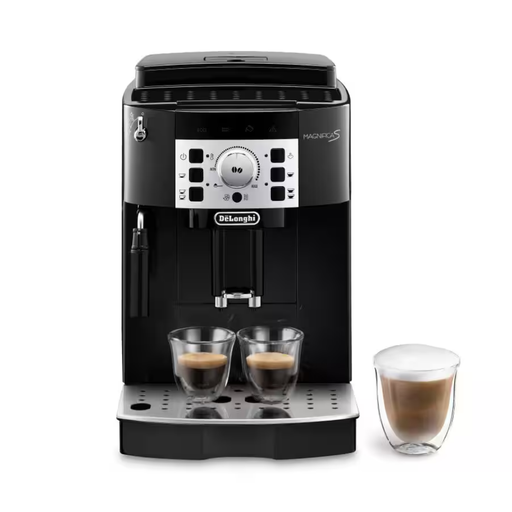 Image unavailable
De’Longhi Magnifica S ECAM22.140.B, black
Its built-in grinder is a good option if you want to make espressos without setting up a separate grinder.
Before deciding where to put it, check its dimensions, the space needed to access the parts that require maintenance, and the instructions.
View on Joybuy
 Image unavailable
HiBREW H10B, 20-bar semi-automatic espresso machine
Worth considering if you’re happy to take a more hands-on approach to adjusting your espresso.
The product name specifies 20 bar of pressure, but that alone isn’t enough to judge the result in the cup. If you use beans, check what you’ll need to grind them.
View on Joybuy
 Image unavailable
HiBREW H11, 1450 W, 19-bar semi-automatic espresso machine
If you’re happy to do more than you would with an automatic bean-to-cup machine, check that handling the coffee and cleaning the machine will suit your daily routine.
The product name specifies 1450 W and 19 bar. These figures don’t replace the need to check how the machine works, how much space you have and what the maintenance instructions say.
View on Joybuy
Frequently asked questions
Does a bean-to-cup machine mean you don’t have to clean it?
No. Automating the preparation doesn’t eliminate maintenance. For the relevant models, De’Longhi lists tasks such as cleaning the trays, water tank and brewing unit. How often you need to descale the machine depends, among other things, on water hardness. Follow the instructions for your chosen machine.
How do you compare beans and capsules for ten espressos a day?
Compare both options for the same number of cups, then check the consumables required for each machine. Ten espressos a day adds up to 3,650 cups over 365 days. At an illustrative dose of 7 g, taken from the lower end of the historical 7 to 9 g range described by the Specialty Coffee Association for a single espresso, you’d need 25.55 kg of beans. For capsules, allow for one compatible portion per cup if that’s how the system you’re considering works.
What needs cleaning on a capsule machine?
It depends on the system. For the machine in question, the Krups instructions say to remove the capsule and clean the capsule holder after use, then empty and clean the drip tray and used-capsule container daily. Check the instructions for the model you plan to use.
Where can you dispose of used capsules in France?
Check what the capsules are made of and follow your local council’s guidance before choosing a disposal route. Nespresso offers collection points for its capsules and also describes collection in the yellow bin, subject to local conditions. This doesn’t mean all capsules go in the same bin.
What should you do with a coffee machine that no longer works?
First, see whether it can be repaired. ADEME also lists donating, reselling and recycling as options for small electrical appliances, including coffee machines. For collection, follow the guidance in your area.


