If you often make espresso from beans and want to cut down on the steps needed for each cup, a bean-to-cup machine could suit you, provided you’re happy with the space it takes up, the noise and the upkeep. Capsules make it easy to prepare one drink at a time, but require consumables designed for their specific system; a portafilter involves more hands-on preparation. A filter coffee machine is better suited to making several cups of filter coffee than espresso.
Which format is right for you ?
Households that regularly drink espresso
If you often want to make espresso from beans, compare the cost based on how frequently you’ll use it, the steps involved for each cup and the upkeep required for a bean-to-cup machine. Que Choisir describes bean-to-cup machines as an option aimed in particular at coffee enthusiasts and heavy coffee drinkers.
Busy coffee drinkers with limited space
If you want an individual cup with minimal effort, a capsule machine may be worth considering. Check the space available, which capsule system it’s compatible with and the ongoing cost of your consumables.
Fans of hands-on preparation
If you enjoy measuring out ground coffee and making espresso yourself, a portafilter machine may suit your routine. You’ll also need to clean it after use and, if you’re starting with whole beans, find a way to grind them.
What should you compare before buying ?
Bean-to-cup machine
Worth considering if you regularly make espresso from beans and would rather not grind and measure out coffee separately for each cup.
Bear in mind the upkeep, space and noise; Que Choisir notes that bean-to-cup machines take up more room and are noisier than capsule systems or filter coffee machines.
Capsule machine
Worth considering if you prefer an individual cup and a straightforward preparation process, and the drinks available on your chosen system suit your routine.
Bear in mind the cost of capsules for every cup and their compatibility with the exact model.
Portafilter machine
Worth considering if you’re happy to measure out ground coffee, handle the portafilter and clean it after use.
Bear in mind the steps involved for each cup and the space needed to prepare it, even if a particular model is narrow.
Filter coffee machine
Worth considering if you mainly want to make several cups of filter coffee at once.
Bear in mind this method isn’t a substitute for an espresso machine.
| Criterion |
What to check before buying |
Who it matters to |
| Frequency and cost of use |
Compare the machine price, number of cups and the cost of coffee, capsules and upkeep over the same period, based on how you’ll use it. |
If I make several espressos regularly, I want to work out the cost for my household rather than assume one format will always be cheaper. Around 29 % of consumers put cost in relation to how often they use their machine first. |
| Day-to-day upkeep |
Check the instructions for cleaning accessible parts, descaling and the steps needed after making a milk-based drink. |
If I can’t spend much time on cleaning, I want to know what I’ll need to do for the model I’m considering. Around 24 % of consumers prioritise upkeep they can manage. |
| Drinks available |
Check the recipes available on the exact model and distinguish between a manual milk frother, an automatic milk-based drink and filter coffee. |
If espresso isn’t the only drink I want at home, I want to check what I can actually make. Around 18 % of consumers put their preferred range of drinks first. |
| Space and noise |
Measure the space available and room needed to use the machine; compare noise levels only if measurements taken under similar conditions are available. |
If my worktop is narrow or the noise from grinding bothers my household, I want to factor these constraints in before choosing. Around 18 % of consumers put space or noise levels first. |
| Preparation steps and coffee format |
Choose between automatically ground beans, ground coffee measured into a portafilter and capsules; check which formats the machine accepts. |
If I prefer hands-on preparation or a particular format, I want to know what steps and consumables each machine involves. Around 11 % of consumers prioritise the preparation process and coffee format. |
Mistakes to avoid
-
Comparing only the machine price
The cost per cup and purchase price vary differently between formats; a general comparison won’t necessarily give the same result for every household.
Compare costs over the same period and for a number of cups that reflects how you actually use the machine.
-
Choosing a bean-to-cup machine without planning for cleaning or space
Rinsing containers, descaling, noise and the space needed are among the considerations Que Choisir highlights for bean-to-cup machines.
Read the instructions and measure the space you’ll need to fill, remove and clean accessible parts.
-
Confusing capsules, ESE pods and filter coffee
These formats aren’t interchangeable: one model may accept ESE pods, while a filter coffee machine uses a different preparation method.
Make a note of the system and exact model before buying the machine and its consumables.
Brands and models to know
De’Longhi
Two models illustrate different ways to prepare coffee: the Magnifica Start ECAM220.21.B bean-to-cup machine and the Dedica Style EC685.M EX:4 portafilter machine.
- According to De’Longhi, the Dedica mentioned is around 15 cm wide and accepts both ground coffee and ESE pods.
- These features apply to the models mentioned and don’t describe the entire range.
Philips
The 2200 Series EP2220/10 is an example of an espresso machine with a grinder and classic milk frother.
- Philips lists a removable brew group and 12 grind settings for this model.
- Its classic milk frother means you’ll need to froth the milk manually; these manufacturer details aren’t an independent measure of noise or the coffee in the cup.
Nespresso
The black Essenza Mini for the Original system is an example of a compact machine for making one drink at a time.
- Nespresso lists Espresso and Lungo options, a 0,6 L water tank and dimensions of 8,4 × 33 × 20,4 cm for this model.
- Check that it’s compatible with Original capsules and allow for descaling; these features don’t apply to the Vertuo system.
Melitta
The AromaFresh X is an example of a filter coffee machine with an integrated grinder, for households that prefer to make several cups of filter coffee.
- Melitta lists a 2-to-10-cup capacity, a grinder that can be switched off and the option to use pre-ground coffee for this model.
- A filter coffee machine doesn’t become an espresso machine; the features of this model don’t describe the entire range.
Bean-to-cup machines available on Joybuy
These are espresso machines with bean grinders. The drinks they make and the features they offer vary by model.
 No image available
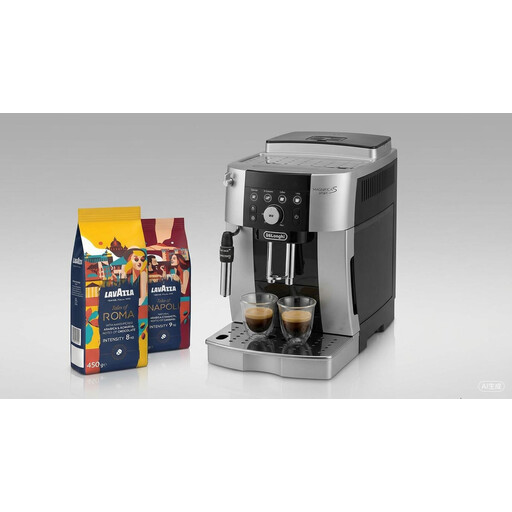
De’Longhi Magnifica ECAM250.23.SB with Lavazza coffee
Worth considering if you want to make espresso from beans and have the option of a long coffee too.
The product description lists an integrated grinder, Espresso and Double Espresso recipes, and a steam wand for frothing milk manually.
The bundle includes two 450 g packs of Lavazza Tales of Napoli & Roma coffee.
View product
 No image available
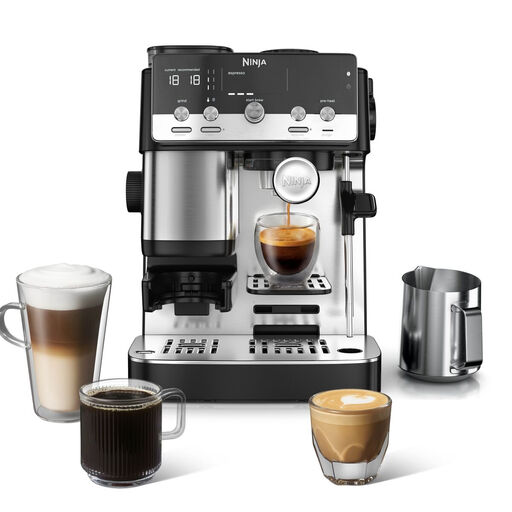
Ninja Luxe Café Mini ES301EU
Worth considering if you want to switch between espresso and filter coffee made from beans.
The title describes a 2-in-1 machine with an integrated grinder and manual milk frother. The product description also lists an integrated weight-based dosing system and removable, dishwasher-safe parts.
View product
 No image available
HiBREW H16
Worth considering if you’re looking for an automatic machine with a grinder and a choice of advertised drinks.
The product description lists 15 grind settings, a touchscreen and six drinks. It also mentions making coffee and milk froth at the same time.
View product
 No image available
Philips EP2230/10 LatteGo
Worth considering if you want to make espresso and milk-based drinks from beans.
The product description lists a grinder with 12 settings, a removable brew group and the LatteGo system for cappuccinos. It also states that the machine is compatible with plant-based milk.
View product
 No image available
De’Longhi Magnifica Start ECAM220.21.WW, white
Worth considering if you want to make espresso from beans and choose from several listed preparations.
The product description mentions an integrated grinder, 13 grind settings, the option to make two cups at once and a 1,8 L water tank. It also lists a descaling programme.
Milk for milk-based drinks is frothed using a steam wand with adjustable intensity.
View product
Frequently asked questions
How many espressos a day does it take for a bean-to-cup machine to be worthwhile ?
There’s no universal threshold for working out whether it’s worthwhile for every household. Compare the price of the machines, the number of cups you make, the coffee or capsules you buy and the upkeep over the same period. Que Choisir doesn’t set a payback period that applies to every usage pattern.
Does a water filter mean you don’t need to descale a bean-to-cup machine ?
Don’t assume so: follow the instructions for your model and act on its descaling alert. Que Choisir recommends descaling bean-to-cup machines when prompted; how often you need to do so depends on the machine and how you use it.
How can you check parts availability and what happens if your machine breaks down in France ?
Ask the seller or manufacturer which parts are available for the model you’re considering. The DGCCRF explains that there is no general legal obligation to make spare parts available for every category of goods. If a business sells goods to an individual, distinguish parts availability from the legal guarantee of conformity, which the Ministry of the Economy says can be claimed within two years.
Where should you dispose of coffee capsules in France ?
ADEME advises putting aluminium or plastic capsules in the sorting bin, bag or container provided for paper and packaging. This sorting guidance doesn’t mean all capsules have the same environmental impact.


