For regular use, the key is to choose the system whose daily routine you are happy to follow: capsules or pods for straightforward preparation, a portafilter for measuring and tamping ground coffee, or a grinder for using whole beans with automated preparation. UFC-Que Choisir reports that capsules and pods cost significantly more than beans and ground coffee, while a grinder requires more space and produces more noise.
Who will find this comparison useful?
Regular coffee drinkers who want coffee instantly
You prepare a cup often, prefer a quick routine and do not want to measure or tamp the coffee. Capsules, soft pods and some automatic grinders meet this need, with different trade-offs in terms of consumables and maintenance, according to UFC-Que Choisir.
Regular coffee drinkers who keep an eye on running costs
You want to monitor your ongoing coffee expenses. UFC-Que Choisir reports that capsules and pods are significantly more expensive than whole beans and ground coffee; then compare the products that are genuinely available near you.
Coffee enthusiasts happy to take an active role in preparation
You want to choose your ground coffee or beans and are comfortable with cleaning and descaling. A portafilter requires you to fill and tamp the coffee, while a grinder automates preparation but adds maintenance, noise and bulk.
Buying priorities for frequent use
Start with the routine you are happy to repeat every day, then check the consumables, available space and maintenance requirements associated with your chosen system.
| Priority |
What to check |
Your needs |
| Ease of preparation |
Check whether the machine uses a pre-measured portion, whole beans or ground coffee. With a portafilter, filling and tamping are still tasks you need to carry out. |
I want to prepare an espresso quickly, without complicated steps for every cup. Portions are ideal for a straightforward routine; a grinder automates grinding and extraction while using whole beans. |
| Cost of consumables |
Compare the cost of compatible coffee or portions, the dose per cup and the number of coffees you actually make each week. Keep this recurring cost separate from the price of the machine. |
I want to avoid a very convenient solution becoming expensive at my rate of consumption. UFC-Que Choisir reports that capsules and pods are significantly more expensive than whole-bean and ground coffee. |
| Space, noise and maintenance |
Check the model’s dimensions, access to the water tank and the cleaning or descaling requirements. With a grinder, also check whether the grinding noise suits your schedule. |
My machine needs to remain practical in my kitchen and not become a chore to clean. UFC-Que Choisir reports that a grinder is noisier and bulkier than a capsule system or filter coffee maker. |
| Waste and recycling |
Identify the material used for the capsules or pods you buy and check local guidance. Recycling or composting options depend on the material and the facilities available near you. |
I prefer a system that fits in with my recycling habits. ADEME explains that aluminium or plastic capsules belong in packaging recycling according to local guidance, while paper capsules can sometimes be composted. |
Mistakes to avoid before buying
-
Choosing solely based on the machine’s purchase price
An affordable machine can still involve expensive consumables when you prepare coffee regularly.
Compare options based on your actual routine: coffee or portions available near you, dose per cup, number of cups per week and planned maintenance.
UFC-Que Choisir reports that capsules and pods cost significantly more than whole-bean and ground coffee.
-
Buying a grinder without planning for its space or noise
A grinder automates preparation from whole beans, but takes up more space and makes more noise than a capsule system or filter coffee maker, according to UFC-Que Choisir.
Measure the space beneath your cupboards, check the precise model dimensions and consider whether the grinding noise suits the times when you prepare coffee.
-
Assuming recyclable or compostable means the same thing everywhere
Instructions depend on the capsule material and the recycling or composting facilities available in or near your local area.
Before choosing a portion-based machine, check the material of the consumables you buy and the local scheme identified by ADEME or your local authority.
-
Underestimating cleaning because the machine is automatic
Regular maintenance helps reduce faults and extend the machine’s lifespan. Descaling and cleaning the filters can also affect water flow.
Choose only the features you are prepared to maintain, read the instructions before buying and plan for any required descaling products or filters.
A guide to brands and their systems
Nespresso
A French ecosystem of machines and capsules to consider if you are looking at a capsule machine and want to check the collection schemes offered by the brand.
- Nespresso states that it has more than 2,000 collection points in France and offers a recycling service in its boutiques.
- Local recycling guidance and the ongoing cost of capsules still need to be checked against your shopping habits.
Senseo
An ecosystem of soft-pod machines that could suit you if the available formats and types of drinks match your habits at home.
- Senseo France offers classic, espresso and extra-long pods, along with various drinks, with some packs containing 40, 54 or 72 pods.
- This brand’s range does not allow conclusions to be drawn about the total cost of ownership or universal compatibility with all pod machines.
De'Longhi
A brand available in France across manual portafilter machines and grinder machines, making it useful for distinguishing between these two preparation methods.
- De'Longhi explains how a portafilter works with ground coffee filled and tamped by the user, and also sells bean-to-cup espresso machines.
- Noise, size and ease of cleaning must be checked for each individual model.
Joybuy options for making espresso at home
These Joybuy options include grinder, capsule, soft-pod and portafilter machines for regular use at home.
 Image unavailable
Philips EP2230/10 Series 2200 LatteGo with grinder
For regular coffee made from whole beans, with automated preparation and adjustable drink settings.
Grinder with 12 settings, 1.8 L water tank, 275 g bean hopper and dimensions of 246 × 371 × 433 mm. The brew group is removable, the LatteGo components are dishwasher-safe and descaling is guided.
Check the available space as well as the maintenance consumables: the AquaClean filter is listed as compatible but is not included.
View on Joybuy
 Image unavailable
HiBREW H1C 6-in-1 compact coffee machine
A compact option for switching between several portion formats and ground coffee when preparing individual drinks.
600 ml water tank, 220–240 V power supply and dimensions of 300 × 143 × 280 mm. The product details state compatibility with several capsule formats, ESE pods and ground coffee.
Before buying, confirm which consumables can actually be used in France, along with the descaling process and removable components.
View on Joybuy
 Image unavailable
HiBREW H11 1450 W semi-automatic espresso machine
Worth considering if you prefer to prepare ground coffee with a more hands-on routine than a portion-based machine.
19-bar pump, removable 1.1 L water tank, one- or two-cup controls, three-hole steam wand and removable drip tray. The product details specify the use of ground coffee or ESE pods.
Preparation and cleaning require regular involvement; also check the contents of the portafilter and the accessories supplied.
View on Joybuy
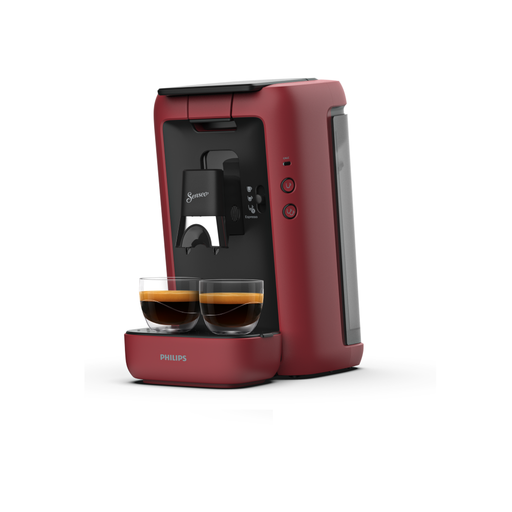 Image unavailable
Philips Senseo CSA260/91 Maestro intense red
For regularly preparing one or two cups with soft pods, without measuring coffee each time.
1.2 L water tank, simultaneous preparation of two cups, three recipes, Memo setting, automatic shut-off and dishwasher-safe components. The stated dimensions are 28.5 × 17 × 31 cm.
The product details recommend descaling every three months. Also compare the cost of the pods and local guidance for their disposal.
View on Joybuy
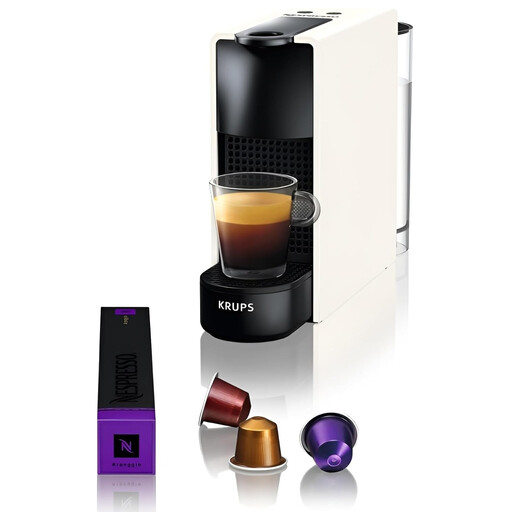 Image unavailable
KRUPS Nespresso Essenza Mini 0.6 L white
A compact machine for espresso or lungo when you prefer one-touch operation with Nespresso Original capsules.
Two programmable volumes, heat-up time of 25 seconds, 0.6 L removable water tank, six-capsule container and automatic shut-off. The stated dimensions are 8.4 × 33 × 20.4 cm.
It uses Nespresso Original or compatible capsules and does not make coffee directly from ground coffee or whole beans. For frequent use, expect to refill and empty it more often.
View on Joybuy
Frequently asked questions
Do coffee capsules have to be returned to a shop in France?
Not necessarily. ADEME states that aluminium or plastic capsules should be placed in the recycling bin, bag or container for paper and packaging, in line with your local authority’s instructions. Some brands also offer in-store collection; check your local guidance before choosing this option.
Can I put a compostable capsule or pod in my food waste?
Only if the material and local facilities allow it. ADEME states that paper capsules can be composted at home, in a shared composting scheme or placed with food waste where one of these options is available near you.
How can I reduce maintenance-related faults?
Plan regular cleaning and follow the descaling schedule specified in your model’s instructions. UFC-Que Choisir links regular maintenance with preventing faults and extending the machine’s lifespan; for a portafilter machine, De'Longhi specifically mentions descaling and cleaning the filters among the checks to make when water flow is slow.
Is a grinder machine suitable for a small kitchen or morning use?
It can be, provided you are comfortable with its size and noise. UFC-Que Choisir reports that a grinder machine takes up more space and makes more noise than a capsule system or filter coffee maker, so check the model’s dimensions and noise level before buying.


