
Livraison le jour même ou le lendemain

Qualité garantie

Débloquez vos offres de bienvenue: Livraison GRATUITE | Jusqu'à -80 % | 30 jours d'essai gratuits à JoyPlus
Téléchargez l'application
Making espresso at home can be very straightforward – as long as you don't get swayed by a single number or a pretty picture. An espresso machine should first and foremost suit your habits, the space you have in your kitchen, and the time you're willing to spend on its upkeep.
The most common pitfalls involve the stated pressure, the choice between a built-in grinder and ground coffee, and the accessories for milk-based drinks. Here are the criteria to consider before buying, followed by a selection of models suited to different needs in the UK.
A 15-bar espresso machine or a 20-bar espresso machine usually refers to the maximum pump pressure. That doesn't mean the coffee is extracted at that level the whole time, nor that higher pressure guarantees a better espresso.
The quality in the cup also depends on temperature, grind fineness, dosage, tamping and flow time. For home use, it's better to look at the full range of settings rather than simply choosing the model that boasts "20 bars".
The drip tray, brew group, water tank and steam wand all need regular cleaning. An automatic coffee machine may include a rinse cycle, but that doesn't mean you can skip emptying the grounds or following the descaling recommendations.
On a semi-automatic machine, the steam wand must be wiped and purged after every use. This is essential to prevent milk from drying and building up inside the circuit.
The dimensions listed on a product spec don't always account for the space needed to remove the tank or open the bean hopper. A compact coffee machine that's 15 cm wide might fit on a narrow worktop, but you also need to check its depth and height.
Remember to measure the gap between your worktop and any wall cupboards, especially if the tank is removed from the top.
An automatic coffee machine with a built-in grinder doses and grinds beans on demand, then prepares the drink using a preset programme. It's ideal for those who want to keep daily steps to a minimum.
A semi-automatic coffee machine requires you to fill the portafilter with ground coffee or an ESE pod, tamp the grounds, and then start the extraction. It gives you more control over the result, but takes a bit of practice.
A coffee machine with a grinder saves you from buying a separate mill and lets you make each cup with freshly ground beans. Check the number of grind levels, the bean hopper capacity, and whether you can also use pre-ground coffee.
A large bean hopper is handy if you're making several coffees a day, but it often makes the machine bulkier. For a single person, a smaller capacity can also prevent beans from sitting in the machine for too long.
If you make several coffees a day, a water tank of around 1.5 to 1.9 litres means fewer refills. In a studio flat or office, a more compact model with a smaller tank might be easier to handle.
Do you like milky drinks? Look for a cappuccino machine, a latte machine or a coffee machine with a milk frother. A manual steam wand takes a bit of learning, while an integrated system focuses on speed and consistency. Either way, all parts that come into contact with milk must be cleaned as instructed in the manual.

Why this choice suits this profile: With dimensions of 12 × 29 × 28.5 cm, it fits easily into a small kitchen and accepts both ground coffee and ESE pods.
Its spec mentions a removable 1.1-litre tank, a removable drip tray and automatic shut-off: daily maintenance stays quick and simple.
A power of 1,450 W, a stated pressure of 19 bar, a three-hole steam wand and a preheat time claimed at 25 seconds.
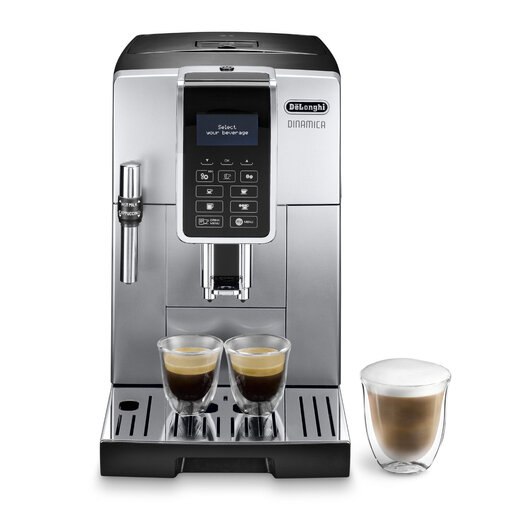
Why this choice suits this profile: This automatic coffee machine offers multiple recipes and customisable settings so you can vary your drinks throughout the day.
The built-in grinder, 1.8-litre tank and automatic rinse programme cut down on repetitive tasks.
A 300 g bean hopper, 13 grind settings, six claimed recipes and the ability to make two cups at once.

Why this choice suits this profile: Its claimed dual-boiler system and 2.8-litre tank are ideal for households that make lots of coffees and milky drinks back to back.
The on-screen settings and built-in grinder mean you don't need extra gadgets, while still allowing you to fine-tune the grind.
A claimed 20-bar pump, 30 grind levels, a 250 g bean hopper and a touchscreen display.
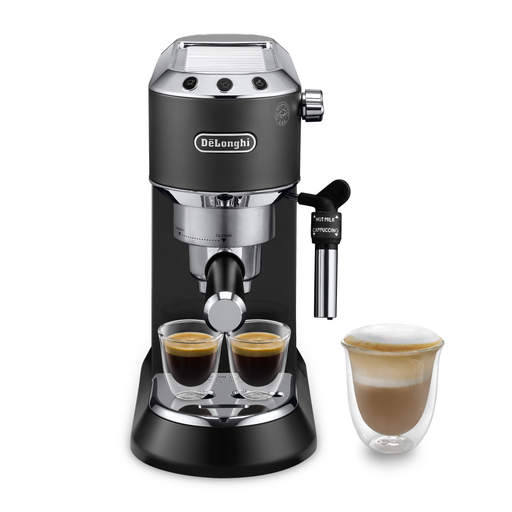
Why this choice suits this profile: With a claimed width of 149 mm, it fits neatly on a narrow worktop while still having a steam wand for cappuccinos and lattes.
Its single and double shot filters and compatibility with ESE pods give you several options, without a built-in grinder.
A size of 149 × 330 × 305 mm, a 1-litre tank, a claimed 15-bar pump and three temperature settings.
We've put together a full, real-time selection of products that meet these exacting criteria, while complying with European safety regulations.
Choose a model whose width, depth and tank access are compatible with your worktop. A compact semi-automatic machine can work if you're happy to dose the coffee manually. An automatic machine with a grinder simplifies preparation, but it's often bigger and heavier.
On top of the purchase price, you need to factor in the cost of coffee, water, electricity, any filters and descaling products. The cost per cup depends mainly on the type of coffee you choose and how often you use it. Regular maintenance can also reduce the risk of breakdowns caused by limescale and residue.
It depends on how often you use it, the quality of your water and how well you look after it. Empty the drip tray, rinse the removable parts, clean the steam wand after each use and run the descaling cycles as recommended in the manual. Before buying, also check the availability of spare parts and the warranty terms that apply in the UK.