Start by choosing the coffee system whose consumables and maintenance you are happy to manage: capsules and pods reduce the number of steps, while a portafilter and grinder give you more freedom over the coffee you use. For regular use, Que Choisir reports that a bean-to-cup machine can reduce the cost per cup compared with pods, but it requires more space, rinsing and descaling; a portafilter is suitable if you are happy to measure, tamp and clean after every preparation.
Which uses is it for?
Households that drink espresso every day
You make several coffees a week or a day and need to weigh up the ongoing cost, the freedom to choose your coffee and the time needed for maintenance. According to Que Choisir, a grinder is worth considering when the cost per cup matters over time.
Users who want quick coffee with minimal effort
You prioritise pre-measured preparation, a compact footprint and minimal daily cleaning. Capsules or pods may meet this need if you are happy with their consumable format and ongoing cost.
Coffee lovers who want to adjust their brew
You want to choose your ground coffee or beans and are happy to do more preparation and maintenance so you are not tied to a specific capsule format.
Buying priorities
Start with the coffee you want to use, then check the maintenance routine and the availability of consumables or parts suitable for your chosen model.
| Priority |
What to check |
Your needs |
| Ongoing coffee cost |
Compare the price per cup of the capsules, pods, ground coffee or beans you will actually use. Also check whether the machine accepts only one consumable format. Que Choisir reports that a grinder can have a cost per cup two to three times lower than pod-based espresso. |
I want to avoid a machine that is inexpensive to buy but leads to high costs for every coffee. I can favour beans or ground coffee if I make espresso regularly. |
| Daily maintenance |
Look at the descaling programme, removable components and parts that need cleaning after preparing milk drinks. Frequency depends in particular on water hardness and usage; Que Choisir recommends descaling every two to three months on average. |
My machine must suit the amount of time my household is willing to spend on rinsing, cleaning and descaling. |
| Consumables, parts and recycling |
Check the accepted format, the usual availability of consumables and the exact reference of compatible parts. For capsules, also check the material and your council’s recycling instructions. |
I want to be able to find suitable consumables and replacement parts easily. In an IFOP survey for the Alliance for the Recycling of Aluminium Capsules, carried out in December 2023 among 2,166 French consumers of aluminium capsules, 75% said they sorted them for recycling at least occasionally and 56% said they routinely included this action in their daily lives. |
Mistakes to avoid before buying
-
Choosing solely on the machine’s price
The type of consumable has a lasting impact on your coffee budget. Capsules and pods can cost more per cup than beans or ground coffee, according to Que Choisir.
Calculate the cost of one cup using the consumables you will use, then compare it with your weekly consumption.
-
Underestimating descaling and cleaning
A machine with a grinder, a steam wand or a milk system adds maintenance tasks to your routine. Descaling should also be adapted to your water and frequency of use.
Compare the descaling programme, the parts that need cleaning and the maintenance consumables before choosing a model.
-
Choosing a capsule system without planning for recycling
Recycling instructions depend on the capsule material and local collection arrangements.
Check the material, your local authority’s instructions and accessible collection points before committing to a system.
-
Assuming all parts in a range are interchangeable
A pod holder, water tank or accessory must match the machine’s exact reference.
Keep the model number and check the compatibility of parts, accessories and descaling products before buying or replacing anything.
Useful information on relevant brands
Nespresso
A machine and capsule ecosystem for capsule-based coffee, with a French ordering website and dedicated collection solutions.
- Nespresso France states that it offers capsule ordering through its French website, as well as collection points.
- Always check which capsule format the machine accepts: compatibility between competing systems should never be assumed.
Philips SENSEO
A soft-pod system for households looking for simple preparation and wanting to identify parts or accessories by model number.
- Philips France offers a SENSEO parts and accessories shop, including pod holders, water tanks and descaling products.
- Compatibility and availability depend on the model number, particularly for older references.
De'Longhi
A range of bean-to-cup espresso machines for households that want to prepare drinks from beans with different levels of automation.
- The French range includes the Magnifica, Rivelia, Eletta, Dinamica and PrimaDonna series.
- Milk drinks, filter consumables and rinsing or descaling procedures vary by model.
Joybuy options for everyday coffee
This selection brings together machines with grinders, soft-pod systems and portafilters for making regular espresso at home.
 Image unavailable
Philips EP2230/10 Series 2200 LatteGo
For a household that alternates between beans, ground coffee and milk drinks every day.
Grinder with 12 settings, 1.8 L water tank, 275 g bean hopper, two-cup preparation and LatteGo carafe. The AquaClean filter is compatible but not included.
The brew group, LatteGo carafe and descaling all need to be included in your maintenance routine.
Joybuy
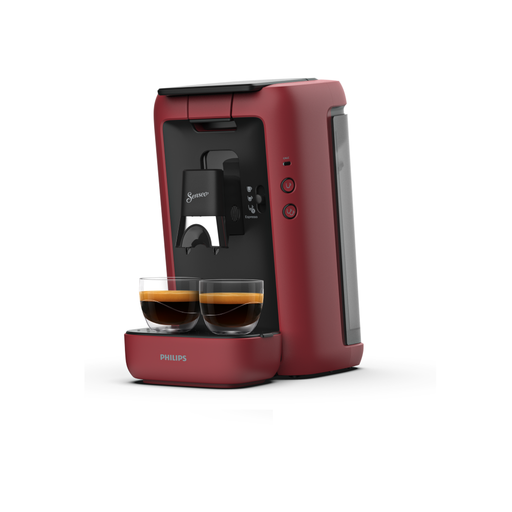 Image unavailable
Philips Senseo Maestro CSA260/91
For making one or two cups without grinding or tamping, using SENSEO pods.
1.2 L water tank, preparation advertised at under 45 seconds for one cup, Memo function, long, intense and espresso recipes, with two pod holders included.
A descaling light helps you plan maintenance; check the availability of parts suitable for reference CSA260/91.
Joybuy
 Image unavailable
HiBREW H16 automatic espresso machine with grinder
For a household that wants to use beans and prepare several types of coffee or milk drinks.
Conical grinder with 15 levels, 4.3-inch touchscreen, dual boiler, 1.5 L water tank and six advertised drinks.
Allow space on a stable surface for its 8.65 kg weight and check how the milk system is cleaned before buying.
Joybuy
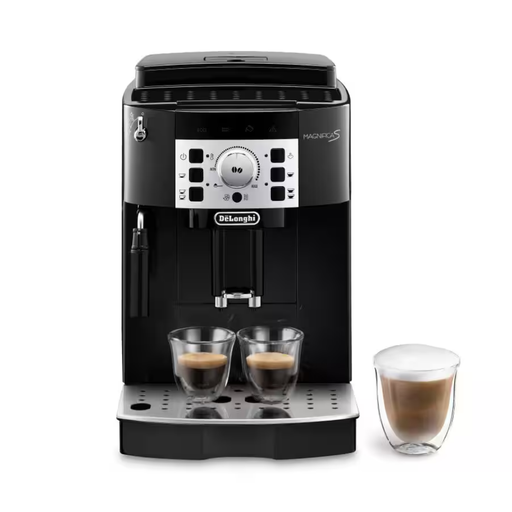 Image unavailable
De'Longhi Magnifica S ECAM22.140.B
For everyday use with beans or ground coffee, including two espressos at once.
Adjustable grinder, 1.8 L water tank, pump rated at 15 bar, hatch for pre-ground coffee, steam wand and dishwasher-safe drip tray.
The steam wand must be cleaned after use, and the descaling alert requires regular attention.
Joybuy
 Image unavailable
HiBREW H13A 3-in-1 semi-automatic
For anyone happy to measure ground coffee and take an active role in preparing espresso and milk drinks.
51 mm portafilter, six modes, dual boiler, three temperature levels, removable 1.3 L water tank and 700 ml milk system.
Its advertised dimensions of 23 × 23 × 32 cm make it easier to assess the space it will occupy on your worktop; check how the milk system is maintained.
Joybuy
Frequently asked questions
Do you have to buy capsules made by the machine’s brand?
No, it depends on the system. Que Choisir reports that most brands accept only one type of capsule, while also listing Nespresso-compatible capsules and Senseo-compatible pods sold in supermarkets. Always check the format explicitly stated by the manufacturer before ordering consumables.
How often should an espresso machine be descaled?
There is no single schedule. Que Choisir recommends descaling every two to three months on average, depending on water hardness and frequency of use. The model’s manual and any descaling light should guide your routine.
How should coffee capsules be recycled in France?
ADEME states that aluminium or plastic capsules should go in the recycling bin, bag or container for paper and packaging. For paper capsules, check whether home composting or local food-waste collection is available in your area, as well as the product’s exact material.
Is a new espresso machine bought from a professional seller covered if it is faulty?
Yes. The French administration states that the legal guarantee of conformity is mandatory for new, second-hand or refurbished goods sold by a professional to a private individual. Keep your proof of purchase and contact the seller first if you identify a lack of conformity.


