What sets the machines apart?
These four types of machine involve different daily routines. First decide whether you prefer pre-measured portions, hands-on preparation or coffee ground by the machine; then compare models based on your routine and how much maintenance they need.
Capsules
Worth considering: if you want to make a short or long coffee with very little effort.
Bear in mind: your choice of coffee depends on which capsules are compatible with the system.
Soft pods
Worth considering: if you prefer a simple routine using pods designed for your machine.
Bear in mind: the pod format offers fewer ways to adjust your coffee than a portafilter.
Portafilter
Worth considering: if you want to choose your ground coffee and control the dose and tamping.
Bear in mind: making the coffee and cleaning the portafilter involve more steps.
Bean-to-cup machine
Worth considering: if you drink coffee regularly and want to use whole beans without grinding and measuring them by hand.
Bear in mind: these machines generally cost more upfront and have several parts to maintain.
| Criteria |
What to check |
Who it suits |
| Everyday ease |
Compare the steps involved in making a cup and emptying the parts you’ve used. |
When mornings are busy, I want to make my coffee without measuring or tamping. Around 22% of consumers might put ease of use first. |
| Long-term cost |
Compare the upfront cost with what you’ll spend on your usual consumables, based on how many coffees you make. |
If I make several coffees regularly, the cost per cup matters to me. Around 29% of consumers might consider this their main concern. |
| Control over preparation |
Check which coffee the machine accepts, what settings are available and, for a portafilter machine, which accessories are included. |
I want to choose my coffee and have a say in how it’s made, even if it takes longer. Around 21% of consumers might put this control first. |
| Milk-based drinks |
Check the type of steam wand or milk system and how it needs to be cleaned after use. |
I often make cappuccinos or lattes and want a milk routine that suits me. Around 14% of consumers might make this a priority. |
| Maintenance and space |
Measure the space, allowing room to access the water tank, and check the manual for cleaning and descaling instructions. |
In a small kitchen, I want to be able to fill, clean and descale the machine easily. Around 14% of consumers might put this need first. |
Machines for different needs
These Joybuy models show three ways to make coffee at home: an automatic bean-to-cup machine, a capsule machine and a portafilter machine. Compare the steps involved and the consumables each uses before choosing a model.
 Image unavailable
Philips Series 2200 EP2230/10 LatteGo, black
If you want to use whole beans with fewer manual steps, this model combines a grinder with automatic preparation. The LatteGo system is also designed for milk-based drinks; check the recipes available on this model and the maintenance routine in its manual.
View on Joybuy
 Image unavailable
HiBREW H16 with grinder and milk system
This automatic machine may suit you if you want to make a range of drinks without grinding or measuring coffee by hand. Its product description lists six drink options and a touchscreen; check the manual for instructions on cleaning the milk system.
View on Joybuy
 Image unavailable
KRUPS Nespresso Essenza Mini, white, 0,6 L
This capsule machine makes coffee with very little effort. Its water tank is listed as 0,6 L and its power as 1200 W; check which capsule format it accepts before choosing your coffee.
View on Joybuy
 Image unavailable
HiBREW H13A 20Bar 3 in 1, portafilter machine
This model is for people who want to make espresso using ground coffee and a portafilter. The steam wand gives you the option of preparing milk-based drinks, but adds extra steps for use and cleaning; check which accessories are included and read the care instructions.
View on Joybuy
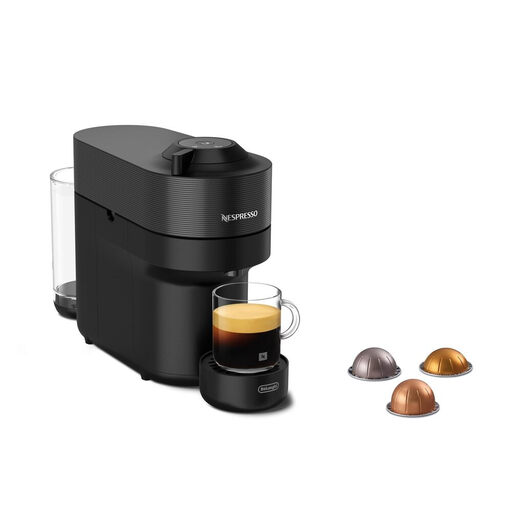 Image unavailable
Nespresso Vertuo Pop ENV90.B, black, 0,6 L
This capsule machine may suit you if you want a simple way to make coffee using the Vertuo system. Its water tank is listed as 0,6 L; make sure Vertuo capsules are available for the coffees you want to prepare.
View on Joybuy
Frequently asked questions
How many coffees a day make a bean-to-cup machine worthwhile?
There’s no single threshold that applies to every machine and every coffee. UFC-Que Choisir says a bean-to-cup machine, which generally costs more upfront, may offset that difference compared with capsules. Compare the difference in upfront cost with the cost per cup, then factor in how much coffee you usually drink and the maintenance involved.
Do I need a milk system if I mainly drink espresso?
A milk system isn’t necessary if you mainly make black espresso. If milk-based drinks become part of your regular routine, compare a steam wand with a milk carafe, taking into account the steps you’re happy with and the cleaning needed after use.
Do you need to descale your machine as often throughout France?
No. De’Longhi notes that how often you need to descale depends, among other things, on water hardness. Follow the instructions and procedure in your model’s manual rather than using the same schedule for every machine.
Are all Nespresso capsules collected in the same way?
No. The options available depend, among other things, on where you live. Nespresso says it offers collection points in France and that putting capsules in the yellow recycling bin is only possible in certain areas; check which option is available near you. This information applies to its capsules, not to all other formats.


