Households that make espresso regularly
If short coffees are part of your daily routine, compare making coffee from beans with the steps and maintenance involved in using a grinder.


If you make espresso at home regularly, a bean-to-cup machine is a good choice if you want to use coffee beans and have room for the machine, as well as time for maintenance. If simplicity and a compact footprint matter more, consider a pod machine. A portafilter machine involves more hands-on preparation, while a filter coffee machine is designed for a different kind of coffee.
If short coffees are part of your daily routine, compare making coffee from beans with the steps and maintenance involved in using a grinder.
For cappuccinos and other milk-based drinks, you’ll also need to consider the milk system. A manual steam wand and an automatic milk carafe involve different ways of preparing and cleaning them.
UFC-Que Choisir describes bean-to-cup machines as larger and noisier than pod machines or filter coffee makers. Check the dimensions and operating requirements of the model you’re considering if your kitchen or morning routine has specific constraints.
Start with the drink you make most often, then compare each type of machine with the space you have and the steps you’re happy to do every day.
| What to consider | What to check | Your needs |
|---|---|---|
| Type of coffee | A bean-to-cup machine uses coffee beans to make espresso. A portafilter machine involves more hands-on preparation, while with pods you’ll need to check which format the machine accepts. Don’t choose a filter coffee maker expecting it to make espresso. | I mainly make short espressos, or I prefer to fill a coffee maker to make filter coffee. |
| Maintenance | For a bean-to-cup machine, check how easy it is to access the containers, along with the cleaning and descaling instructions. If the model has a milk system, check how it needs to be rinsed and taken apart, too. | I’m happy to do a few regular maintenance tasks. Otherwise, I want to know exactly what the routine involves before choosing a more automated system. |
| Milky drinks | Check the wand, frother or carafe on the specific model. Find out which drinks are made automatically and which parts need cleaning after use. | Cappuccino is part of my usual routine, but I need to decide whether I want to prepare the milk myself. |
| Space and noise | Measure the height, width and depth, and allow room to access the tanks and containers. UFC-Que Choisir says that a bean-to-cup machine takes up more space and makes more noise than a pod machine or filter coffee maker. | In a small kitchen, access to the containers matters just as much as the space the machine takes up on the worktop. Morning noise may also affect my choice. |
| Pod format and recycling | For pods, check they’re compatible with the machine. In France, ADEME says aluminium or plastic pods can be put in the recycling collection for paper and packaging. However, each coffee still comes individually packaged. | I prefer the convenience of making coffee with pods, or I’d rather avoid individual packaging for every cup. |
Making coffee from beans doesn’t mean you can skip rinsing the containers or following the descaling instructions. UFC-Que Choisir points out that these tasks are part of using an automatic coffee machine.
Check the model’s manual to find out which parts need cleaning and how often.
Remember to allow time for cleaning and budget for any consumables specified for the machine.
An automatic carafe, a standard milk frother and a steam wand all need different care. De’Longhi’s maintenance guide, for example, says to clean milk residue from the relevant machines after use.
Check exactly which milk system the machine has and how to rinse it before choosing based on the number of drinks listed.
UFC-Que Choisir describes bean-to-cup machines as noisier than pod machines or filter coffee makers. A manufacturer’s description alone isn’t enough to compare how noisy two models are under the same conditions.
Check the machine’s dimensions and, if noise is a key factor, look for test results that explain how the measurements were taken.
ADEME says aluminium or plastic pods can be put in the paper and packaging recycling collection in France. This doesn’t change the fact that each coffee comes individually packaged.
If you want to reduce this type of packaging, also compare making coffee from beans or ground coffee with your usual coffee-drinking habits.
Features and maintenance requirements vary between models. A feature advertised for one model won’t necessarily apply to the whole brand.
The Magnifica range includes bean-to-cup machines with different ways of preparing coffee and milk, depending on the model.
Philips bean-to-cup espresso machines offer different coffee and milk preparation features, depending on the model.
The VeroCafe Série 2 TIE20119 is one specific bean-to-cup configuration, with a cleaning and descaling programme.
Nespresso represents the pod option here, which you can compare with other types of machine based on the coffee format you prefer.
These models offer an automatic, bean-to-cup way to make coffee from whole beans. To compare them, look at how they prepare milk, how much space you have and the maintenance instructions for each model.
 Image unavailable
An option with a grinder and LatteGo system if you also make milky drinks. Check the cleaning routine and the consumables required for this version.
 Image unavailable
The model name lists six coffee varieties and a touchscreen. If you plan to use the milk system regularly, check the cleaning steps and how much space you’ll need around the machine.
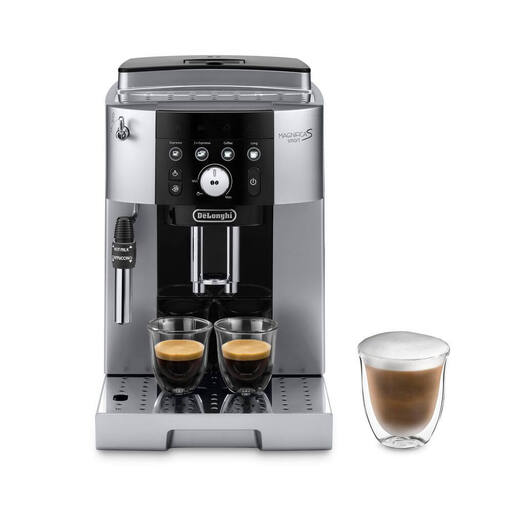 Image unavailable
This automatic machine with a grinder is suited to espresso-focused coffee routines. If you also enjoy milky drinks, check how milk is prepared and what cleaning steps are involved.
 Image unavailable
This model makes espresso from whole beans. If you enjoy milk-based drinks, check that the manual milk preparation listed for this model suits your routine, and read the maintenance instructions.
 Image unavailable
This bean-to-cup machine features dual heating, a 20 Bar pump and a 2.8L water tank. Check the drinks it makes and the maintenance instructions if you also plan to prepare milk-based drinks.
Rinse the containers regularly and follow your machine’s descaling alerts. If it has a milk system, clean the parts according to the manual after use. For the relevant automatic machines, De’Longhi’s guide also recommends removing and rinsing the removable brewing unit.
Not necessarily. ADEME says aluminium or plastic pods can go in the recycling bin, bag or container for paper and packaging. You can also check your local council’s guidance for your area.
Check the model’s dimensions and allow enough space to fill the tank and remove the containers. UFC-Que Choisir describes bean-to-cup machines as noisier and larger than pod machines or filter coffee makers. If noise is a deciding factor, look for measurements taken under clearly stated conditions rather than relying on the word ‘quiet’ alone.