
Livraison le jour même ou le lendemain

Qualité garantie

Débloquez vos offres de bienvenue: Livraison GRATUITE | Jusqu'à -80 % | 30 jours d'essai gratuits à JoyPlus
Téléchargez l'application
An ergonomic pillow can improve comfort in bed, at your desk or during pregnancy. However, not every model meets the same needs. A contoured shape, memory foam or a breathable cover do not, on their own, guarantee the right support for your body shape.
Before buying, pay particular attention to the height, firmness, dimensions and care requirements. Here are the main pitfalls to avoid, along with a selection of models suited to different uses.
A thick pillow is not necessarily the most suitable. When sleeping on your side, a generous height can fill the space between your shoulder and head. When sleeping on your back, however, a pillow that is too high may put your neck in an uncomfortable position. People who sleep on their front generally prefer a thinner, softer profile.
So do not just look at the stated height. Also consider the pillow’s shape, the density of its filling and whether its volume can be adjusted.
Claims such as ‘all sleeping positions’ or ‘enhanced neck support’ should be treated with caution. A contoured cervical pillow may suit some back or side sleepers, but others may need time to get used to it.
Proper alignment depends on several factors: shoulder width, mattress firmness and your usual sleeping position. A model that is comfortable for someone who works at a desk will not necessarily suit a pregnant woman looking for a maternity pillow.
Memory foam can retain heat, particularly in a poorly ventilated bedroom. Before buying, check for ventilation holes, a removable cover and breathable fabric.
Another detail that is often overlooked is that the cover may be machine washable, while the foam core must not be washed. This distinction has a direct impact on hygiene and the pillow’s lifespan.
To choose an ergonomic pillow for sleeping, compare its dimensions with those of your bedding and take your usual sleeping position into account.
The 50 × 70 cm format is very common in France. A 60 × 60 cm model offers a wider surface, but takes up more space on the bed.
Memory foam responds to heat and pressure. It provides a cocooning feel and consistent support, but its firmness varies depending on how it is designed. Perforated foams encourage air circulation.
Cotton or PP cotton fibres provide a softer feel. In some cushions, they can also be redistributed to adjust the volume. For a maternity cushion, the resilience of the filling is essential: it must retain its shape despite repeated use.
Choose a removable, washable cover, and carefully check the washing and drying instructions. The product specifications for MORPHEA foam models notably mention a machine-washable cover and advise against washing the foam core.
The relevant products also display labels such as STANDARD 100 by OEKO-TEX, CertiPUR or Sanitized. This information should be checked on the product page and does not replace reading the full composition details.
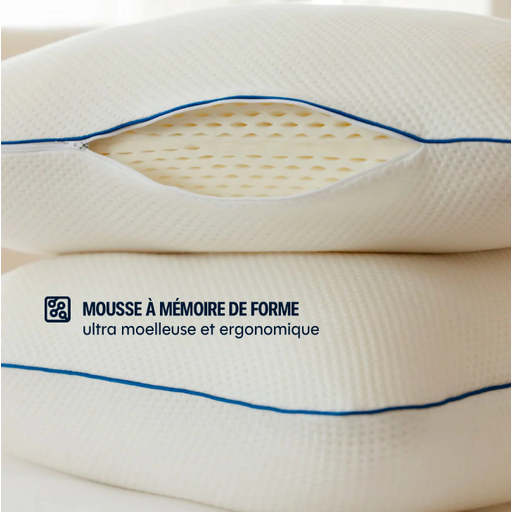
Why this choice suits this profile : Its standard size fits easily into French bedding, while its 12 cm height makes it easy to compare the level of support you need.
The product page states that the foam core must not be washed, while the cover is removable and machine washable.
50 × 70 cm format, perforated foam, cover made from 66 % polyester and 34 % lyocell.
Why this choice suits this profile : Its square 60 × 60 cm surface is ideal for people who appreciate a wider sleeping area and foam that provides consistent support.
The perforated foam addresses ventilation concerns, while caring for the cover is separate from caring for the core.
60 × 60 cm dimensions, 12 cm thickness, removable cover and STANDARD 100 by OEKO-TEX label stated on the product page.
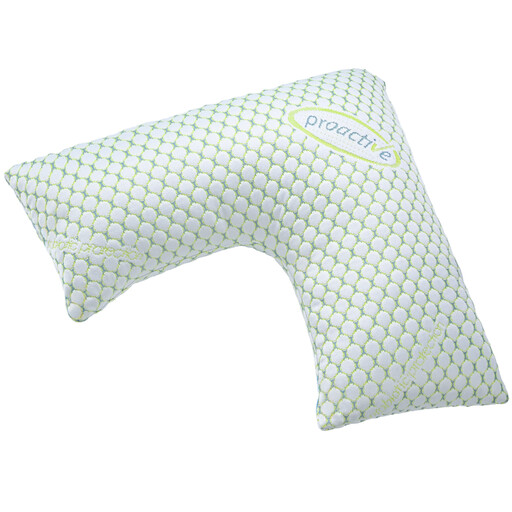
Why this choice suits this profile : This V-shaped maternity pillow supports a range of resting positions, whether you are in bed, on the sofa or sitting on a chair.
Its shape meets a specific need, helping you avoid choosing a standard cervical pillow to support your stomach or back.
‘Air-layer’ fabric described as breathable, resilient PP cotton filling and a removable cover that can be washed separately.
If the model has a cervical contour, place the highest part under the nape of your neck, then check that your head remains aligned with your spine. The pillow should not push your chin towards your chest. Try the position for a few nights, taking your mattress firmness into account.
Its lifespan depends on the material, frequency of use, humidity and loss of shape. Replace your pillow when it sags, becomes uneven or no longer supports your head properly. After unpacking it, allow the foam to air and follow the manufacturer’s instructions.
In most cases, only the cover is washable. Remove the cover and follow the instructions on its care label. The foam core should generally be aired or spot-cleaned without being immersed. This check is essential if you are looking for a washable pillow and want to preserve its supportive properties.