
Livraison le jour même ou le lendemain

Qualité garantie

Débloquez vos offres de bienvenue: Livraison GRATUITE | Jusqu'à -80 % | 30 jours d'essai gratuits à JoyPlus
Téléchargez l'application
An ergonomic memory foam pillow can make bedtime more comfortable, but not every model suits every body shape or sleeping position. Someone who sleeps on their side has different needs from someone who sleeps on their back, while anyone who tends to overheat may prefer a well-ventilated pillow.
Before you place your order, it’s worth looking beyond claims of “restful sleep” or “guaranteed relief”. Here are the criteria to consider when choosing a cervical pillow to suit your habits, bedding and budget.
A very thick pillow isn’t necessarily the most supportive. For a pillow for side sleepers, enough height can fill the gap between your shoulder and head. However, when you sleep on your back, a pillow that’s too thick may alter your neck position and feel uncomfortable. Pillows with two height options or adjustable filling give you more scope to find the right fit.
Memory foam can be made from a single block, perforated, built up in several layers or supplied as shredded foam. These different designs don’t all feel the same. Dense foam generally provides more consistent support, while shredded filling can be adjusted and often feels softer.
The cover material is worth checking too. A removable, washable cover makes care easier, but that doesn’t mean the foam core is machine washable.
Viscoelastic foam can retain more heat than some traditional fillings. If you’re looking for a breathable pillow, check for perforations, air channels or a cover designed to help wick away moisture.
Once unpacked, a compressed pillow usually needs several hours to regain its shape. It may also have a slight manufacturing smell. Before using it for the first time, leave it to air in a well-ventilated room, following the manufacturer’s instructions.
When choosing a pillow for back sleepers, look for a cervical shape that follows the natural curve of your neck without pushing your head forwards. Side sleepers may prefer taller models or pillows with a gradual contour. If you sleep on your front, it’s generally best to avoid pillows that are too thick.
A stated height of 8 to 13 cm isn’t enough to predict comfort. Foam firmness, shoulder width and how much your mattress sinks also affect your head position.
A memory foam pillow made with several layers can combine a soft feel on top with a more stable base. This design may suit people who don’t like sinking too far into their pillow. Perforated foam or foam with air channels can also help air circulate.
For a pressure-relieving pillow, look for a surface that can distribute the weight of your head and a shape that helps limit uncomfortable pressure points. These are comfort features, not medical claims.
Before buying, check the following:
Certifications generally apply to specific materials or processes assessed against a defined standard. They don’t guarantee that a pillow will suit every body shape.
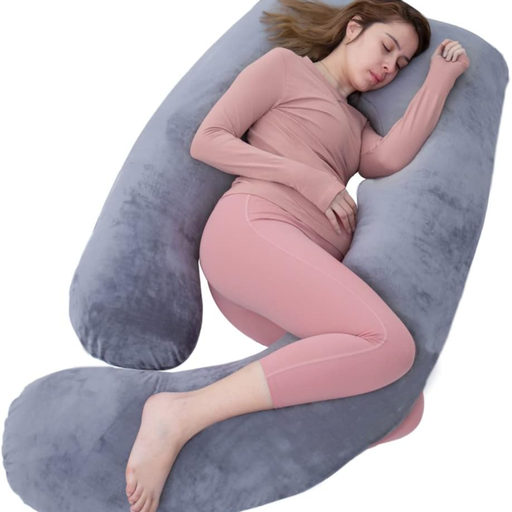
Why it suits this profile : This model is designed for pregnant women looking for support around the sides of the bump, back, hips and legs. It can also be used for reading or breastfeeding.
It’s clearly designed to support the whole body, not just the neck. The cover is removable and machine washable at 30 °C.
Measures 155 × 70 cm, filled with PP cotton, with a removable velvet cover and multiple uses during and after pregnancy.
We’ve put together a comprehensive, real-time selection of products that meet these demanding selection criteria and European safety standards.
Lie down in your usual sleeping position and check that your head is in line with your back, without tilting noticeably upwards or downwards. Side sleepers may need more support height than back sleepers. With an adjustable pillow, remove or add filling gradually rather than making a major change in height all at once.
It depends on the foam density, how often it’s used, the level of moisture and how well it’s cared for. Replace the pillow if its core starts to crumble, stays misshapen or no longer returns to its original shape. Air it regularly and wash only the cover, if the care instructions allow.
Some models have a washable cover or materials described as suitable for people with sensitivities. However, check the full list of materials and any available certifications. A clean cover doesn’t remove the need to check for materials you may react to.