
Livraison le jour même ou le lendemain

Qualité garantie

Débloquez vos offres de bienvenue: Livraison GRATUITE | Jusqu'à -80 % | 30 jours d'essai gratuits à JoyPlus
Téléchargez l'application
An ergonomic pillow isn’t something you should pick based on looks alone or the promise printed on the packaging. Whether you sleep on your side, back or front, its height, material and ease of care all directly affect your comfort, night after night.
Tension in your neck and shoulders can also stem from poor positioning, a pillow that goes flat, or a cover that traps heat. Here are the criteria to consider before ordering a memory foam pillow, a cervical pillow or a model designed for pregnancy.
A very firm pillow isn’t necessarily the best choice. If it holds your head too high, it can increase the bend in your neck, especially when you sleep on your back. On the other hand, a pillow that’s too soft may collapse under the weight of your head and lose all its ergonomic benefit.
The right balance depends on your shoulder width, your sleeping position and the firmness of your mattress. Side sleepers generally need enough volume to fill the gap between the shoulder and the head. On your front, a flatter profile is often better.
The claim “pillow suitable for all sleeping positions” should be taken with a pinch of salt. A cervical shape can work for several postures, but the feeling of support varies greatly depending on your body shape and habits.
Instead, look at the stated height, whether there’s a recessed central zone, and the shape of the edges. These details usually tell you more than the simple word “ergonomic”.
Memory foam can retain more heat than a more breathable filling. To reduce this feeling, go for perforated foam, a breathable cover or a fabric designed to promote air circulation.
Care matters just as much. A removable, washable cover makes it easier to manage sweat, dust and daily use. Bear in mind, though: the foam core generally can’t go in the machine.
The height should keep your head in line with your spine, without pushing it forward or tilting it to the side. An 8 cm pillow may suit some sleepers, while a 12 cm model offers more volume, particularly for those with broad shoulders or who sleep on their side.
Cervical contours, a central dip and supportive edges are all features to compare in the product specifications. A neck and shoulder support pillow should be chosen based on your usual sleeping position, not just on a general promise of comfort.
Slow‑return memory foam gradually moulds to the contours of your head and neck. It gives a hugging sensation, but may take some getting used to. Multi‑layer models combine several densities to prevent excessive sinking.
If you’re after a breathable pillow, look for concrete details: perforated foam, an airy cover, moisture‑wicking fabric or a structure designed to improve ventilation. These specifics are far more telling than a vague “thermoregulating” claim with no technical information.
A removable, washable cover makes maintenance much simpler. The washing temperature, drying instructions and whether the core must not be washed should all be clearly stated.
Some products carry references such as STANDARD 100 by OEKO-TEX, CertiPUR or Sanitized. Check the exact certification linked to the product and what it actually covers. A label doesn’t replace reading the composition, usage instructions and any warnings.

Why this choice suits this profile: Its wedge shape and two extra cushions allow you to adjust your position during pregnancy or during long periods of rest.
Your position isn’t fixed: the removable cushions can be moved depending on the space you need and your body shape.
Air‑Layer fabric described as breathable, high‑density cotton filling and a removable cover that can be washed separately.
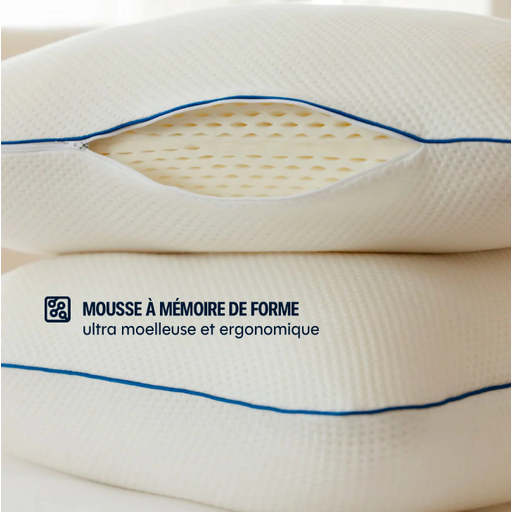
Why this choice suits this profile: Its square 60 × 60 cm format and washable cover make it suitable for regular use at home.
The product page clearly distinguishes the foam core from the outer cover and states that only the cover is machine‑washable.
Perforated foam, 12 cm thickness and a removable cover in polyester and lyocell. The product page also mentions STANDARD 100 by OEKO-TEX.
We’ve put together a full selection, updated in real time, of products that meet these demanding criteria as well as European safety standards.
When you sleep on your back, place the thicker part under your neck, then check that your chin stays in a natural position. On your side, the pillow should fill the gap between your shoulder and head without tilting your head towards the mattress. Test each adjustment over several nights – a change in shape can take some getting used to.
It depends on the foam density, how often you use it and how you care for it. Replace your pillow when the core stays deformed, the support becomes uneven or the foam starts to break down. If the instructions recommend it, let a new pillow air out for 24 to 48 hours and always follow the manufacturer’s guidelines.
It can help make your sleeping position more comfortable if it suits your body shape, but it is neither a medical device nor a treatment. If you have persistent pain, tingling or significant discomfort, seek advice from a healthcare professional.