
Livraison le jour même ou le lendemain

Qualité garantie

Débloquez vos offres de bienvenue: Livraison GRATUITE | Jusqu'à -80 % | 30 jours d'essai gratuits à JoyPlus
Téléchargez l'application
Spending hours at your desk, whether working from home or in the office, should never mean back pain or fatigue. A good ergonomic office chair is a true investment in your well-being and productivity. Yet, faced with a market saturated with marketing promises, making the right choice can feel like an uphill battle. As a product expert at Joybuy, my mission is to help you cut through the noise and find the chair that’s truly made for you.
Before you even start comparing spec sheets, it's crucial to know the most common mistakes that lead straight to disappointment.
To make an informed choice, focus on a few technical parameters that make all the difference. These are the true pillars of a great chair for remote work.
A simple bulge in the lower back isn't enough. A true office chair with lumbar support must offer a support that is adjustable in height and, ideally, in depth. Every body is unique; the support must be able to sit precisely in the curve of your lower back to be effective and prevent pain.
The ability to lean your backrest is essential for relieving pressure on the spine. A quality reclining office chair should allow you to lock the tilt in several positions (for example, at 90° for work and up to 135° for a break). The mechanism should be smooth, and its tilt tension should be adjustable to your weight for perfect control.
The upholstery has a direct impact on your comfort over the hours. A breathable mesh office chair is an excellent option to prevent heat buildup, especially during long summer days. For the structure, look for certifications like BIFMA/SGS. These labels guarantee that key components, like the gas lift or the base, have undergone tens of thousands of cycles of strength and safety testing.
To help you see how these criteria apply in practice, here are a few models that meet specific needs, all while avoiding the common pitfalls.
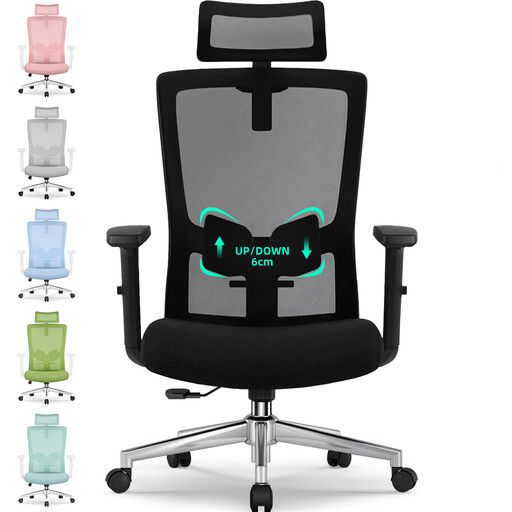
The highlights: Perfect for professionals who spend more than 8 hours a day sitting. Its multiple adjustments allow you to tailor the chair to your body with pinpoint accuracy for flawless support.
Here, ergonomics aren't sacrificed for design: the lumbar support is adjustable by 6 cm, and the office chair with a headrest adjusts by 11 cm. The quality is verifiable, with the manufacturer citing BIFMA and SGS certifications for the gas lift and base.
The breathable mesh backrest and memory foam seat provide lasting comfort without overheating, while the lockable recline up to 135° allows for truly relaxing breaks.
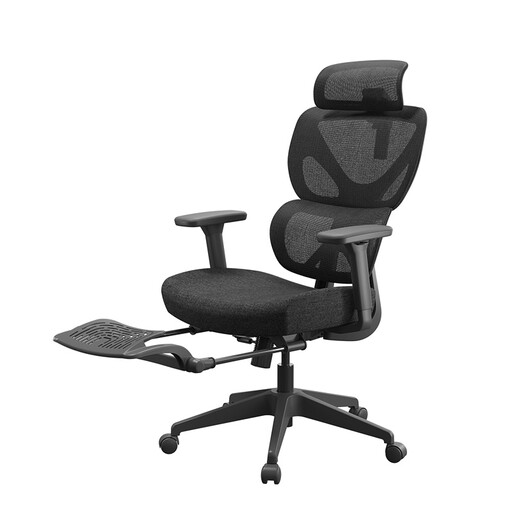
The highlights: The ultimate multi-purpose chair, equally suited for working, relaxing, reading, or watching a movie. The integrated footrest is the killer feature for total relaxation.
Rather than simple padding, it combines a 10 cm thick seat cushion with adaptive lumbar support and rotating armrests, offering dynamic rather than static support.
The retractable footrest transforms this office seat into a true relaxation chair. A rare versatility in this price range.
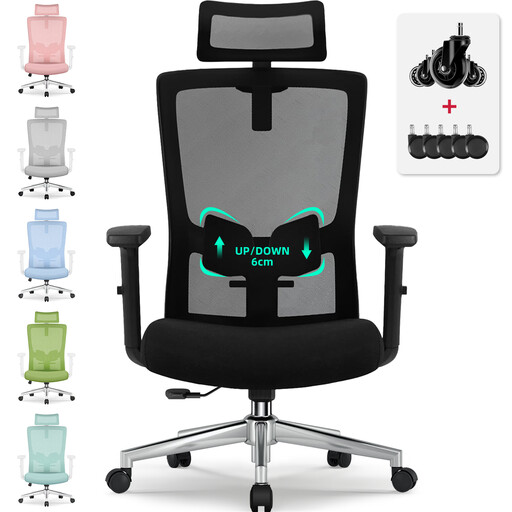
The highlights: An excellent starting point for students or occasional remote workers who want true ergonomic comfort without breaking the bank. It packs in essential features at a very accessible price point.
This model makes no compromises on safety. The manufacturer states that the gas lift and base have passed over 120,000 safety tests and are certified with BIFMA and SGS, a mark of quality that's rare at this price point.
It offers a full suite of adjustments (lumbar support, headrest, recline) often reserved for much more expensive models, all with quick and easy assembly.
A good chair is the foundation. But the right accessories can make all the difference. Optimize your workspace with our selection of products.
Start with the seat height: your feet should be flat on the floor with your knees at a 90-degree angle. Next, adjust the lumbar support to perfectly match the natural curve of your back. Finally, set the armrest height so your shoulders are relaxed and your forearms are parallel to the desk.
It all depends on the quality of the materials and the intensity of use. A chair with a metal frame, high-density foam, and certifications like BIFMA can last from 5 to 10 years. Entry-level models often show signs of wear (sagging foam, cracking upholstery) after only 1 to 2 years.
Mesh often ages better. High-quality mesh is very resistant to abrasion and won't deform. Conversely, low-quality faux leather (PU) can peel or crack over time, especially when exposed to heat or sunlight. As a bonus, mesh offers much better ventilation.