
Livraison le jour même ou le lendemain

Qualité garantie

Débloquez vos offres de bienvenue: Livraison GRATUITE | Jusqu'à -80 % | 30 jours d'essai gratuits à JoyPlus
Téléchargez l'application
Whether you work from home or in the office, spending long hours sitting down has become a part of our daily lives. This often leads to tension, discomfort, and the infamous back pain. In this context, an ergonomic office chair is no longer a luxury, but a crucial investment in your well-being and focus.
My role as Product Recommendation Officer at Joybuy is to help you make sense of it all. This guide breaks down the objective selection criteria and presents a curated selection of models to help you make an informed choice, all without the unnecessary marketing jargon.
Finding the right office chair depends on your body type, how you'll use it, and your work environment. Let's review the key criteria you shouldn't overlook.
An ergonomic office chair is defined by its multiple adjustment options. The more customisable it is, the better it will adapt to your body.
A chair's durability and comfort are directly linked to the quality of its materials.
Your workspace is another factor to consider. For an ergonomic chair for working from home in a compact space, flip-up armrests are very practical for sliding the chair under the desk to save space.
We have selected a few models that stand out from the crowd, designed to meet different profiles and needs.
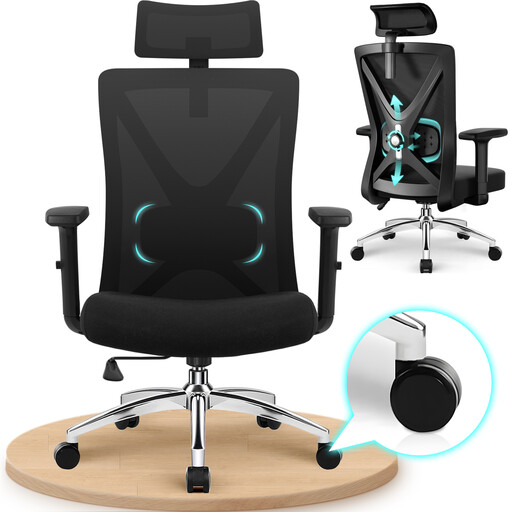
Why this model stands out: This chair stands out thanks to its dual-adjustment lumbar support (6 cm height and 3 cm depth), a level of fine-tuning rarely seen in this category. Its robust frame supports a maximum weight of 150 kg, and its 8 cm natural sponge seat cushion ensures lasting comfort without creating pressure points.
Pros:
Who is it for? Users looking for a sturdy chair, especially for larger body types. It's also perfect for those who require precise lumbar support adjustment to relieve back tension.

Why this model stands out: Its main selling point? Its flip-up armrests. This is a particularly clever feature for compact workspaces, typical when working from home, as it allows the chair to be pushed completely under the desk. With its simple and functional design, it's an effective all-rounder.
Pros:
Who is it for? Ideal for working from home and for people with limited space. It's an excellent choice for those who prioritise practicality and simple comfort without being bogged down by unnecessary adjustments.
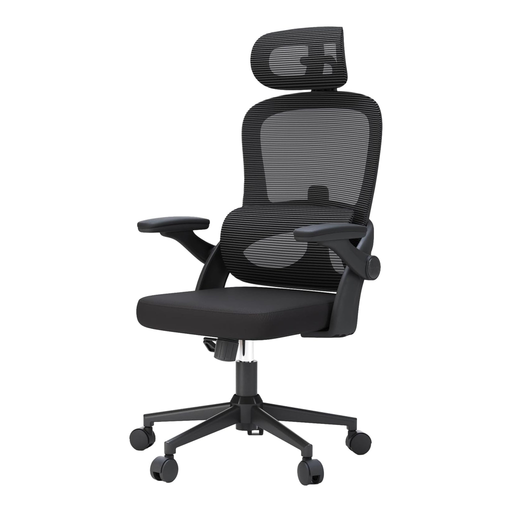
Why this model stands out: The SIHOO M102C is all about customisation. Its 3D armrests (adjustable forwards/backwards, pivoting, and height-adjustable) adapt to all your activities. The separate lumbar support, vertically adjustable by 6 cm, allows you to precisely target your lower back.
Pros:
Who is it for? Perfect for larger frames and for anyone who wants total flexibility in arm positioning, whether for typing, reading, or simply relaxing.
The ideal chair is, above all, the one that's right for you. If you haven't found what you're looking for in this selection, feel free to explore other models.
Discover our entire selection of office chairs
Proper adjustment is the key to good posture. Follow these steps:
A standard office chair merely offers basic seating, with adjustments often limited to height. An ergonomic office chair, on the other hand, is designed to adapt to your body through multiple adjustment points (lumbar support, armrests, headrest, tilt, etc.) to promote good posture, reduce fatigue, and prevent pain.
Several factors influence a chair's lifespan: the quality of its materials, frequency of use, and maintenance. In general, a quality model with a metal base and certified components can easily last you 5 to 10 years. Simple maintenance (tightening screws, cleaning castors) is often enough to extend its longevity.