
Livraison le jour même ou le lendemain

Qualité garantie

Débloquez vos offres de bienvenue: Livraison GRATUITE | Jusqu'à -80 % | 30 jours d'essai gratuits à JoyPlus
Téléchargez l'application
Whether you're working from home or cramming for exams, spending hours glued to your desk can quickly turn into a nightmare for your back. While the term "ergonomic office chair" is everywhere, it's too often used as a marketing veneer to hide flaws that only become apparent with use. Before you pull out your credit card, it's essential to know the pitfalls to avoid to make a purchase that truly benefits your posture and comfort.
To avoid buyer's remorse, the first step is to identify these deceptively bad ideas. Here are the three most common mistakes:
To find a chair that will stand the test of time, you need to read between the lines of product descriptions and focus on very specific technical features. Here are the points on which you should make no compromises.
It's the cornerstone of a good ergonomic chair: lumbar support. Forget the simple bump in the backrest; we're talking about a real mechanism designed to conform to and actively support the curve of your lower back.
The holy grail? An office chair with adjustable lumbar support. At a minimum, it must be height-adjustable to sit exactly at your lumbar region. More advanced models add depth adjustment to modulate the intensity of the support. It's this customisation that makes all the difference in maintaining a healthy posture and saying goodbye to pain.
A truly adjustable office chair goes far beyond a simple lever to raise or lower the seat. The tilt mechanism is crucial for moving and changing positions throughout the day.
The choice of upholstery isn't just a matter of taste: it directly affects the comfort and lifespan of your chair.
To help you move from theory to practice, our editorial team has scrutinised several promising models. We've categorised them by user profile, based on our objective criteria: adjustments, support, and material quality.
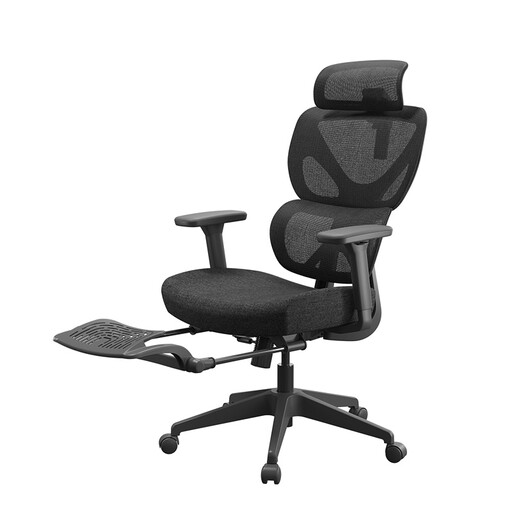
Who it's for: Designed for those who work 8+ hour days, this chair is all about long-term comfort. Its retractable footrest is a real bonus for taking a break or simply changing positions to relieve pressure on the legs.
It sidesteps the trap of low-quality materials with its 10 cm thick seat and a dynamic lumbar support that follows your movements—a far cry from simple foam that flattens out.
Integrated footrest for maximum relaxation. 3D armrests and dynamic lumbar support for a custom fit.
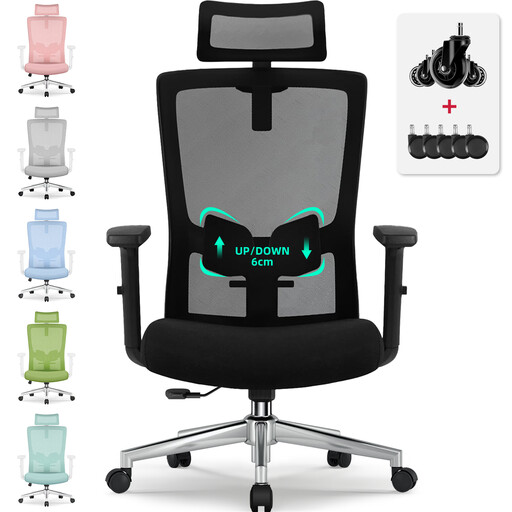
Who it's for: Perfect for mixed use (work and leisure), this chair focuses on robustness and safety. The BIFMA and SGS certifications for the gas lift and base are concrete guarantees of durability, a reassuring point for anyone looking for a model built to last.
It avoids the "fake lumbar support" issue by integrating a support that is adjustable by 6 cm in height, allowing for precise positioning. Its lockable recline up to 135° offers far more versatility than a simple tilt mechanism.
Certified components (BIFMA, SGS) for rock-solid reliability. Wide recline range (135°) and height-adjustable lumbar support.

Who it's for: Ideal for a student's room or a small home office, this clever model packs essential ergonomics into a compact design. Its real strength? The flip-up armrests, which allow the chair to slide under any desk for maximum space-saving.
It doesn't fall into the "design over everything" trap by prioritising function: it includes adjustable lumbar support, a comfortable seat, and a tilt function—rare options on entry-level chairs with a minimalist look.
Flip-up armrests for optimal space-saving. The winning combination: a breathable mesh back and a thick foam seat for the perfect balance of comfort and ventilation.
Our selection doesn't stop here. Discover our complete guide with dozens of models that meet our demanding criteria and current safety standards.
It all depends on the build quality and how you use it. A good model with a steel base, a certified gas lift, and high-density foam can easily last you 5 to 10 years. Conversely, an entry-level model with a lot of plastic and low-quality foam will show signs of wear (squeaking, flattened seat) within the first or second year. A little maintenance, like tightening the screws from time to time, also extends its life.
The perfect setup is unique to each person, but here are the basics to get you started:
It's primarily a matter of feel and work environment.