
Livraison le jour même ou le lendemain

Qualité garantie

Débloquez vos offres de bienvenue: Livraison GRATUITE | Jusqu'à -80 % | 30 jours d'essai gratuits à JoyPlus
Téléchargez l'application
Whether you're working from home or studying, spending hours glued to your desk can quickly turn into a nightmare. Back pain, a stiff neck, persistent fatigue… If these symptoms sound familiar, the culprit is often obvious: your chair. The ergonomic office chair market is flooded with promises, but it's also full of marketing traps that can be a costly mistake with disappointing results.
To ensure you don't regret your investment, you need to learn to see through the marketing hype. Here are the most common mistakes to avoid:
To find the durable and comfortable office chair that will support you for years, ignore the marketing claims and focus on objective criteria. Here are the three non-negotiable checkpoints.
A true ergonomic office chair must adapt to you, not the other way around. Make sure it offers at least the following adjustments:
Long-term comfort depends directly on the quality of the materials.
The stability and safety of your chair depend on its base. A five-star base made of metal (steel or aluminum) is a guarantee of durability far superior to plastic, which can crack over time. The maximum supported weight (often 120 kg or more on reputable models) is also a good indicator of robustness. Finally, check that the casters are suitable for your floor type (hardwood, tile, carpet) for a smooth, silent roll that won't cause scratches.
To help you see more clearly, here are a few models that perfectly illustrate these criteria, each suited to a specific type of user.

Why this model? Perfect for those who spend long hours in front of their screen. The adjustable headrest relieves neck tension, while the adjustable lumbar support and wide seat ensure lasting comfort, even after 8 hours of work.
This model avoids the "style over substance" trap by integrating practical adjustments (headrest, lumbar support) that have a direct impact on posture, steering clear of purely aesthetic gimmicks.
Full spinal support, from the neck to the lower back. The breathable mesh and flip-up armrests make it particularly versatile for intensive use.
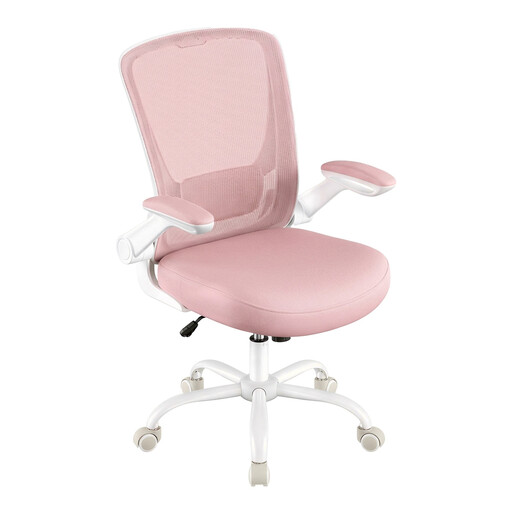
Why this model? Perfect for a desk corner in a living space. Its clean design and flip-up armrests allow it to slide completely under the desk. A real space-saver, without sacrificing ergonomics.
It avoids the "one-size-fits-all" trap with its height-adjustable lumbar support and armrests that adapt to the task (work or storage), offering a flexibility that fixed models lack.
The perfect balance of essential ergonomic features and a compact design. Its thick seat and breathable mesh back ensure optimal daily comfort.
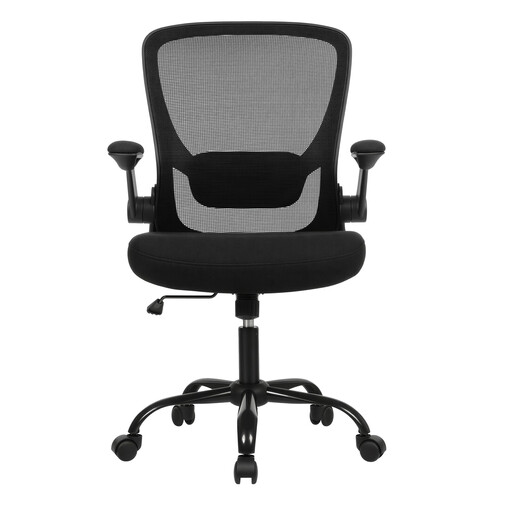
Why this model? For those who want the benefits of ergonomics without the frills. This model gets straight to the point: good lumbar support, a comfortable fabric seat, and the practicality of flip-up armrests.
It avoids the cheap materials trap with a resilient foam seat and a sturdy steel base. Durability is built-in where it counts, unlike entry-level models that wear out quickly.
It combines fundamental ergonomic adjustments (lumbar support, flip-up armrests) with a reliable build and a pleasant fabric finish. It offers excellent value for money.
Discover our complete selection of products that meet these demanding criteria, all designed for long-term support and comfort.
It depends heavily on the quality of the components. A model with a metal base, a Class 3 or 4 gas lift, and high-density seat foam can easily last 5 to 10 years with normal use. Conversely, entry-level models with plastic bases and low-quality foam show signs of wear (sagging, height loss) in just 1 to 2 years. The maximum weight capacity and the warranty period are excellent indicators of robustness.
Follow these four steps to find your ideal posture:
Yes, and for many, it's a real plus, largely thanks to its breathability. It prevents heat buildup and sweating during long workdays. Be careful, though: it all depends on the quality of the mesh. High-quality mesh offers firm, even support, whereas a low-grade weave will quickly sag and offer no support at all. The ideal combo is often a dense foam seat for comfort and a mesh back for support and ventilation.