
Livraison le jour même ou le lendemain

Qualité garantie

Débloquez vos offres de bienvenue: Livraison GRATUITE | Jusqu'à -80 % | 30 jours d'essai gratuits à JoyPlus
Téléchargez l'application
Remote work, long days at the office, intense gaming sessions... Poor seating is an almost certain guarantee of back pain and dwindling productivity. The ergonomic office chair market is a jungle, and not all promises of comfort are created equal. Before you invest, it's crucial to know how to avoid the marketing traps to make a truly informed choice.
As a product expert for Joybuy, my mission is to help you navigate this landscape. Here are the key red flags and essential criteria for choosing a chair that will support you for the long haul.
Ergonomics is an often-overused term. Many products carry this label without possessing the fundamental features. Here are the most common flaws that can make a chair uncomfortable, or even counterproductive.
To guarantee comfort and durability, focus on these three non-negotiable parameters. They separate a simple gadget from a genuine work tool.
This is the most critical element of a good ergonomic chair. Aim for a model with adjustable lumbar support that can at least be moved up and down. More advanced options offer depth adjustment (2D) or even dynamic support that adapts to your movements. This feature is essential for maintaining the natural curve of your spine and preventing lower back pain.
Be aware, not all mechanisms are created equal. A simple tilt mechanism leans the seat and backrest back as a single unit, which can lift your feet off the floor. Opt for a synchronous mechanism: when you lean back, the backrest reclines more than the seat (usually at a 2:1 ratio). This promotes a dynamic posture, stimulates blood circulation, and allows you to keep your feet firmly on the ground. A reclining office chair with a multi-position lock offers highly appreciated versatility.
A chair's longevity primarily depends on the quality of its frame. Check the maximum weight capacity, a crucial point if you're looking for a 150 kg office chair. Certifications like BIFMA or SGS are valuable indicators of reliability. They guarantee that the gas lift, base, and casters have undergone rigorous strength and safety tests. A metal base (steel or aluminium) is always more robust than a plastic equivalent.
Every user has specific needs. Here are a few recommended options, categorised by user profile, to help you find the right chair for remote work or the office.
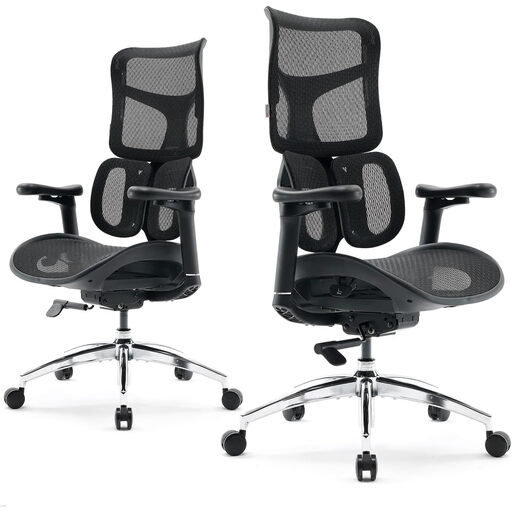
The Ideal User: Perfect for those who spend more than 8 hours a day at their desk and require dynamic, comprehensive support. Its precision adjustments ensure maximum comfort for intensive use.
Its dual dynamic lumbar support automatically adjusts to your movements, avoiding the problem of a static, poorly positioned support. The 4D armrests synchronise with the recline for continuous support.
The 4-spring dynamic lumbar support and coordinated 4D armrests offer state-of-the-art ergonomics. Its aluminium frame guarantees rock-solid durability.
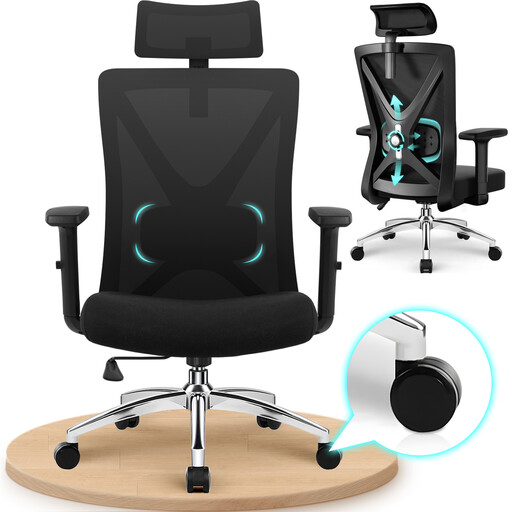
The Ideal User: Perfect for the remote worker or student looking for a reliable, fully adjustable chair without breaking the bank. It offers an excellent balance of essential features, comfort, and durability.
It includes lumbar support that's adjustable for height (6 cm) and depth (3 cm), a rare feature at this price point. The high-density nylon mesh back ensures excellent breathability.
High load capacity (150 kg) and a full suite of adjustments (height, armrests, headrest, recline up to 135°). An unbeatable feature-to-price ratio.
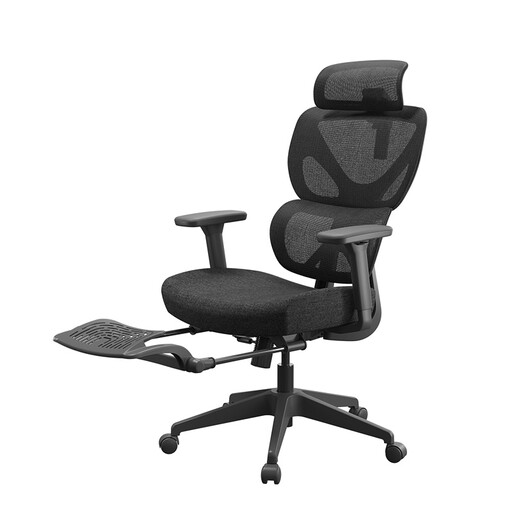
The Ideal User: Designed for those who like to alternate between focused work and moments of relaxation. The integrated footrest is a major asset for unwinding or changing position during breaks.
More than just a gimmick, this chair offers real ergonomic adjustments: an elastic lumbar support that adapts to pressure, rotating armrests, and an adjustable headrest, in addition to its recline function.
The retractable footrest, combined with a deep recline, transforms the chair into a true relaxation seat. The 10 cm thick seat cushion ensures plush comfort.
Discover our full selection of products that meet our strict selection criteria and safety standards.
Start with the height: your feet should be flat on the floor with your knees at a 90-degree angle. Next, adjust the seat depth to leave a space of 2 to 3 fingers between the edge of the seat and the back of your knees. Adjust the lumbar support to match the natural curve of your lower back. Finally, set the armrests so that your shoulders are relaxed and your forearms are parallel to the floor.
The lifespan depends on the quality of the materials and the intensity of use. An entry-level model will show its limits after 1 to 2 years. A well-maintained mid-range chair can last 5 to 7 years, while premium models with robust components (aluminium base, certified mechanisms) can last over 10 years.
For long work sessions, especially in a warm environment, mesh often outperforms leather or thick fabric. Its primary quality is its breathability, which prevents the build-up of heat and moisture. It also offers support that is both firm and flexible, ideally distributing pressure across the entire back.