
Livraison le jour même ou le lendemain

Qualité garantie

Débloquez vos offres de bienvenue: Livraison GRATUITE | Jusqu'à -80 % | 30 jours d'essai gratuits à JoyPlus
Téléchargez l'application
Whether you're working from home or in the office, the reality is often the same: spending hours sitting down can quickly lead to back pain and fatigue. Far from being a luxury, a good ergonomic office chair is a true investment in your health and productivity. The problem? The market is flooded with models making vague marketing promises, making the choice incredibly difficult.
Before you pull out your credit card, beware of the common traps. Many chairs claim to be "ergonomic" without offering the essential adjustments. Others sacrifice comfort for the sake of a flashy design. Finally, the most common mistake is overlooking durability, which leads to premature replacement and unnecessary expenses. This guide is here to help you decipher spec sheets and identify the features that truly make a difference.
To make an informed decision, you need to focus on objective parameters rather than marketing claims. Here are the three points you must check before any purchase.
Don't be fooled by a simple curved backrest. A true office chair with lumbar support must offer adjustable height, and ideally depth, to perfectly match the curve of your lower back. Poorly adjusted lumbar support is as counterproductive as having none at all. Check that the mechanism is easy to operate and provides firm support, even after several hours.
A good comfortable office chair is one that adapts to your body, not the other way around. Three adjustments are fundamental:
A chair's frame is the best indicator of its longevity. The base (the part with the casters) should be made of metal or reinforced nylon for rock-solid stability. The gas lift, which controls the height adjustment, is another key component: quality models are certified, a guarantee of reliability.
Finally, make it a habit to check the maximum load capacity. For total peace of mind and heavy-duty use, a model like a 150kg office chair is a safe bet that won't fail you after just a few months.
To help you see how these criteria apply in practice, here are a few options that meet specific needs.
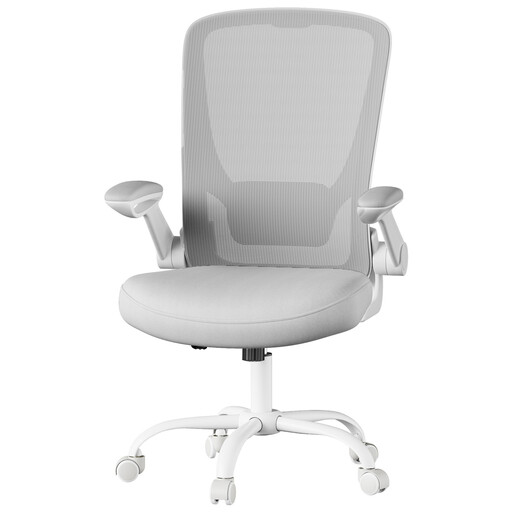
The smart choice: Perfect for a home office where every square inch is precious. Its minimalist design and light colour blend in anywhere, while its retractable armrests free up space in an instant.
This model doesn't bet everything on looks. It focuses on an ultra-practical feature: flip-up armrests. A simple solution that meets a real need for space optimisation, often overlooked by bulkier chairs.
Its breathable mesh back ensures excellent air circulation. It's the essential comfort feature for surviving long workdays, especially in the summer.
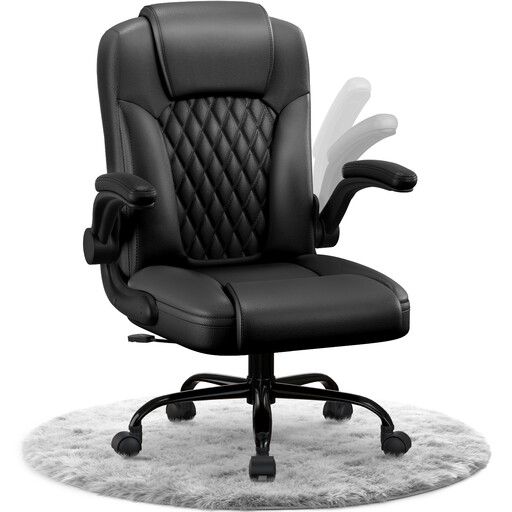
The elegant choice: For those who refuse to choose between a high-end aesthetic and flawless ergonomics. Its faux leather upholstery gives it a premium look, while its numerous adjustments ensure tailored comfort.
This chair proves that design and function are not mutually exclusive. It avoids the trap of stylish but uncomfortable seats by integrating real lumbar support, a 90° to 120° tilt, and flip-up armrests, all in a polished package.
The combination of a sturdy metal frame, capable of supporting 150 kg, and quality faux leather upholstery. An excellent compromise between durability and premium seating comfort.
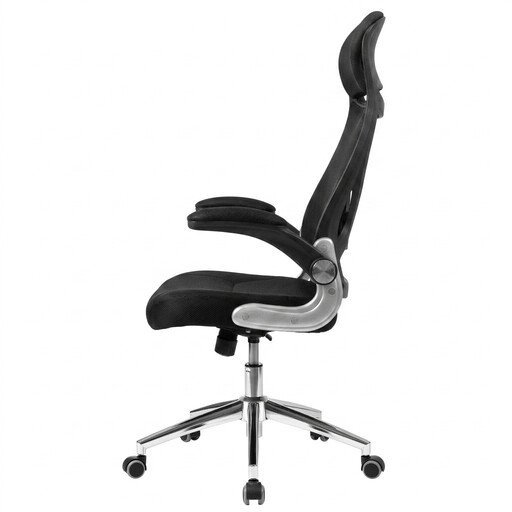
The marathon choice: Designed for those who spend long hours in front of their screen. The integrated headrest relieves neck strain, the high-density padding promises lasting comfort, and its high load capacity is a guarantee of rock-solid durability.
It goes beyond the simple "ergonomic" label by providing total support, from the neck to the lower back. It counters the trap of false sturdiness by clearly stating a 150 kg load capacity, a true mark of confidence for intensive use.
The combination of a headrest and lumbar support. Together, they offer complete postural support, ideal for reducing neck and back tension during long work sessions.
Beyond the chair, a well-designed desk, especially in a small space, relies on smart furniture. To maximise every square metre, discover our modular furniture solutions.
The perfect adjustment is achieved in 4 key steps.
It all depends on the build quality and your usage. An entry-level model will hardly last more than 2 or 3 years. In contrast, a well-designed chair (metal base, certified gas lift, quality upholstery) can last for 5 to 7 years, or even longer. Rely on the maximum load capacity: it's an excellent indicator of sturdiness.
Each material has its own advantages.