Remote work, long gaming sessions, or marathon days at the office: we spend a growing part of our lives sitting down. A sedentary lifestyle that often comes at a high cost: back pain, poor posture, chronic fatigue... Far from being a gimmick, an ergonomic office chair is a true investment in your health and productivity.
But with a dizzying array of options, how do you navigate the market? As product experts, our mission is to decode the market for you, separate the wheat from the chaff, and guide you toward an informed choice, beyond the marketing jargon. Follow our guide: here are the criteria that truly matter and our selection of the top models to watch in 2026.
Key Criteria for Choosing the Right Ergonomic Chair
Before you fall for a particular model, let's review the essential checklist. A good chair should adapt to you, not the other way around. Here are the three pillars of a successful choice.
1. Adjustability: The Key to Custom-Fit Ergonomics
A chair worthy of the name must conform to your body. Adjustability is therefore the number one criterion.
- Adjustable Lumbar Support: This is non-negotiable. Proper support for the small of your back is essential to maintain the natural curve of your spine. Prioritise a model where this support is adjustable in height and, ideally, in depth for precision support.
- Adjustable Armrests: Armrests that are adjustable in height (2D), depth, and angle (3D or 4D) are crucial. They allow your forearms to rest at the correct height (elbows at a 90° angle), thus relieving tension in your shoulders and neck.
- Seat Height and Depth: Your feet should rest flat on the floor with your knees bent at approximately 90°. Seat depth adjustment ensures your thighs are supported without the edge of the seat cutting off circulation behind your knees.
- The Headrest: Often optional, an adjustable headrest is not a luxury if you suffer from neck pain or like to recline while you think.
2. Materials: A Matter of Comfort and Durability
The choice of upholstery and seat foam is crucial for your daily comfort, as well as for the lifespan of your chair.
- Mesh Backrest: A must-have feature, the mesh backrest has one major advantage: its breathability. Air circulates freely, a real bonus during long workdays or in the middle of summer. This flexible material also conforms very well to the shape of your back.
- Fabric and Leather: Fabric, which offers a warmer feel, and leather (or faux leather), which is more stately and easy to maintain, are excellent alternatives. Be aware, however, that they are far less breathable than mesh.
- Seat Foam: For the seat, insist on high-density foam. It's the only way to guarantee firm support, prevent premature sagging, and ideally distribute pressure across your pelvis.
3. The Base and Casters: The Foundation of Your Chair
A good chair must swivel and roll smoothly to follow your movements. The combination of the base (the star-shaped part) and casters guarantees your stability and safety. A metal base (steel or aluminium) will always be more durable than a plastic equivalent. Also, remember to check that the casters are suitable for your floor type (hardwood/tile or carpet) for a quiet, scratch-free roll.
Our Top Ergonomic Chair Picks
We've sifted through dozens of models to select just three that stand out from the crowd, each with its own unique strengths.
1. Ochama Mesh Office Chair, Beige
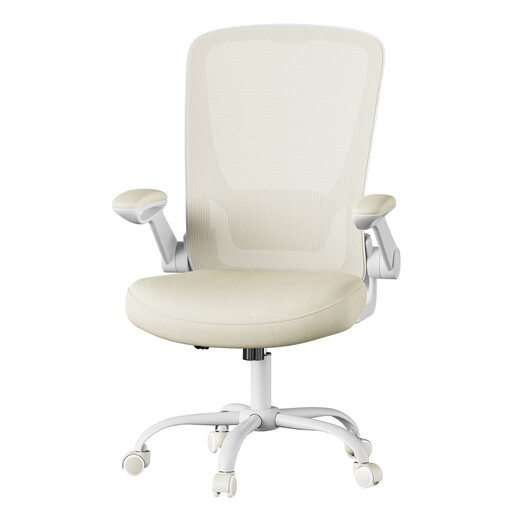
Ochama Mesh Office Chair, Ergonomic and Swivelling, Flip-Up Armrests, Beige
- Key Feature: This model excels in both design and clever functionality. With its clean lines and beige colour, it blends seamlessly into contemporary interiors. But its real trump card is its flip-up armrests: once raised, they allow the chair to slide completely under the desk. A smart space-saving feature.
- What we love:
- Flip-up armrests for optimised storage.
- Curved backrest with integrated lumbar support.
- Thick, resilient seat for lasting comfort.
- Rocking mode for moments of relaxation.
- Who is it for? The ideal choice for remote workers and students looking for a compact and stylish solution without sacrificing fundamental ergonomics.
2. SIHOO M102C Ergonomic Office Chair
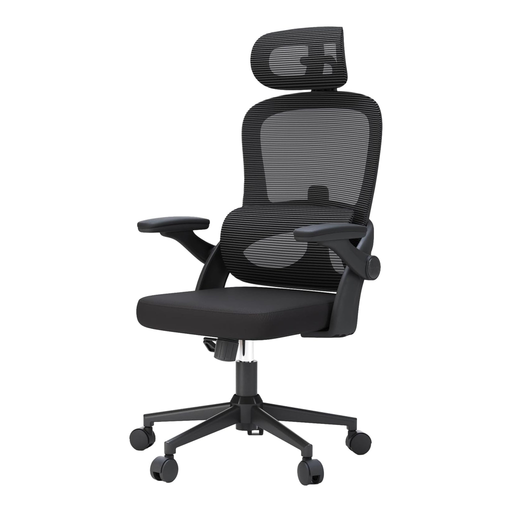
SIHOO M102C Ergonomic Mesh Office Chair, High Back, 3D Armrests, Adjustable Lumbar Support, Black
- Key Feature: The SIHOO M102C is all about customisation. Its independent lumbar support, adjustable in height by 6 cm, allows for pinpoint positioning. Add to that its 3D armrests (height, depth, pivot), and you get an ultra-versatile chair that adapts to all your activities.
- What we love:
- Advanced ergonomic adjustments (lumbar, 3D armrests, headrest).
- High, breathable mesh back for full support.
- Wide, padded seat with high-density foam.
- Weight capacity of up to 136 kg.
- Who is it for? Perfect for heavy users who demand maximum adjustability to prevent RSI (Repetitive Strain Injuries). Its robust design is also well-suited for larger individuals.
3. GTIMEX Ergonomic Office Chair
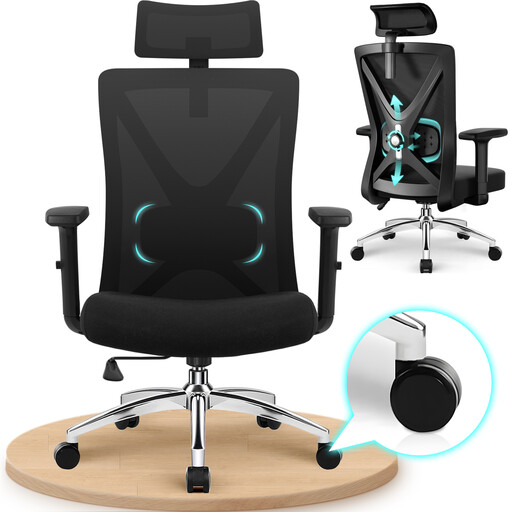
GTIMEX Ergonomic Office Chair with Adjustable Armrests, Soft Lumbar Support, and Headrest
- Key Feature: Here, the focus is on robustness and absolute comfort. Capable of supporting up to 150 kg and reclining to 135° for relaxing breaks, it's a heavyweight in its class. Its masterstroke? Lumbar support that's adjustable not only in height (6 cm) but also in depth (3 cm)—a rare and decisive feature for perfect support.
- What we love:
- Very high load capacity of 150 kg.
- Generous recline up to 135° for relaxation.
- Lumbar support adjustable in both height and depth.
- Thick 8 cm seat made of natural sponge for maximum comfort.
- Who is it for? The chair of choice for larger individuals or those seeking rock-solid durability. Its recline and advanced lumbar adjustment make it an excellent ally for alternating between intense work phases and moments of relaxation.
Go Further: Optimise Your Workspace
A good chair is the foundation, but a truly ergonomic workstation doesn't stop there. Thinking about your desk organisation is also key to fighting eye strain and muscle tension.
To fine-tune your setup, take a look at our selection of rotating desk stands and other accessories designed for your comfort.
Your Questions, Our Answers
How do you properly adjust an ergonomic office chair?
A perfect adjustment is achieved in 5 steps:
- Seat Height: Sit down and adjust the height until your feet are flat on the floor and your knees are at a 90° angle.
- Seat Depth: Leave a gap of two to three fingers between the edge of the seat and the back of your knees.
- Lumbar Support: Adjust it to fit and support the natural curve of your lower back.
- Armrests: Adjust them so your elbows form a 90° angle when your shoulders are relaxed.
- Headrest: Position it to support the base of your skull and your neck, without pushing your head forward.
What is the average lifespan of an office chair?
A good ergonomic chair can last between 5 and 10 years. It all depends on the quality of its components (metal base, foam density, mechanism), your usage, and its maintenance. Regular cleaning and occasional tightening of the screws will make all the difference to its longevity.
Is a mesh back a good option?
Absolutely. The mesh back is popular for one simple reason: its exceptional breathability, which is ideal for preventing overheating. Being flexible, it also conforms very well to the shape of your back. If you prefer a softer feel or more enveloping support, fabric or leather backs remain solid choices. Ultimately, it's a matter of feel and personal preference.


