
Livraison le jour même ou le lendemain

Qualité garantie

Débloquez vos offres de bienvenue: Livraison GRATUITE | Jusqu'à -80 % | 30 jours d'essai gratuits à JoyPlus
Téléchargez l'application
Spending hours at your desk, whether working from home, studying, or for leisure, should never mean back pain and discomfort. Yet, choosing an ergonomic office chair often feels like an uphill battle. Between aggressive marketing and confusing spec sheets, it's easy to make a mistake.
As a Product Expert at Joybuy, my mission is to help you cut through the noise. Let's forget the technical jargon and focus on what truly matters. Here are the pitfalls to avoid and the criteria that really count for making the right choice.
To avoid these traps, focus on three fundamental points. These are what separate a gimmick from a true ergonomic office chair.
Back pain often stems from poor lower back support. A good office chair with lumbar support doesn't just have a vague, fixed bump in the backrest. It must offer adjustment—at least for height—to fit perfectly into the curve of your lower back. More advanced models add depth adjustment for more or less pronounced pressure. This is a non-negotiable feature for anyone looking to protect their back.
The mesh backrest is popular for its breathability, a real asset during long workdays. Be warned, not all mesh is created equal. A quality mesh should be flexible enough to conform to your back's shape but also taut enough to provide firm support that won't sag over time. For the seat, opt for high-density foam: it ensures better weight distribution and will save you from that infamous "sitting on a wooden plank" feeling after a few hours.
They are often overlooked, yet armrests are essential. They significantly relieve tension built up in the shoulders and neck.
To help you see these criteria in action, here are a few models that meet specific needs while avoiding the pitfalls we've mentioned.

The verdict : Perfect for a home office where every inch counts. Its flip-up armrests let you slide it under the desk in a flash, while essential adjustments (height, lumbar, headrest) ensure excellent comfort for a standard workday.
This model doesn't just make a vague "ergo" promise. It provides a concrete solution to space constraints with its flip-up armrests and meets a real need for comfort with its adjustable lumbar support.
Its versatility. It combines work-focused comfort with a smart space-saving feature, making it the king of multi-functional spaces (office, bedroom, living room...).
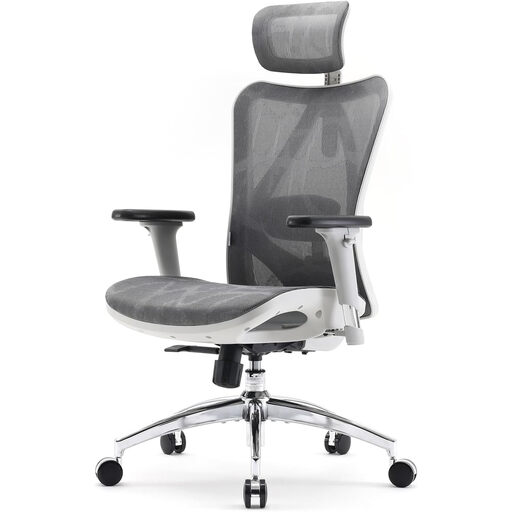
The verdict : Designed for those who spend more than 8 hours a day seated. The Sihoo M57S chair takes it to the next level with its advanced adjustments, including 3D armrests and dynamic lumbar support, for a precision fit and perfect support from morning to night.
It shatters the "one-size-fits-all" myth by offering a wealth of adjustments. Its 3D armrests and adaptive lumbar support allow for a surgical-level fit to your body and habits, a rarity at this price point.
Extreme customisation. Every contact point (head, back, lumbar, arms) adjusts independently to sculpt THE ideal working posture—yours.
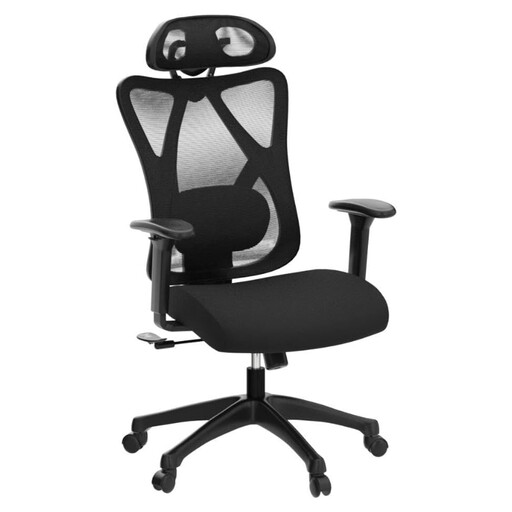
The verdict : For those on a controlled budget who refuse to compromise on the essentials. This model includes an adjustable lumbar cushion and a solid frame, laying the foundation for good ergonomics without breaking the bank.
It avoids the classic trap of "all-fixed" entry-level models. By integrating an adjustable lumbar cushion and supporting up to 150 kg, it proves that a tight budget can still mean robustness and useful adjustments.
Its excellent feature-to-price ratio. It gets straight to the point: adaptive lumbar support, a reassuring weight capacity, and a seat built to last.
We have curated a complete selection of chairs that meet our quality criteria and European safety standards.
1. What is the lifespan of a good office chair? The lifespan depends on the quality of the materials and the intensity of your use. An entry-level model will show signs of wear after 2 to 3 years. A well-made chair with a metal frame and quality mesh can easily last you 5 to 10 years. The manufacturer's warranty is often an excellent indicator.
2. How do I properly adjust my chair to avoid back pain? Start with the seat height: your feet should be flat on the floor with your knees at an approximately 90-degree angle. Next, adjust the lumbar support to perfectly match the natural curve of your lower back. Finally, set the armrests so your forearms can rest on them naturally without your shoulders shrugging up.
3. Is a mesh backrest really better? Comfort is subjective, but mesh offers an undeniable, objective advantage: breathability. It allows air to circulate, which is a huge plus during long work sessions, especially in the summer. In terms of support, a high-quality, taut mesh is just as effective as a padded backrest, with the added benefits of being lightweight and airy.