
Livraison le jour même ou le lendemain

Qualité garantie

Débloquez vos offres de bienvenue: Livraison GRATUITE | Jusqu'à -80 % | 30 jours d'essai gratuits à JoyPlus
Téléchargez l'application
With the rise of remote work and long days at the office, one problem has become all too common?: discomfort and pain from poor posture. An ergonomic office chair is no longer a luxury, but an essential investment in your daily health. The catch?? The market is saturated with models where the term "ergonomic" is more of a marketing buzzword than a true guarantee of comfort.
As the Head of Product Recommendations at Joybuy, I'm here to help you navigate the options. Let's break down the common pitfalls to avoid and the technical criteria that truly make a difference for a successful purchase.
Before you even start comparing models, it's crucial to know how to spot the common traps that can cost you dearly—both in money and back pain.
To make the right choice, focus on a handful of non-negotiable technical features. These, and only these, guarantee lasting comfort and support that is genuinely tailored to your body.
Lower back support is fundamental. A simple cushion or a fixed curve is not enough. Look for an office chair with lumbar support that is at least height-adjustable, allowing you to position it perfectly in the small of your back. More advanced models also offer depth adjustment or even dynamic support that moves with you for constant reinforcement.
A good chair should adapt to you, not the other way around. Make sure it has the following adjustments:
For intensive use, the choice of materials is paramount. A breathable office chair, often featuring a mesh back, ensures excellent air circulation and prevents overheating. For the seat, opt for high-density foam that will retain its shape and support over time. A "waterfall" seat edge (gently sloping downwards) is also a plus for reducing pressure under the thighs.
To illustrate these criteria, here are a few models that meet specific needs, focusing on features that deliver real added value.
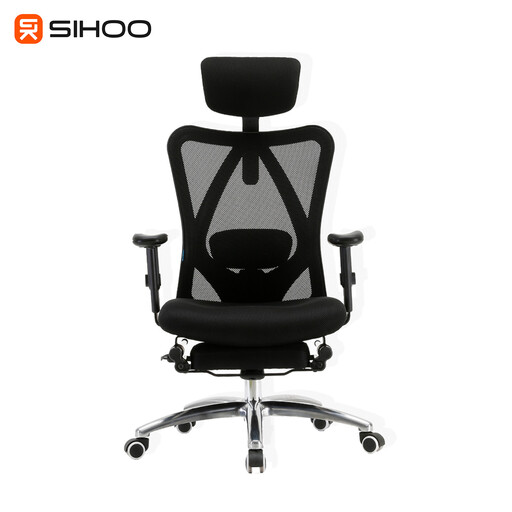
Why this choice ? Ideal for those who spend more than 8 hours at their desk and need to alternate between intense work phases and moments of relaxation. Its high back, headrest, and especially its footrest make it the perfect companion for unwinding without ever leaving your workstation.
It avoids the trap of faux-ergonomic design with its 5 adjustment points (lumbar support, headrest, height, tilt, armrests). Its mesh back and high-density foam seat bypass the pitfall of low-quality materials that age poorly.
Its key feature : the integrated adjustable footrest, which allows for near-total relaxation. Its aluminium alloy base and SGS & BIFMA certifications are guarantees of sturdiness (it supports up to 150 kg).
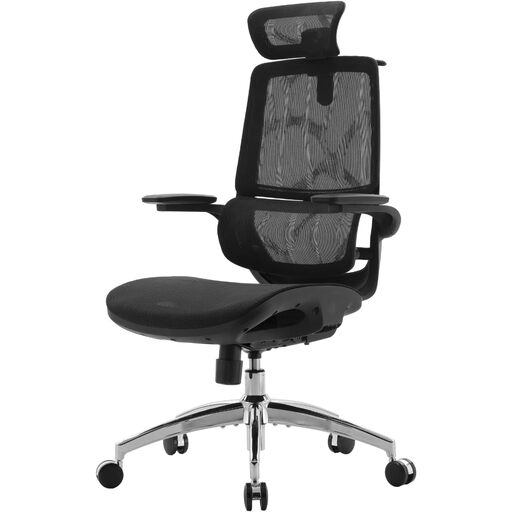
Why this choice ? Perfect for apartments or home offices where every square inch counts. Its flip-up armrests allow the chair to be slid completely under the desk for maximum space-saving. It's also suitable for people who need to free up their movements (like for playing the guitar, for example).
This Sihoo model avoids the trap of superficial ergonomics thanks to its dual backrest with adaptive lumbar support, which dynamically adjusts to your posture. Its coordinated 3D armrests offer far superior comfort compared to fixed or 1D models.
Its signature feature : the 80° flip-up armrests, perfect for optimising space. The wide, saddle-shaped seat and breathable nylon mesh back ensure excellent comfort, even during long work sessions.
Because a great chair deserves a great desk, discover our selection to create a truly optimised workstation.
Start with the seat height?: your feet should be flat on the floor and your knees at a 90-degree angle. Next, adjust the lumbar support so it perfectly matches the natural curve of your back. Finally, set the armrest height so your forearms rest on them naturally, without your shoulders being either raised or slumped.
It all depends on the quality of the components and the intensity of your use. An entry-level model will show its limits after 1 to 2 years. In contrast, a quality chair with a metal frame, a sturdy base, and certifications like BIFMA can easily last you for 5 to 10 years. Regular maintenance (cleaning, tightening screws) will extend its lifespan even further.
Absolutely, it's a crucial element. Prolonged sitting tends to flatten the natural curve of the lower back (the lumbar lordosis), which increases pressure on the intervertebral discs and can cause pain. Well-adjusted lumbar support helps maintain this curve, distribute pressure more evenly, and thus significantly reduce fatigue and the risk of back pain.