
Livraison le jour même ou le lendemain

Qualité garantie

Débloquez vos offres de bienvenue: Livraison GRATUITE | Jusqu'à -80 % | 30 jours d'essai gratuits à JoyPlus
Téléchargez l'application
Working from home, doing homework, attending video meetings or enjoying the occasional gaming session: an ergonomic office chair should suit how you use it, your body shape and the space available. The problem is that product descriptions sometimes pile on the promises — “ergonomic”, “long-lasting comfort” and “enhanced support” — without explaining which adjustments are available or the model’s limitations.
Before choosing your ergonomic computer chair, here are the main pitfalls to avoid and the key features to compare.
An S-shaped backrest can improve support, but that does not necessarily mean it will suit your height. For everyday use, check for adjustable lumbar support, with adjustable height or depth. A fixed cushion may work for some users, but it will be less versatile if several people use the same chair.
An adjustable office chair should not be judged solely by its maximum angle. Also check whether the backrest can be locked in the working position, whether the mechanism tension can be adjusted and whether the recline remains stable. An angle of 125° or 135° may be comfortable for a break, but the working position should remain sufficiently controlled.
A chair that is too wide can reduce the space available beneath your desk. Conversely, a seat that is too short or narrow may become uncomfortable after several hours. Compare the seat dimensions, height adjustment range and static load capacity stated by the manufacturer. A chair rated for 150 kg does not necessarily mean that all its components are designed for intensive use without maintenance.
To work comfortably, your feet should rest flat on the floor and your legs should remain in a natural position. A height-adjustable seat allows you to adapt the chair to a standard desk, a higher worktop or a student’s table.
Also look at the seat width and depth. The GTIMEX model, for example, offers a seat 50 cm wide and 53 cm deep and recommends a user height between 155 and 185 cm in its product description. This kind of information is far more useful than simply mentioning “comfort”.
Flip-up armrests are particularly practical in a small room: they allow you to slide the chair under the desk or quickly free up space. Height-adjustable armrests can also help align your forearms with the work surface.
An office chair with a headrest may be useful if you alternate between working and taking breaks in a reclined position. However, the headrest must be at the right height to support your neck. An adjustable model will always be more adaptable than a fixed headrest.
A breathable mesh office chair improves airflow through the backrest, which is especially welcome in a heated room or during a long session. The seat may be made from foam, fabric or mesh: compare its thickness, width and stated maximum load.
Also remember to examine the base, castors, lifting mechanism and assembly instructions. On a wooden floor or other delicate surface, a protective mat will help reduce marks and friction.
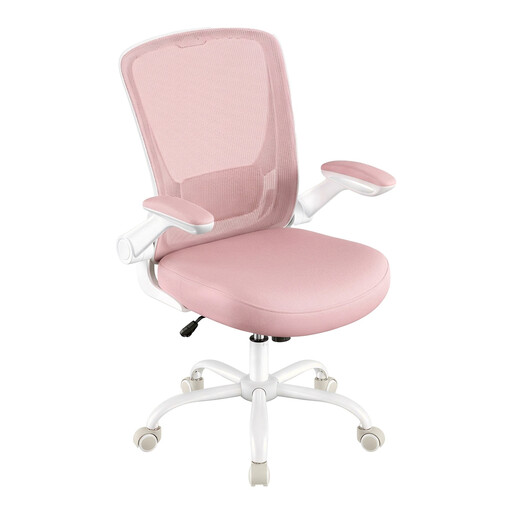
Why this choice suits this profile : Its flip-up armrests and compact design fit easily into a home office where every centimetre counts.
The product description mentions height and lumbar support adjustment, rather than simply offering a fixed backrest. The rocking function is specified as ranging from 90° to 105°.
Thick, padded seat, breathable fabric backrest, flip-up armrests and a stated static load capacity of up to 120 kg.
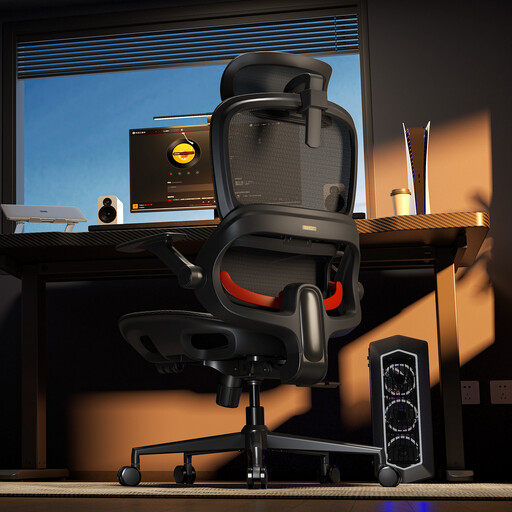
Why this choice suits this profile : Its footrest and three recline angles are ideal for those who want to switch from work to reading and then to relaxing without changing chairs.
The stated angles of 110°, 123° and 135° provide clear, practical reference points. The backrest and mesh seat are also described separately.
Adaptive lumbar support, a wide headrest, flip-up armrests and castors designed for easy movement.
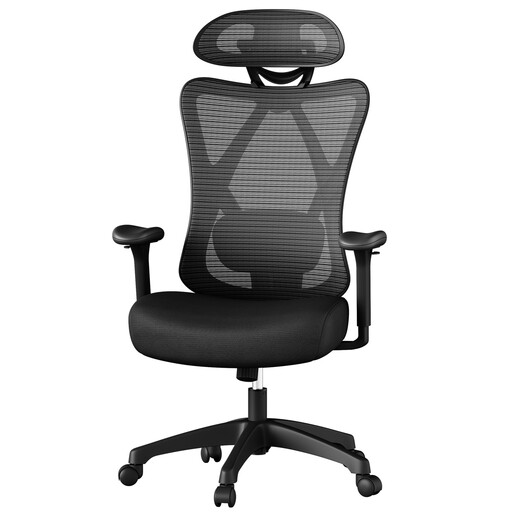
Why this choice suits this profile : Its stated static load capacity of up to 150 kg and numerous adjustments meet the needs of a workstation used for several hours a day.
The product description details the dimensions, maximum load and adjustments for the seat, lumbar support, armrests and headrest.
Breathable mesh backrest, foam seat, reclining backrest and stated dimensions of 70 × 70 × 115–125 cm.
After assembly, start by adjusting the height so that your feet touch the floor. Then adjust the armrests so that your shoulders remain relaxed, and position the lumbar support at a level that feels natural. When you are working, the backrest should not push you forwards.
To keep your office chair in good condition over the years:
Choose a model with adjustable height, adjustable lumbar support, a sufficiently wide seat and a breathable backrest. Flip-up armrests are particularly useful if your desk is narrow. A reclining chair can also make it easier to alternate between work and breaks, provided its mechanism is stable.
Mesh improves airflow through the backrest and can reduce the feeling of heat. However, it cannot compensate for a poorly sized seat. Before buying, check the quality of the padding, the seat width and the stated maximum load.
Routine maintenance generally involves cleaning, tightening the screws and, if necessary, replacing the castors or a mechanism component. Check the warranty terms and the availability of spare parts before ordering: these factors can affect the long-term cost of use.