
Livraison le jour même ou le lendemain

Qualité garantie

Débloquez vos offres de bienvenue: Livraison GRATUITE | Jusqu'à -80 % | 30 jours d'essai gratuits à JoyPlus
Téléchargez l'application
An ergonomic neck pillow isn’t something you should choose based solely on its appearance or the promises on the packaging. Its height, material, your sleeping position and the care requirements all directly affect your day-to-day comfort. A pillow that’s too high can misalign your head, while one that’s too soft is likely to lose its shape in no time.
Whether you sleep on your side, back or front, whether you’re a senior, a student or someone who spends long hours in front of a screen, here are the criteria to consider before buying, along with a selection tailored to different needs.
A height of 8 cm isn’t automatically suitable for every body type. The right volume depends largely on your shoulder width and sleeping position. Someone who sleeps on their side will generally need more thickness to fill the gap between the shoulder and head. If you sleep on your front, a thinner pillow will often be more comfortable.
So don’t just check the height – also look at the pillow’s shape and its ability to keep your head aligned with your spine.
A memory foam pillow can offer gradual support, but not all models have the same density or construction. A uniform foam often gives a hugging sensation, whereas a multi-layer structure aims to balance initial comfort with proper support.
Foam also tends to retain more heat than natural fillings. A cover described as breathable, thermoregulating or designed to wick away moisture deserves your close attention.
A pillow delivered vacuum-packed may need several hours to regain its shape. Some manufacturers recommend letting it air out for 24 to 48 hours to reduce manufacturing odours. The foam core generally can’t be machine-washed, unlike some covers or feather-filled models.
Before ordering, check the care instructions, whether the cover is removable and any precautions specific to the material used.
To choose an ergonomic pillow for sleeping on your side, back or front, go for a shape that keeps your head supported without straining your neck. A central dip can help stabilise your head, while contoured edges can better support your neck and shoulders.
Versatile models work well for people who change position regularly, but they don’t replace the need for precise height adjustment.
Slow-release foam gradually moulds to the contours of your head. It suits people who want stable support and a hugging feel. A multi-layer design, on the other hand, can offer several levels of firmness.
If you prefer natural fillings, you might consider a duck feather pillow. This type generally offers a softer, more breathable feel. Its thickness can vary depending on the loft and how the filling settles.
A 60 x 60 cm pillow will suit those who appreciate a generous surface area and a traditional style. When travelling, size and weight become priorities – a compact, inflatable cushion takes up far less space in a bag.
For everyday use, choose a cover that can be removed and check the maximum washing temperature. A breathable, washable pillow can be easier to maintain, provided the manufacturer clearly states which parts are machine-washable.
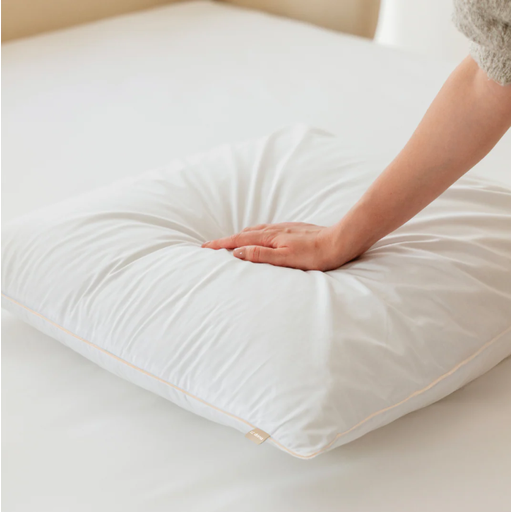
Why this suits this profile: Its natural filling and 100% cotton cover appeal to those looking for a large format with a soft, plush feel.
The composition is clearly detailed: 90% duck feathers and 10% duck down. According to the product page, it can be machine-washed at up to 40 °C.
60 x 60 cm format, stated thickness of 20 cm, cotton cover and certifications mentioned on the product page.
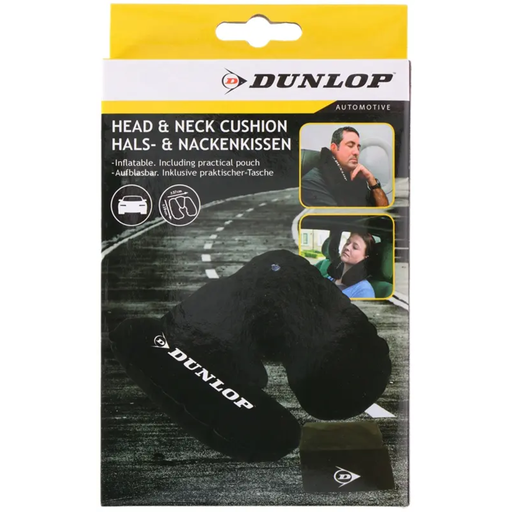
Why this suits this profile: This neck cushion for car or plane inflates and deflates after use, making it easy to carry in a bag or suitcase.
The stated weight of 100 g and the inflatable function are clearly specified. The product page also reminds you to keep it away from sharp objects.
PVC, compact when deflated, 100 g weight and intended for use in car, train, bus or plane.
We’ve put together a comprehensive, real-time updated list of products that fully meet these strict selection criteria and European safety regulations.
The ideal height depends on your sleeping position, shoulder width and mattress firmness. Someone who sleeps on their side may need more volume than someone who sleeps on their front. A stated height of 8 cm provides a point of comparison, but doesn’t guarantee the same comfort for everyone.
A few nights of adjustment may be necessary, especially if you’re switching from a very soft pillow to a structured foam one. Start by checking the pillow’s orientation and the position of your head. If discomfort persists, it’s best to stop using it and reconsider the height or shape you’ve chosen.
Follow the manufacturer’s instructions. On foam models, the cover can often be washed separately, while the core should stay out of the machine and air-dry away from direct heat. A feather pillow can sometimes be machine-washed, as indicated on the product page for the model in question.