
Livraison le jour même ou le lendemain

Qualité garantie

Débloquez vos offres de bienvenue: Livraison GRATUITE | Jusqu'à -80 % | 30 jours d'essai gratuits à JoyPlus
Téléchargez l'application
An ergonomic memory foam cervical pillow can genuinely improve your comfort during the night, provided you choose a shape and height suited to your body. Whether you sleep on your side, sleep on your back, are prone to neck tension or simply want better support, your purchase should not be based on a marketing promise alone.
A few details can make all the difference between a pleasant surprise and a disappointing purchase.
The term ‘ergonomic’ does not refer to any standardised shape. A cervical pillow for sleeping may feature a central recess, raised edges or a curved design. Its comfort also depends on the width of your shoulders, the firmness of your mattress and your sleeping position.
A model that is too high may keep your head tilted forwards when you sleep on your back. Conversely, insufficient height may leave your neck unsupported when sleeping on your side.
Viscoelastic foam gradually responds to your body weight and warmth. It therefore moulds more closely to the contours of your head than traditional filling. That does not mean it will feel soft to everyone. Dense foam can provide firm support, while shredded foam offers a more adaptable feel.
To avoid disappointment, check the type of foam, the stated height and the recommended sleeping positions.
A removable, washable cover generally refers to the outer layer, not the foam core. A pillow that is fully machine washable is still unusual. Take the time to read the care instructions before placing your order.
There may also be a manufacturing odour when you first open the package. Leave the pillow to air for 24 to 48 hours, as recommended by the manufacturer, before using it.
The height should suit your sleeping position:
Some models state a height of 8 or 12 cm. These figures alone are not enough to predict comfort: the pillow’s width and the firmness of your mattress also play an important role.
A pillow with neck support may feature a lowered central area, a cervical curve or edges of different heights. The central recess should support your head without creating uncomfortable pressure. The contours should also allow for your movements during the night.
If you switch between sleeping on your side and on your back, choose a shape described as versatile. People who sleep exclusively on their side can browse our selection of orthopaedic pillows for side sleepers.
A breathable pillow may feature ventilation channels or perforated foam. These elements help air circulate, but do not guarantee the same cool feeling for everyone. The cover’s composition also deserves your attention: polyester, lyocell, knitted fabric and inner lining do not offer the same feel or moisture management.
If you have sensitive skin or allergies, check the available information about the materials and certifications. The STANDARD 100 by OEKO-TEX label, when shown on the product page, indicates that the product has undergone checks for certain unwanted substances. However, it does not replace reading the full composition or taking the necessary precautions in the event of a known allergy.
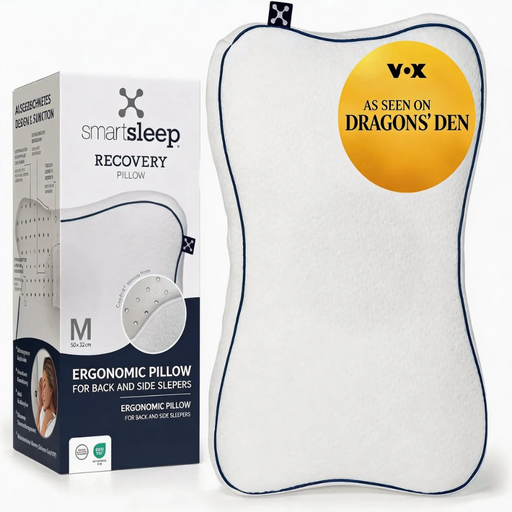
Why this choice suits this profile : Its design is aimed at back and side sleepers looking for viscoelastic foam with integrated air channels and certified materials, according to the product information.
The product page clearly distinguishes between the foam core, air channels and certified materials, rather than relying solely on a promise of comfort.
Head recess, memory foam, integrated airflow and a stated 30-night home trial period.
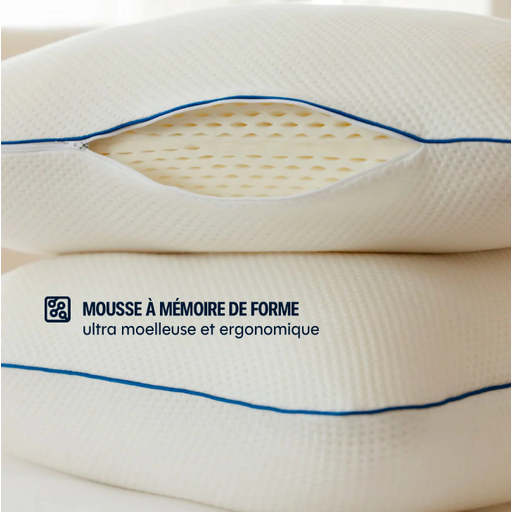
Why this choice suits this profile : Its 60 x 60 cm size, perforated foam and removable cover make it suitable for users who prioritise space, ventilation and regular care.
The product page details the fabric, inner cover, perforated foam and machine washing of the cover, without claiming that the core itself is washable.
60 x 60 cm size, 12 cm thickness, perforated foam and a removable cover stated to be machine washable.
We have put together a complete, real-time updated list of products that meet these demanding selection criteria and European safety requirements.
When your pillow arrives, leave the foam to regain its shape on a flat surface. Air the room before the first night, particularly if you notice a manufacturing odour. For care:
The lifespan depends on the density of the foam, how often it is used, humidity and care. There is no universal lifespan that applies to every pillow.
Start by comparing the pillow’s height with the width of your shoulders and the firmness of your mattress. When sleeping on your side, you may need a higher pillow. On your back, a thinner model or one with a central recess may be more suitable. It may take a few nights to get used to it.
It may provide a feeling of support, but it is not a medical treatment. If the pain persists, gets worse or is accompanied by other symptoms, seek advice from a healthcare professional. Above all, choose a height that does not push your head forwards or to one side.
Air it regularly, use a suitable pillowcase and wash the cover according to the instructions on its label. Claims such as ‘hypoallergenic’, antibacterial or dust-mite resistant should be checked on the product page; they do not remove the need to check its composition if you have a known allergy.