
Livraison le jour même ou le lendemain

Qualité garantie

Débloquez vos offres de bienvenue: Livraison GRATUITE | Jusqu'à -80 % | 30 jours d'essai gratuits à JoyPlus
Téléchargez l'application
Spending hours in front of a screen, whether for gaming or remote work, can quickly become a nightmare for your back and neck. An ergonomic gaming chair isn't a luxury, but a genuine investment in your comfort and health. The problem? The market is flooded with marketing promises and models that all look the same. To avoid disappointment, let's break down the pitfalls to avoid before you pull out your credit card.
Here are the 3 most common mistakes to avoid:
To avoid being fooled by appearances, focus on objective technical criteria. Here are the key points to inspect closely.
A reclining gaming chair is nice, but true ergonomics lies in the details and customisation. Make sure the model you're eyeing offers at least the following:
A chair's durability depends on its skeleton. Insist on a steel frame, which guarantees the overall sturdiness. Another crucial point is the gas lift (the cylinder that adjusts the height). Check its class (Class 4 is the gold standard for reliability) and safety certifications like BIFMA or SGS.
Finally, pay close attention to the advertised load capacity. If you're looking for a 150kg gaming chair, ensure this capacity is clearly specified and supported by a wide, solid base, most often a five-star metal design.
For those who use their chair for gaming, working, and also relaxing with a movie, a gaming chair with a footrest is a game-changer. A good telescopic footrest should be easy to deploy, stable, and made from robust materials to support your legs without flinching. This is what elevates the chair from a simple office seat to a truly versatile personal cocoon.
To move from theory to practice, here is our selection of models that check all the right boxes for different uses.
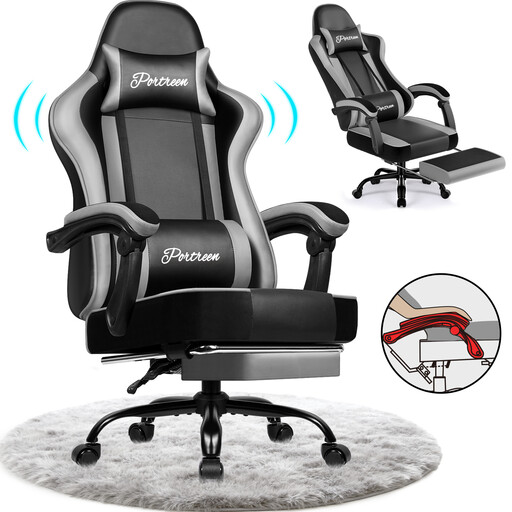
Why It's a Match: Perfect for juggling intense gaming sessions, remote workdays, and relaxation breaks. Its telescopic footrest instantly transforms it into a true recliner.
This model goes beyond the simple "gamer" look. It focuses on substance: a generous recline (90-170°) and a stable footrest, delivering versatility that isn't just marketing fluff.
Its telescopic footrest with a metal frame and its water-resistant, easy-to-clean PU leather upholstery make it a comfortable and practical daily companion.
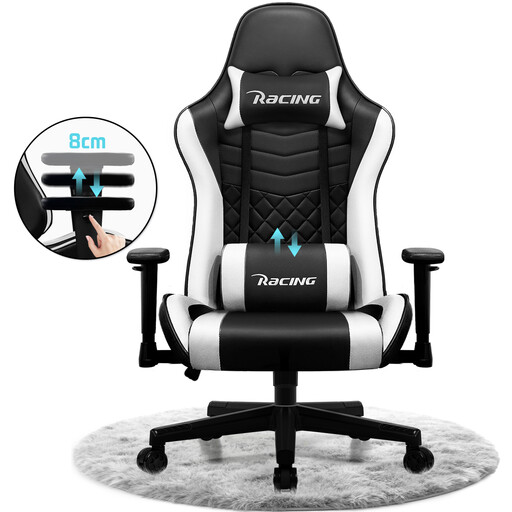
Why It's a Match: Designed for keyboard marathoners who demand impeccable postural support. The focus here is on precision adjustments to maintain good posture and ward off fatigue.
It bypasses low-end foam in favour of high-density memory foam. Designed to hold its shape and distribute pressure, it won't sag, even after a 12-hour session.
Its height-adjustable lumbar support and its armrests with 8 cm of adjustment allow for a custom fit, providing targeted support where it really counts.
Why It's a Match: Perfect for those who prioritise robustness and longevity, especially users with larger builds or those who use their chair ultra-intensively.
It sidesteps the trap of wobbly frames. Its design relies on an all-metal frame and a certified gas lift, all validated by BIFMA and SGS standards. The result: a weight capacity that isn't just hot air and rock-solid safety.
The 150 kg weight capacity isn't just a number on a spec sheet. It's the result of a design focused on durability, from the widened base to the metal frame of the footrest, ensuring unwavering stability.
We have selected a full range of products that strictly adhere to these demanding specifications for quality and safety.
It all depends on the quality of the materials and the intensity of your use. An entry-level model, with its low-density foam and fragile faux leather, will show signs of wear (sagging, cracking) in just one or two years. Conversely, a premium chair with a steel frame, high-density foam, and a Class 4 gas lift can last you more than 5 years, provided it receives minimal maintenance.
Here are the 4 essential adjustment points:
Not necessarily. An excellent ergonomic office chair will always outperform an entry-level gaming chair. The difference often comes down to the design, which is more enveloping on gaming models, and features like a deep recline or a footrest. The key, beyond the label, is to find a seat that offers the adjustments, support, and durability suited to your body and your usage.