
Livraison le jour même ou le lendemain

Qualité garantie

Débloquez vos offres de bienvenue: Livraison GRATUITE | Jusqu'à -80 % | 30 jours d'essai gratuits à JoyPlus
Téléchargez l'application
An ergonomic memory foam cervical pillow can genuinely transform how supported you feel during the night. However, you still need to choose a model suited to your body shape and sleeping position. Excessive height, foam that is too dense or a cover that holds in heat can quickly turn a promise of comfort into a disappointing purchase.
People who spend their days in front of a screen, older adults, side sleepers and anyone who experiences tension around the neck or shoulders should take a close look at the pillow’s design. Here are the criteria to check before buying a pillow for neck pain or an ergonomic model designed to help relieve neck and shoulder discomfort.
The term ergonomic does not guarantee that a pillow will suit everyone. A cervical contour pillow should be designed around your sleeping position, with a central hollow, support zones and a height that corresponds to the width of your shoulders.
A height of 8 cm, for example, may suit some sleepers but feel too low or too high depending on their build and mattress type. It is therefore better to compare the dimensions listed on the product page than to rely on a flattering photo or a general claim.
A firm, welcoming pillow is not necessarily a rigid block. Memory foam can gradually mould under the weight of your head while retaining a stable base. Conversely, foam that is too soft may allow your head to sink and disturb the alignment of your neck.
The right balance depends on your preferences, sleeping position and mattress. A firm bed does not provide the same feel as a more enveloping mattress and may require a different pillow.
Foam can retain more heat than natural filling. A breathable, removable and easy-to-clean cover therefore deserves your full attention. Also check the difference between a washable cover and the foam core, which generally should not be put in the washing machine.
After unpacking, a compressed pillow should be left in the open air so that it can regain its shape. A manufacturing odour may remain for 24 to 48 hours, depending on the manufacturer’s instructions.
For side sleeping, the pillow should generally fill the space between your shoulder and head. When sleeping on your back, a central hollow and cervical contour can help keep your neck in a more neutral position. For front sleepers, a thinner pillow is often preferable.
Models presented as pillows suitable for all sleeping positions may indeed work for several uses, but comfort remains highly personal. Compare the height, width and shape with your actual sleeping habits.
A memory foam pillow with slow rebound gradually moulds around your head and neck. Some multi-layer models combine comfort foam with a support layer and a firmer base to limit sinking.
To avoid vague descriptions, look for the product’s precise composition: memory foam alone, a combination of several foams or natural filling. Where this information is available, the cover, density and firmness level should be clearly stated.
A cover described as breathable, absorbent or temperature-regulating may be worth considering if you tend to feel hot during the night. However, take the time to check the practical care instructions: washing the cover, spot-cleaning the core, air drying and protection from flames.
Certifications mentioned on a product page, such as OEKO-TEX Standard 100, CertiPUR-US, Sanitized or ISO 9001, should be treated as information declared for the product concerned. They do not remove the need to check the composition or usage instructions.
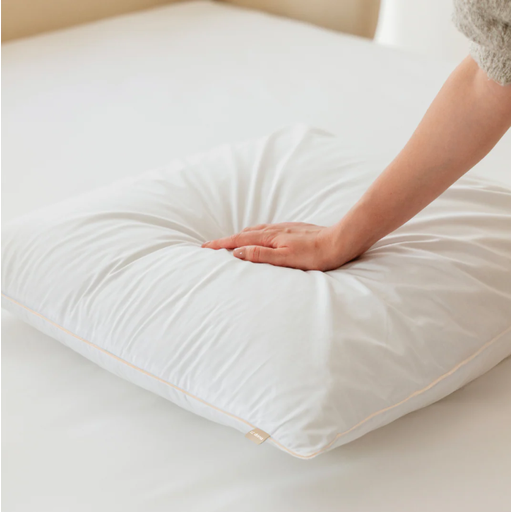
Why this choice suits this profile : This model is designed for people who prefer natural filling, a traditional 50 x 70 cm size and washable care, subject to the information provided on the product page.
The composition is clearly detailed: 90 % duck feathers and 10 % down, with a 100 % cotton cover. This is useful information when comparing this filling with foam designed for cervical support.
50 x 70 cm size, stated thickness of 20 cm, cotton cover and washable at up to 40 °C according to the product page.
We have brought together a complete, real-time selection of products that meet these demanding criteria and European safety standards.
A pillow can improve comfort and encourage a more comfortable sleeping position, but it is not a medical device. If you experience persistent pain, an injury or unusual symptoms, seek advice from a healthcare professional.
It all depends on your sleeping position, shoulder width and mattress firmness. Side sleepers often need more volume than those who sleep on their back or front. An 8 cm height should therefore be considered in relation to your body shape, rather than treated as a universal measurement.
You may need a few nights to adjust, particularly if you are switching from a soft pillow to more structured foam. Pay attention to the position of your neck, any feeling of pressure and how stable your head feels. If discomfort persists or becomes worse, the pillow’s shape or height may not be right for your needs.
The two types of pillow require different care. The foam core is generally spot-cleaned, while a feather model may be washed if the manufacturer permits it. In both cases, a clean cover, regular airing and following the care instructions will help preserve comfort.