
Livraison le jour même ou le lendemain

Qualité garantie

Débloquez vos offres de bienvenue: Livraison GRATUITE | Jusqu'à -80 % | 30 jours d'essai gratuits à JoyPlus
Téléchargez l'application
An ergonomic baby carrier can make journeys on public transport, walks and everyday tasks much easier. However, a product page does not always tell you everything about the experience in real life. A material described as breathable may feel hot if the back panel allows little airflow, while a model presented as “universal” may not be suitable for a newborn or a smaller-framed parent.
Before buying a baby carrier, check the practical details: weight range, carrying positions, adjustments, back support and care requirements. Here are the main points to consider to avoid choosing the wrong product.
A baby carrier with a capacity of 3 to 20 kg is not necessarily designed for a newborn who cannot yet hold their head up. Some models are recommended from around 3 months, even if their minimum weight starts at around 3.18 kg.
For a baby carrier for newborns and infants, always check:
The term physiological baby carrier is often associated with the M-position, but this position primarily depends on correct adjustment. The baby’s knees should be higher than their bottom, with a seat that is wide enough to support the thighs without compressing the legs. The baby’s back should remain supported without being forced into a rigid posture.
A poorly adjusted front-facing baby carrier may press the child’s face against the fabric or, conversely, leave their body too far away from the parent’s. Every time you put the carrier on, keeping the baby’s face visible and their airways clear must remain the priority.
A lightweight baby carrier is not necessarily comfortable over longer periods, particularly if its straps are narrow or if all the weight rests on the shoulders. For longer outings, it is better to choose a structured waistband, a baby carrier with lumbar support and adjustable straps.
The way the straps cross at the back, the quality of the padding and the ability to distribute the load effectively can make a noticeable difference. Also take the wearer’s build and the thickness of winter clothing into account.
A wide, adjustable seat supports the child’s growth better than a fixed panel. Models offering several adjustment options may suit different body sizes, but you must make sure that the legs remain properly supported at every stage.
The M-position is not a medical guarantee. It is a carrying configuration described in the product instructions. If you have any doubts about carrying a newborn, ask a healthcare professional or someone trained in babywearing for advice.
A cotton baby carrier may appeal because of its soft feel and simple care. Several models are machine washable, which is a real everyday advantage. However, cotton may feel warmer during summer outings.
A breathable baby carrier with an Air Mesh panel helps air circulate between parent and child. This does not remove the need to monitor the baby’s temperature, keep their face uncovered at all times and limit exposure to the sun. The claimed breathability should be assessed in the context of the carrier’s complete design, rather than just a small mesh section.
A weight of around 760 to 810 g is reasonable for a structured baby carrier, but how it feels depends mainly on how the load is distributed. In particular, check:
A babywearing sling can be compact and comfortable for some parents, but it generally requires a little more practice to ensure a secure fit. A buckle carrier can be put on more quickly, provided you check every fastening.
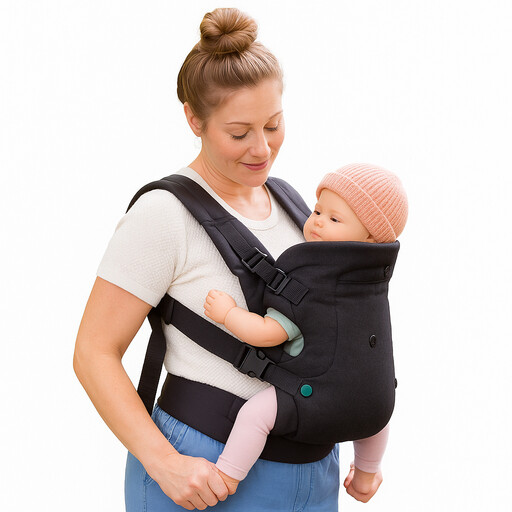
Why this choice suits this profile: its different positions may suit parents who want to get started with an adjustable baby carrier and try several front-carrying options, in line with the manufacturer’s instructions.
The 4-in-1 design encourages you to check which configuration is suitable for the child’s age and weight, rather than using one position at every stage.
Several advertised positions and adjustments designed for babies and infants.
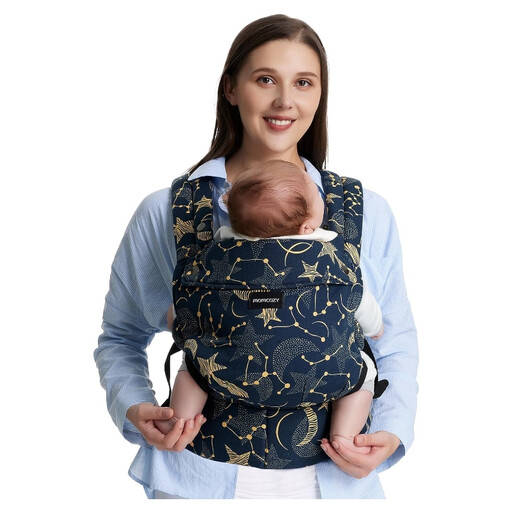
Why this choice suits this profile: this cotton model focuses on adjustability, hands-free carrying and lower-back support for regular outings.
The product page states a range of approximately 3.2 to 20 kg and machine-washable care. You must still follow the manual and the recommended age.
100% cotton, adjustable straps, an EVA panel and a seat designed for the M-position.
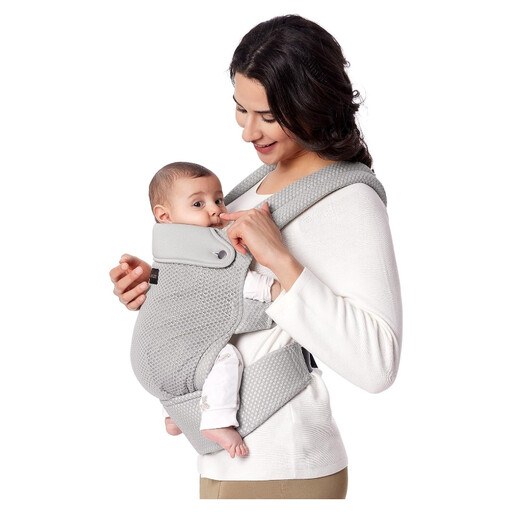
Why this choice suits this profile: the Air Mesh fabric and the contact textile described as cooling meet the needs of summer travel, holidays and frequent carrying.
The breathable design is combined with an adjustable seat, integrated lumbar support and an advertised range of approximately 3.18 to 19.96 kg.
Air Mesh panels, three size adjustments, front carrying and machine washing according to the product page.
An adjustable baby carrier should be tightened gradually, without leaving excessive space between the baby and the parent’s chest. Once the buckles are fastened, check the following:
Do not use the baby carrier for running, cycling, cooking near a flame or taking part in any activity involving a risk of falling. It is not protective equipment against accidents.
We have put together a complete, real-time updated selection of products that meet these strict criteria and the requirements of European safety regulations.
It depends on the model. Some products are recommended from around 3 months and a minimum weight of approximately 3.2 kg. For a baby who cannot yet hold their head up, use only a configuration explicitly designed for this purpose and follow the instructions carefully.
There is no universal length of time that applies to every child and every parent. Start with short periods, monitor the baby’s breathing, temperature and position, and take regular breaks. Stop carrying if the baby appears uncomfortable or you experience any pain.
Yes, a machine-washable baby carrier makes cleaning easier after mealtimes or outings. Before washing, fasten the buckles and follow the temperature and drying instructions. Afterwards, inspect the seams, straps and attachments before using it again.