
Livraison le jour même ou le lendemain

Qualité garantie

Débloquez vos offres de bienvenue: Livraison GRATUITE | Jusqu'à -80 % | 30 jours d'essai gratuits à JoyPlus
Téléchargez l'application
An ergonomic baby carrier can make city trips, errands and walks with a newborn so much easier. But you need to choose a model that suits both your baby’s body shape and your own. Between promises of comfort, posed portage photos and sometimes unclear weight guidelines, certain details can turn an appealing purchase into a real disappointment.
Here are the criteria to check before you order, along with a selection of models suited to different types of parents.
A physiological baby carrier is not just thick fabric or quilted straps. In front carry, your baby must be positioned correctly, with their face well clear and their legs properly supported. The M position, where the knees are slightly higher than the bottom, is a simple reference point to check after each adjustment.
A label saying “from 3 to 20 kg” does not necessarily mean the product suits all newborns. Some models are designed from around 3 months and require your baby to hold their head up unaided. Always check the instruction manual, the minimum weight required and any age restrictions before use.
A cotton baby carrier can feel nice against the skin, but it may be warmer than an open-weave fabric during summer outings. Conversely, a breathable material might need special care when washing. A machine-washable baby carrier makes daily life easier, provided you follow the instructions for buckles, temperature and drying.
Choose a seat that is wide enough to support the thighs, padded openings and an adjustment system that keeps your baby close to your chest. A rounded C-shaped spine and an M-shaped seat are often mentioned as signs of physiological carrying, but they don’t replace precise fitting.
Your baby should stay upright, visible and close to you. Their chin must not be pressed against their chest, while their nose and mouth must remain completely clear. The straps should be adjusted firmly, without applying unnecessary pressure.
The weight of the carrier isn’t everything. A model weighing 760 to 771 g can still be comfortable if its straps and lumbar support distribute the load properly. A baby carrier with lumbar support or a crossed strap design will suit longer walks, while a simpler model will do for short trips.
Before buying, check in particular:
A cotton baby carrier offers a familiar fabric that’s easy to wash, while a breathable mesh model may be better suited to warmer weather. The products shown below offer front carrying and an approximate weight range of 3.18 to 19.96 kg. However, the instruction manual supplied with your chosen model remains the reference to consult.
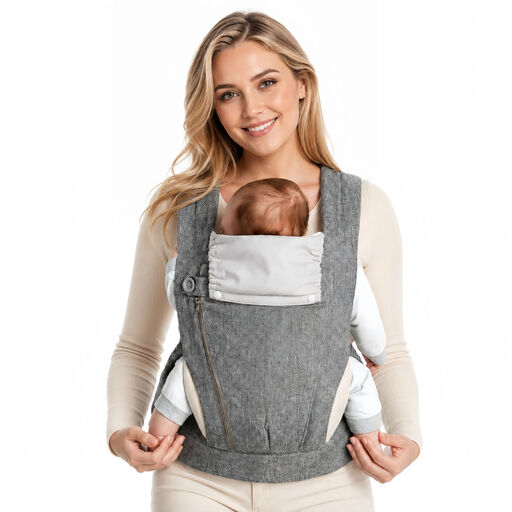
Why this choice suits this profile: Its click buckle and crossed straps can reassure parents looking for a simple operation for short trips and first-time use.
Its cotton composition and the indication of an M position let you check the material and setup concretely, rather than relying on a vague promise of comfort.
100% cotton, front carry, click fastening and stated weight range of 3.2 to 20 kg.
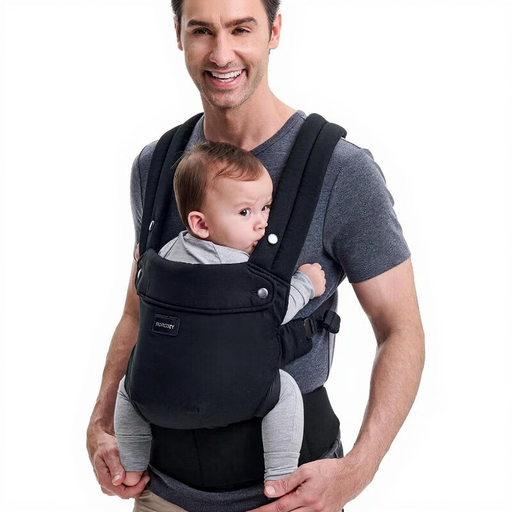
Why this choice suits this profile: This Momcozy model combines a cotton structure, crossed straps and an EVA panel designed to support the lumbar area during regular carrying.
The product page details the carrier’s weight, material, carrying mode and load limits – all useful information for comparing models beyond the marketing talk.
100% cotton, approx. 771 g, EVA lumbar support, adjustable straps and machine washable according to the manufacturer’s instructions.
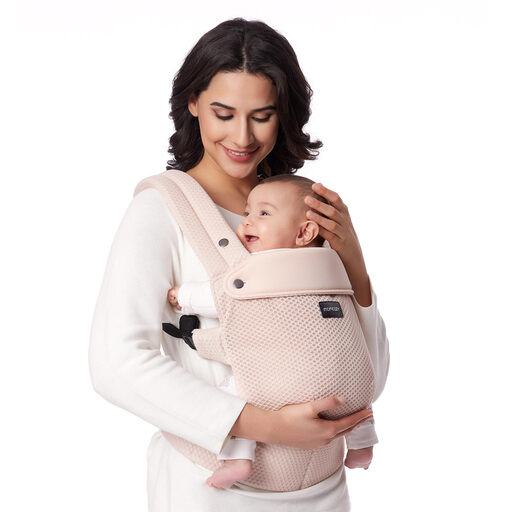
Why this choice suits this profile: The airy mesh and the fabric designed around the neck area are intended for outings in warm weather, travel and periods of repeated carrying.
Ventilation is clearly presented as a feature of the fabric – though it does not replace protecting your baby from the sun or keeping a close eye on them.
Breathable mesh, EVA lumbar support, three adjustment positions, front carry and machine washable.
We’ve put together a comprehensive, real-time updated list of products that fully meet these strict selection criteria as well as European safety regulations.
Before putting your baby in the carrier, take a few seconds to check the following points:
A baby carrier is not protective equipment against falls. It must not be used for running, cycling, cooking near a flame or any activity that carries a risk of falling. If the wearer feels pain or your baby seems uncomfortable, stop using the carrier and reposition it correctly.
It depends entirely on the model. Several products indicate use from around 3 months and a weight close to 3.18 kg, with a baby who can hold their head up. The product manual should always take priority over the theoretical age shown on a sales page.
There is no universal duration that suits all children. Start with short periods, monitor breathing, temperature and posture, and give your baby regular breaks. They must remain visible and properly supported throughout the entire carry.
It depends on your use. Cotton may suit parents who prefer a soft fabric and easy care. A breathable mesh will often be better for outings in warm weather. In both cases, the quality of the fit and respecting the weight limits remain the priority.